Back to articles
How to Write Rap Lyrics That Truly Connect

Writing rap lyrics is all about channeling your thoughts into rhythm and rhyme. It’s a process that begins way before you even think about the perfect rhyme—it starts with a single idea, a brainstorm of keywords, and the first few lines that begin to tell your story.
From Blank Page to Your First Verse

The blank page can be intimidating. Every great rapper has been there. But here’s the secret: you don’t need a perfect verse to start. You just need one spark. One idea, one feeling, one unique observation is all it takes to get things rolling.
Before you even try to write a single rhyme, you need to know what you want to talk about. Is it a personal story? A feeling like frustration or pure joy? Or maybe just a cool concept that’s been bouncing around in your head? The most powerful rap lyrics always feel authentic, because they come from somewhere real.
Brainstorming Your Core Idea
Once you've settled on a theme, just start riffing. Brainstorm any words and phrases that pop into your head related to it. Don't judge, just write. If your song is about overcoming a tough time, your list might look something like this: "struggle," "the climb," "finish line," "doubt," and "prove them wrong."
Think in concepts: What’s the one thing you want your listener to feel or understand?
Use sensory details: What did it look like? How did it feel? Jot down those specifics.
Focus on action words: Verbs are your best friend. They inject energy and create movement in your bars.
This raw material becomes your wellspring of inspiration when you start building lines. To really streamline this process from idea to finished verse, it helps to have an effective content creation workflow in place. A little structure goes a long way in keeping your ideas organized and the momentum going.
Overcoming Writer’s Block Instantly
But what about those days when the words just won’t come? Even with a great idea, we all get stuck. This is where having a creative assistant can be a total game-changer, giving you a running start instead of a dead end.
Key Takeaway: The goal isn't to write a perfect first line. It’s about getting any line on the page to break the inertia and build momentum.
This is exactly what Lyric Studio was built for. It’s designed to smash through that initial wall. Take the “Magic Draft” feature, for example. You tap a button, and it instantly generates a first verse and chorus based on your theme. It’s not meant to be your final song, but it serves as an incredible launchpad. You get an immediate foundation of rhymes and concepts that you can then edit, rewrite, and mold into something that’s truly yours.
The app gives you smart, context-aware suggestions that actually understand your topic, helping you pinpoint that perfect word you were looking for. It's like having a creative partner on call, always ready with a fresh idea.
Feeling inspired to finally fill that blank page? Download Lyric Studio free on iOS and see just how fast you can get that first verse down. Keep in mind, while the app is free to download, in-app purchases may apply.
Mastering Rhyme and Lyrical Wordplay

Anyone can make two words rhyme. But making them feel right? That’s where the real craft is. The thing that separates a throwaway line from a bar that gets replayed over and over is the wordplay—the clever, unexpected ways you connect your words.
If you want your lyrics to really hit, you have to move past those simple, grade-school rhymes. Think of your lyrics like a painting. Basic rhymes are your outline; they give you a structure to work with. But the magic happens with the details inside: the internal rhymes, multis, and slant rhymes that add texture and show your true skill.
Going Beyond Basic End Rhymes
We all start with the classic A/A, B/B rhyme scheme, where the last word of each line matches up. It’s a solid starting point. But the real pros know how to weave rhymes inside their bars. That’s when things get interesting.
Internal Rhymes: These are the rhymes you tuck away inside a single line or sprinkle across a few. Think of a line like, “I stay on my grind, it’s all by design.” It creates a rhythm that pulls the listener in.
Multisyllabic Rhymes: This is a huge level-up. Instead of just rhyming "cat" with "hat," you're rhyming whole phrases like "lyrical miracle" with "spiritual individual." It’s a signature move of some of the greatest to ever do it.
Near Rhymes (Slant Rhymes): These are words that almost rhyme, like "shape" and "great." They don't match perfectly, which gives you so much more creative freedom. Your lyrics won't sound forced, and you can say what you really mean. If you want to dive deeper, we break it all down in our guide on what is a rhyme scheme.
The Power of Smart Word Choice
This isn't just a hunch; the game is getting more technical. An analysis of hip-hop lyrics shows a 23.7% increase in vocabulary diversity over the years. Rhyme complexity has also shot up, with some artists going from an average of 1.81 to 3.04 rhymes per line. The bar is constantly being raised.
Pro Tip: Stop hunting for just any rhyme. Look for words that push your story forward. The best wordplay isn't just clever; it reinforces your theme and gives your listeners another layer to peel back.
This is where having the right creative partner can completely change your process. Instead of getting stuck scrolling through a clunky rhyming dictionary, you need something that gets the vibe of your song.
Lyric Studio’s AI-driven suggestions are built for this. Its integrated thesaurus and rhyme tools don't just find rhymes; they find words that fit the emotion and story you’re building. It helps you find those slick connections between words you might have missed—the ones that turn a good verse into a great one.
Building a Song Structure That Hits Hard
A song without a solid structure is like a building with no blueprint. It might have some strong individual parts, but it's likely to fall apart. The structure is what takes your listener on a journey, creating a real experience from the first beat to the final fade-out.
Think of it this way: your best bars can get completely lost if they aren't arranged with purpose. The most common pieces you'll work with are the intro, verse, chorus, bridge, and outro. Getting these right is the key to a track that truly connects.
The Essential Building Blocks
Every part of your song has a specific job to do. Your intro sets the mood, the verses tell the story, and the chorus delivers the knockout punch that everyone remembers.
Verse: This is your storytelling space. Use your verses to unpack the narrative, get into the details, and move the plot forward with each new section.
Chorus: This is your hook—the core message of the track. It absolutely has to be catchy and powerful. This is the part people will be singing in their heads all day.
Bridge: A bridge is optional, but it can be a secret weapon. It’s a chance to switch up the energy, offer a new angle on the topic, or just create a moment of musical tension before you slam back into that final, powerful chorus.
This image gives you a simple look at how these pieces can come together.
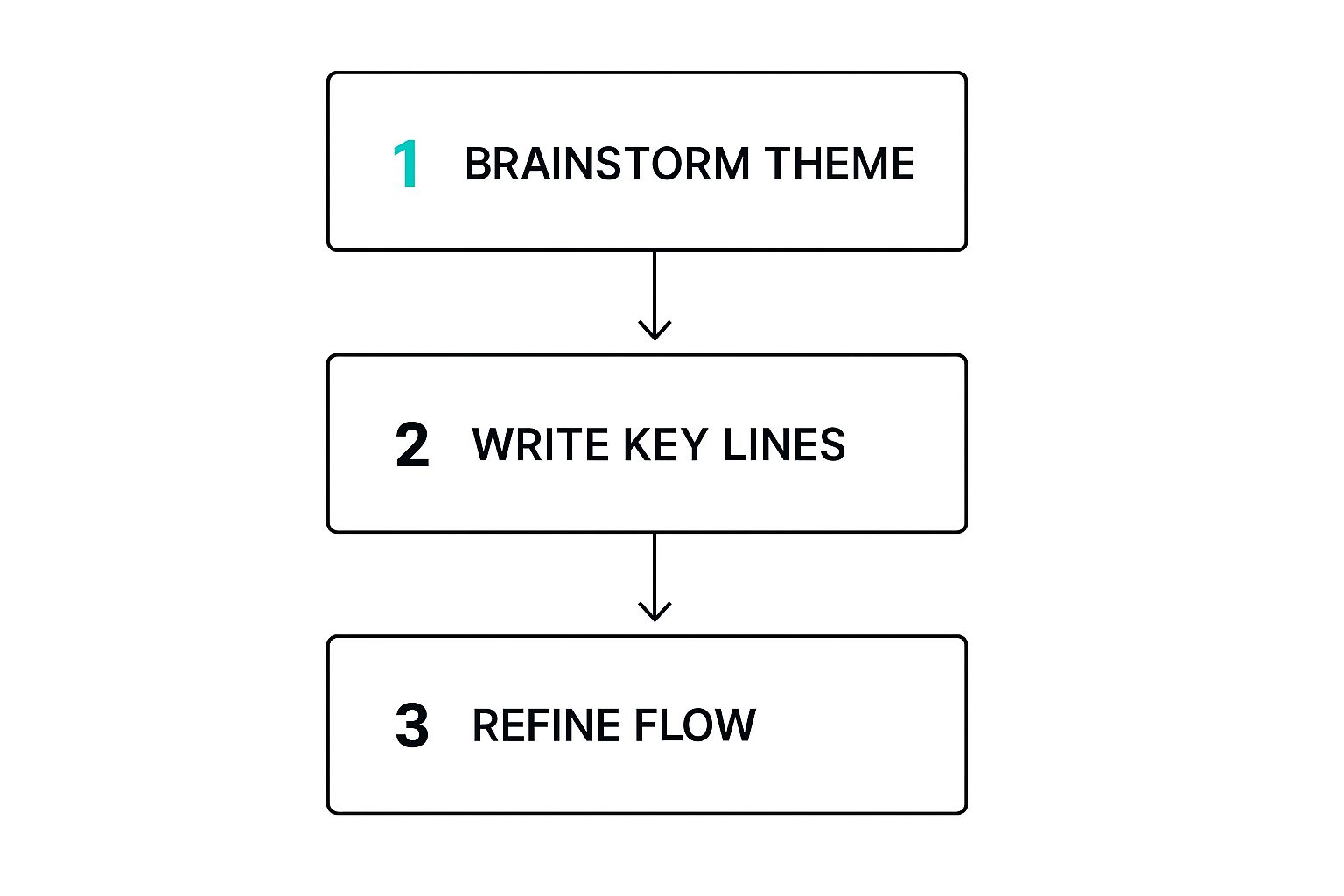
Starting with a core idea and building out from there, as shown above, helps you keep your lyrics focused and cohesive.
Charting Your Course: Common Song Structures
Deciding on a structure before you start writing can be a game-changer. It gives you a roadmap, so you’re never just staring at a blank page wondering what comes next.
Here’s a quick look at some proven song structures. This table can help you visualize how to arrange your song for maximum impact, whether you're aiming for a radio hit or a deep, lyrical track.
Common Rap Song Structures
Structure | Component Order | Best For |
|---|---|---|
Verse-Chorus | Verse 1 - Chorus - Verse 2 - Chorus | The most common and popular structure. It's great for catchy, memorable songs. |
Verse-Chorus-Verse | Verse 1 - Chorus - Verse 2 - Chorus - Bridge - Chorus | Adds a bridge for a change of pace and builds to a strong finish. |
AABA | Verse 1 - Verse 2 - Bridge - Verse 3 | A classic storytelling structure, often used in older hip-hop. The "B" section (bridge) provides contrast. |
Picking a structure and sticking to it provides a framework that frees you up to focus on what matters most: the lyrics. If you want to dive even deeper, our guide on how to write a rap song has even more layouts to explore.
Pro Tip: The chorus is the absolute anchor of your song. Don't rush it. Pour your energy into making it concise and unforgettable, because that's what will bring people back again and again.
Trying to juggle all these sections in your head or a jumbled notes app is a surefire way to kill your creative vibe. You need a dedicated space where you can see the whole picture while still perfecting every line.
This is where a tool like Lyric Studio really shines. It’s built to help you visually organize your song, letting you drag and drop verses, A/B test different choruses, and see exactly how it all flows together. The AI suggestions are smart, too—they understand the context of your song, so they can help you find that perfect line to transition from a verse right into your hook.
Finding Your Unique Flow and Delivery
Let's be real. The best lyrics in the world can completely fall flat if the delivery is off. That special sauce, the thing that makes a rapper sound like them and nobody else? That's flow. It’s the rhythm, the cadence, the whole vibe of your vocal performance. It's not just what you say, but how you say it.
Think of your flow as your signature. It's the pocket you find in the beat, the way you pause for impact, and the speed you choose to spit your lines. You have to stop seeing your lyrics and the beat as two separate things. They're a team, and they need to move together.
The Mechanics of Cadence and Rhythm
Your voice is just another instrument in the track. The trick is to create a rhythm with your words that dances with the instrumental without just copying it. This is where you get to play with syllable counts and pauses to really shape your sound.
Switch Up Your Pacing: Try spitting a line fast, then pull back and deliver the next one slow. That contrast builds energy and keeps your listener locked in.
Use Pauses for Power: Sometimes the silence between your words hits harder than the words themselves. A perfectly timed pause can build suspense or give a punchline the space it needs to land.
Count Your Syllables: Pay attention to how many syllables you’re fitting into each bar. Keeping it consistent can create a smooth, hypnotic effect, while switching it up can make certain lines really jump out.
A great exercise is to just put on a beat and freestyle gibberish. Don't worry about making sense. Just focus on the rhythm and how your voice finds different pockets in the beat. It frees you from the pressure of writing lyrics and helps you connect with the music on a gut level.
Key Insight: Don't just rap over the beat; rap into it. Your goal is to weave your voice between the drums and the melody, making your performance feel like a living, breathing part of the song.
Matching Your Flow to the Beat
The instrumental’s vibe should be your guide. A laid-back, lo-fi beat demands a totally different flow than a frantic, high-energy trap beat. Writing lyrics that match the mood from the jump is the secret to a track that just works. For a deeper dive, check out our guide on how to write lyrics to a beat.
This is one of those spots where Lyric Studio’s creative tools can be a game-changer. You can tell it the genre and mood you're aiming for—hip-hop, pop, R&B, whatever—and the AI will give you lyric ideas that fit that specific style. It helps you find lines that not only rhyme but also have the right rhythmic feel for the production you're working with.
Ready to find the perfect flow for your next banger? Download Lyric Studio free on iOS and start playing around with how your words and beats can lock in together. The app is free to download, with optional in-app purchases.
Telling Stories That Resonate
Think about the greatest rap songs. They're not just a string of hot bars and clever rhymes, are they? They're stories. They paint pictures so vivid you feel like you’re standing right there in the moment. This is the secret sauce. Learning how to write rap lyrics that tell a real, compelling story is what takes your music from technically good to truly unforgettable.
It all boils down to the fundamentals of any good story. Every strong narrative needs a character (even if that character is you), a setting your listener can see in their mind's eye, and a clear arc. You need a beginning that grabs them, a middle that builds up the tension or explores the idea, and an ending that delivers a punch. The real goal is to make your listener feel something.
Crafting a Vivid Scene
So, how do you pull your audience into your world? You do it with concrete, sensory details. Don't just tell me a street was "dangerous." Show me. Describe the cracked pavement under your feet, the single flickering streetlight overhead, and the faint wail of sirens in the distance. Specific imagery is the most powerful tool you have for making an abstract idea feel real.
Here’s a simple breakdown of what to focus on:
Establish a Character: Who are we following? Give them a goal, a struggle, or just a unique way of seeing the world.
Set the Scene: Where and when is this all going down? Use sights, sounds, smells—anything that brings the environment to life.
Create an Arc: We need to see some kind of change or journey. Your character could go from being full of doubt to brimming with confidence, or from loss to triumph. It can even be as simple as them coming to a new understanding.
When you nail these elements, you give listeners a story they can follow and get emotionally invested in. It’s about turning your own experiences into truths that everyone can relate to.
Key Insight: Your personal stories are your greatest asset. The more specific you get about your own struggles, triumphs, and observations, the more universal your message actually becomes.
Turning Personal Truth into Universal Themes
The most powerful, gut-punching stories almost always come from real life. Dig deep. Think about a time you felt completely overlooked, a moment of pure, unadulterated joy, or a lesson you had to learn the hard way. These are the moments packed with raw emotion and authentic details that you just can't fake.
But here's the thing: just telling a unique story isn't always enough to cut through the noise. Listeners today are drawn to artists who push the envelope. In fact, research analyzing music charts shows that rap songs with lyrics that break from the usual genre norms often perform better commercially. Being unique in your storytelling and word choice can make a real, tangible difference. You can read more about how lyrical uniqueness impacts charting success.
This is where having an AI creative partner can give you a serious edge. We’ve all been there—you know exactly the story you want to tell, but you're stuck using the same old words to describe it. Lyric Studio is built to help you smash through that wall. Its suggestions are context-aware, meaning it can introduce you to fresh descriptive language and new angles on your theme. It's a tool for finding those unexpected phrases that make your personal story connect on a much deeper level.
Ready to tell a story that will stick with people long after the track ends? Download Lyric Studio free on iOS and start turning your experiences into powerful, resonant lyrics. The app is free to download, with optional in-app purchases available.
Polishing Your Lyrics Like a Pro
Let's be real: your first draft is never the final one. A truly great song gets built in the edits. This last step is where you learn to put on your critic hat, look at your work with fresh eyes, and turn a good idea into something that really connects.
The whole point here is to hunt down anything that feels weak. I'm talking about clunky phrases, rhymes that feel cheap or forced, or lines that just don't add anything to the story you're telling. This is all about tightening up your verses, making your imagery sharper, and ensuring your message lands with maximum impact.
The Read-Aloud Test
Before you touch a single word, you have to read your lyrics out loud. This is non-negotiable. What looks great on paper can sound awkward or clunky when you actually try to spit it.
Reading your lyrics aloud instantly reveals a few things:
Rhythm issues: Are you tripping over certain phrases? Do some lines feel like a sprint while others drag?
Forced rhymes: Can you spot the rhymes that are only there to rhyme? If it compromises the meaning, it's gotta go.
Filler words: Be ruthless. If a word isn't adding value, it's just clutter. Cut it out.
This simple test is the quickest way to check your flow and cadence. It takes your lyrics from a concept in your head to a physical performance, which is exactly what rap is.
Key Takeaway: If a line is hard to say, it's going to be hard for your audience to hear. Trust your ear—it's one of the best editing tools you've got for finding the weak spots.
Refining Every Word
As you get into the nitty-gritty of editing, your focus should be on clarity and impact. With real-time lyrics on platforms like Spotify and Apple Music, your audience is reading along. This makes having sharp, memorable lyrics more important than ever. In fact, the demand for clear lyrics has helped fuel a transcription market that's projected to hit $4.11 billion by 2026. You can learn more about the growing importance of clear lyrics here.
This is where having a creative assistant can be a game-changer. Instead of just staring at a line wondering how to fix it, you can get smart suggestions. Lyric Studio really excels here. It acts as a creative partner, using its AI to offer suggestions that actually fit the theme of your song. It's great for swapping out weak filler words with something more creative and helps you dig into its integrated thesaurus to find the perfect word. This is how you take a rough draft and make it shine.
Ready to turn those ideas into lyrics that pop? With Lyric Studio, you have a powerful partner to help you brainstorm, write, and polish your next hit.
Download Lyric Studio free on iOS.
(Note: The app is free to download, and in-app purchases may apply.)

SCAN TO GET