Back to articles
How to Write Love Songs That Feel Real

Every truly great love song has one thing in common: it tells a real, personal story. Anyone can string together a few generic phrases, but the songs that stick with us for years are built on specific memories, sensory details, and unique emotions. That's what connects with a listener and makes them feel something.
Finding the Heart of Your Love Song

A good love song starts with a feeling, not a formula. Sure, the words "I love you" are powerful, but they become unforgettable when they're tied to a specific moment. Your job as a songwriter is to dig past the clichés and find the angle that only you can write.
So, what makes your story different? Think about the little things. It might be an inside joke, the specific way they laugh, or a quiet memory of a rainy afternoon you spent together. These are the details that breathe life into your song and make it feel genuine.
Pinpoint a Specific Emotion
Love isn't just one feeling; it's a whole spectrum of emotions. Are you trying to capture the quiet comfort of a long-term partnership? The dizzying thrill of a new romance? Maybe it's a touch of bittersweet nostalgia or a feeling of deep, unwavering devotion. Nailing down this core emotion gives your song a clear direction and a strong foundation.
Once you know the feeling you want to express, brainstorming gets a lot easier. For example, if you're writing about quiet contentment, you might focus on small, everyday moments:
The comfort of just being in the same room, reading a book.
The familiar sound of their keys in the door after a long day.
Sharing a simple meal without feeling the need to fill the silence.
These details ground your song in reality, making it far more relatable than some grand, abstract declaration of love.
Translate Memories into Lyrics
The most powerful lyrics almost always come from sensory details. As you think about a memory, try to experience it through your five senses. What did you see? What did you hear, smell, taste, or touch?
Key Insight: Specificity is your best friend in songwriting. "Your old faded denim jacket" paints a much clearer picture than just "your clothes." Similarly, "the smell of the coffee you made" tells a much richer story than "a nice morning."
This approach invites the listener into your world, allowing them to feel the emotion right there with you. It’s this combination of universal feeling and personal detail that creates a lasting impact. Just look at "Love Is All Around" by Wet Wet Wet—it spent an incredible 15 consecutive weeks at Number 1 on the UK charts. Its success proves how a straightforward theme, when told with heart, can resonate with millions. You can explore more about the top-selling love ballads of all time to see this principle in action.
When the blank page stares back, a creative assistant can be a game-changer. This is where a tool like Lyric Studio can be a huge help. It’s not about writing the song for you, but about being a creative partner. Its AI offers context-aware suggestions based on your theme, and its “Magic Draft” feature instantly generates a first verse-and-chorus to jump-start your songwriting.
Ready to find the heart of your song? Download Lyric Studio free on iOS and start turning your feelings into unforgettable lyrics. (In-app purchases may apply.)
Giving Your Song a Structure That Tells a Story
Okay, you’ve got a powerful message and a story you’re dying to tell. That’s the heart of your song. But for that message to really hit home, it needs a skeleton to hold it all together. This is where song structure comes in. It’s not just a technicality; it’s the roadmap that guides your listener through the emotional journey you've created.
One of the most tried-and-true structures in songwriting is the classic Verse-Chorus-Verse-Chorus-Bridge-Chorus. Think of it as a blueprint for great storytelling. Each piece has a specific job to do, and together they build an emotional arc that makes your song unforgettable.
The Key Parts of a Love Song
Let's break down what each part actually does for your song.
The Verse: This is your storytelling space. It's where you drop in all those specific, intimate details you came up with earlier. Maybe it’s a memory of your first road trip, the way they laugh, or that quirky thing they do that nobody else notices. Each verse should push the story forward, revealing a little more each time.
The Chorus: This is the soul of your song. It’s the big, central idea—the one line you want stuck in their head for days. The chorus should be catchy, powerful, and get straight to the point. It’s your emotional thesis statement.
The Bridge: The bridge is your secret weapon for keeping things interesting. It’s a chance to step back and offer a new perspective. You can introduce a different angle, a moment of doubt, or a sudden realization. It breaks up the pattern and adds a layer of depth before you hit them with that final, powerful chorus.
This image really helps visualize how you can go from a bunch of ideas to a solid, structured outline that delivers your message perfectly.
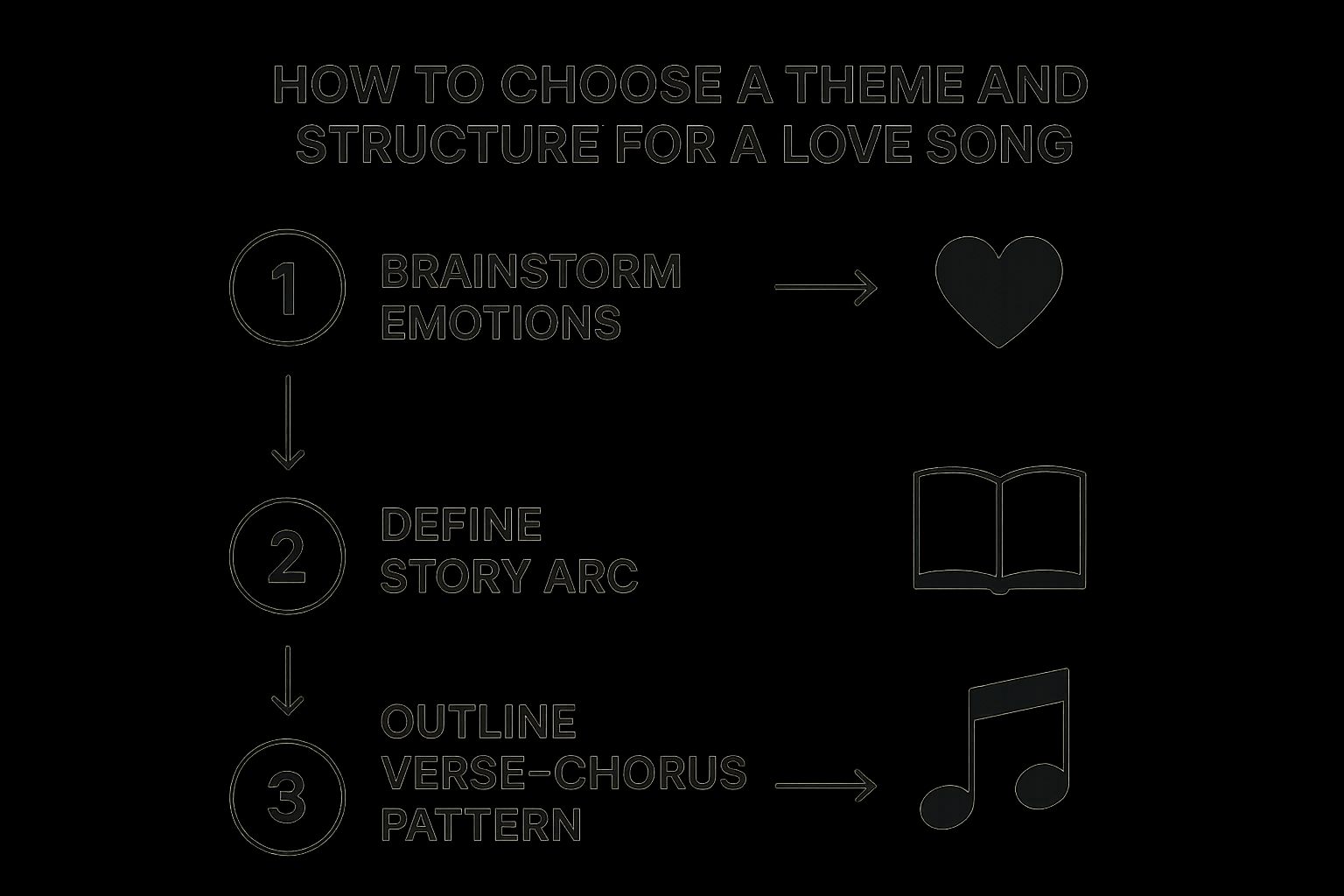
As you can see, the process flows naturally from brainstorming your feelings and story points into a structure that can carry their weight.
Building Emotional Momentum
A truly great love song doesn't just state an emotion; it builds it. You want to start your first verse with those small, personal details, pulling the listener right into your world. By the time you get to that last chorus, you should be making a grand, sweeping statement about love that feels earned and resonates with everyone.
This progression is a signature of so many hit love songs. Just think about Barbra Streisand's iconic "Woman in Love," which spent three weeks at Number 1 on the Billboard Hot 100. Its staying power comes from a structure that masterfully builds from personal vulnerability into a powerful, universal declaration.
Key Takeaway: The chorus is the most important part of your song's structure. It's the hook that will stick with your listener. For a deep dive, check out our guide on how to write a chorus that truly connects.
Does structure still feel a bit daunting? A creative tool can be a huge help here. For instance, Lyric Studio can give you AI-powered suggestions that fit the theme you’re working with, helping you fill out your verses and chorus. The “Magic Draft” feature can generate an initial verse-and-chorus layout, giving you a solid starting point to build from and make your own. The next step is to Download Lyric Studio free on iOS and start building your masterpiece.
Crafting Lyrics That Sound Like You
What separates a decent love song from a timeless one? It's authenticity. It’s that secret sauce that makes the lyrics feel less like words on a page and more like a real, human experience. The goal is to get past the generic fluff and find the words that sound like they could only come from you.
Think of it like painting a picture. Instead of just saying you’re happy, show us why. What did you see in that moment? What sounds filled the air? What tiny, specific detail can you share that makes the memory feel real and tangible?

Use Specific Imagery and Sensory Language
The most powerful lyrics hook into our five senses. They don't just tell the listener something; they make them feel it. Dig into those small, concrete details that define your story.
Sight: The way sunlight caught their hair, or the exact shade of blue of the shirt they wore on your first date.
Sound: The quiet rhythm of their breathing as they sleep, or that one song you always blast in the car together.
Smell: The lingering scent of their cologne on your favorite sweater, or the smell of rain on hot pavement during a walk home.
These are the details that are uniquely yours. A line like, "the smell of coffee from the mug you left behind" hits so much harder than "I miss you in the morning." It grounds a universal feeling in a specific, relatable moment. At its core, songwriting is a form of communication, and honing your effective written communication skills will make your message resonate that much more.
Find Your Unique Metaphors
Metaphors are a songwriter's best friend, but they can quickly fall into cliché territory. We've all heard "love is a battlefield" a thousand times. To make your song memorable, you need to create comparisons that feel fresh and personal.
Pro Tip: Your personal metaphor doesn't have to be some grand, earth-shattering idea. It just has to be true. Maybe your love feels less like a raging fire and more like "a quiet Sunday morning" or "the only working streetlight on a dark road."
This is where a little creative help can be a game-changer. When you're stuck on a word or just can't nail a phrase, an AI creative assistant can spark new ideas without taking over your voice. For instance, Lyric Studio has an integrated thesaurus and rhyme tools that help you find the perfect word without sounding cheesy or forced. The AI suggestions adapt to your song's theme, offering ideas that feel like a natural extension of your own thoughts.
Polishing those raw ideas is a crucial part of the process. For a deeper dive, our guide on the 5 steps to easily write song lyrics offers more great tips on refining your work.
Ultimately, you want to turn your honest feelings into lyrics that are polished, powerful, and unmistakably you. Download Lyric Studio free on iOS and start writing.
Pairing Your Words with Melody and Rhyme
So, you've got your lyrics down. That's a huge step, but it's only half the story. The real magic happens when you weave those words together with a melody. This is where the emotional core of your love song truly comes to life. You don't need a degree in music theory for this part—it’s all about feel.
Think of it this way: the music sets the mood before a single word is even sung. A fast, bouncy melody in a major key just screams "I'm on top of the world!" It's the perfect backdrop for lyrics about that first spark or the pure joy of being with someone.
But if you’re writing about quiet intimacy or the vulnerability of saying "I love you" for the first time, a slower, more delicate melody, maybe in a minor key, will draw the listener in. It creates that sense of closeness and longing.
A great way to get started is to simply hum. Seriously. Read your chorus out loud and then just start humming whatever tune comes to mind. Pull out your phone and record these little snippets. Listen back. Does one feel more hopeful? Does another sound more reflective? Trust your gut. You’re searching for the melody that feels like it was born from the words themselves.
Making Rhymes Serve the Story
Rhyme is a songwriter's best friend, but it can also be a real trap. If you want to write a love song that feels genuine, your rhymes have to serve the story, not the other way around. Nothing pulls a listener out of a song faster than a clunky line that was obviously twisted into a pretzel just to make a rhyme work.
Let's look at how different rhyme schemes can change the entire vibe of your verse or chorus:
AABB: This is your classic, straightforward rhyme pattern (line one rhymes with two, line three rhymes with four). It’s instantly catchy and feels very song-like, which makes it perfect for a chorus you want people to sing along to.
ABAB: When you alternate your rhymes, it gives the song a more sophisticated, conversational feel. It lets each thought hang in the air for a moment before the rhyme clicks into place.
ABCB: This might be the most common pattern you hear in modern music. By only rhyming the second and fourth lines, you give the verse a more natural, storytelling flow that doesn't feel forced.
My two cents: The best rhymes feel like a discovery, not a construction. They should shine a light on an idea or give a line a satisfying sense of completion, not shout, "Hey, look at me, I'm a rhyme!"
When you're banging your head against the wall trying to find the perfect word that says what you mean and fits your rhyme scheme, a creative assistant can be a lifesaver. This is where a tool like Lyric Studio can really make a difference. Its integrated rhyme and thesaurus tools don't just give you a list of rhyming words; they offer suggestions based on the context of your song.
This helps you find fresh, interesting words that keep your song’s heart intact. You can explore options beyond the obvious choices, making sure your lyrics stay powerful and true to your original vision.
Ready to find the perfect words and rhymes for your melody? Download Lyric Studio free on iOS and see how its smart suggestions can help you craft a beautifully written love song. (Note: In-app purchases may apply.)
Overcoming Hurdles in Your Songwriting

Writer's block is more than just a little frustration. It’s that heavy, sinking feeling you get when the words just won't cooperate, especially when you're trying to write about something as personal as love. Trust me, every single songwriter, from beginners to seasoned pros, has stared down a blank page feeling utterly stuck.
This creative friction is just part of the deal. The secret isn't learning how to avoid it, but having a few tricks up your sleeve to push right through it. Sometimes, just stepping away for a bit is the answer. Other times, all you really need is a gentle nudge to get things flowing again.
When the Blank Page Stares Back
The pressure to write something brilliant from the very first line can be completely paralyzing. You have this huge, beautiful emotion you want to capture, but getting it into lyrical form feels like an impossible climb. This is exactly where a creative assistant can make a world of difference.
Think about how tough it is to nail the opening of a love song. You’re aiming for something that feels both unique and emotionally true. When you hit that wall, a tool designed to spark inspiration can be a lifesaver. For instance, Lyric Studio has a feature called “Magic Draft,” which can generate a first verse and chorus based on a genre and mood you select.
This isn't about letting an app write the song for you. Not at all. It's about breaking that initial inertia. It hands you a starting point—a lump of clay that you can then shape, refine, and infuse with your own story and voice.
Finding the Right Words
Another classic hurdle is that feeling you're just recycling the same tired words and rhymes. You know what you want to communicate, but everything you write sounds cliché or just misses the specific emotional mark you're aiming for.
This is where having context-aware suggestions can be a game-changer. An AI-powered tool can look at what you’ve already written—your theme, your emotion, even your genre—and offer up fresh ideas that actually fit the vibe of your song.
Key Insight: Getting past writer’s block isn’t about some magic fix. It’s about having tools and techniques that help you see your song from a new angle. A new rhyme, a different metaphor, or an alternate turn of phrase can be the spark that gets your creativity firing again.
Lyric Studio was built to be that creative partner. Its AI-driven suggestions and integrated rhyme and thesaurus tools are designed to help you explore different directions without derailing your original vision. It keeps you moving forward, turning a moment of frustration into one of discovery.
Once your lyrics are drafted, the real work of refining them begins. To make your words shine and hit home, you can find some fantastic editing tips for writers that really help polish your final product.
Don’t let a creative wall stop you from finishing that beautiful love song you started. Download Lyric Studio free on iOS and push through writer’s block.
Common Questions About Writing Love Songs
Diving into a love song can feel massive, and it’s natural for a few questions to pop up along the way. I've heard these from countless songwriters over the years, so let's walk through some of the most common hurdles and how you can clear them.
How Do I Make My Love Song Unique and Not Cheesy?
The quickest way to dodge cheesy clichés is to get specific. Generic lines are forgettable. Instead, dig into the real, personal details that only you would know.
What’s that inside joke you both have? What’s a little quirk they have that you secretly adore? Paint a picture of a real memory—the way the sun hit their face on that one afternoon or a quiet conversation that shifted everything for you. The more your lyrics are rooted in these genuine, tangible moments, the more original and deeply felt your song will be.
Think about it this way: the best love songs aren't just about love; they're about a specific love. Your unique details are the bridge that connects a universal emotion to your listener's heart.
Sometimes, a creative nudge can help you see past the obvious. A tool like Lyric Studio can be a great partner here. It offers AI-driven, context-aware lyric suggestions that can help you discover fresh metaphors or find that perfect word you've been searching for, all without feeling forced or generic.
What if I Am Not Good at Writing Melodies?
Hey, that's okay. You don't need a music theory degree to write a beautiful melody. For many songwriters, the words come first. So, lean into your strengths.
Start by just reading your lyrics out loud. Listen to their natural cadence and rhythm. When you get to the chorus—the emotional core of your song—try humming a few different tunes over the words. Don't second-guess yourself; just hit record on your phone and capture every rough idea. The goal is to get something down, not to get it perfect.
The most important thing is to nail the story and emotion in the lyrics. Once you have that solid foundation, the melody has a much clearer job to do. You can always get your words just right and then team up with a musical friend or use a simple melody tool to bring it to life.
How Can I Start a Song if I Have No Ideas?
We’ve all been there. Staring at that blinking cursor on a blank page is easily the most intimidating part of writing a love song. The secret? Start small and take all the pressure off.
Don't sit down trying to write the whole song in one go. Just aim for one thing. It could be a powerful image, a catchy title, or a single, hooky first line. Something as simple as, "The coffee's always better when you make it," holds enough story and emotion to get the entire song rolling.
If you’re really stuck, a tool designed to kickstart your creativity can be a game-changer. For instance, Lyric Studio has a feature called “Magic Draft,” which generates a first verse and chorus based on a genre and mood you pick. It's not there to write the song for you. It’s there to destroy the "blank page" problem, giving you an immediate starting point that you can twist, edit, and build upon with your own voice.
Don't let these common roadblocks stop you from sharing your story. Lyric Studio is built to be a creative partner in your pocket, helping you find the right words, push past writer's block, and turn your feelings into a song you can be proud of.
Download Lyric Studio free on iOS.
(Note: In-app purchases may apply.)

SCAN TO GET