Back to articles
How to Begin Writing a Song From Scratch

Every great song starts somewhere. It's rarely a fully formed masterpiece that just pops into your head. More often, it’s just a single, nagging idea—a title, a feeling, a little snippet of melody, or even a line you overheard at a coffee shop. That one little spark is all you need. It sets the theme, gives you an emotional direction, and becomes the foundation for everything else. Forget about perfection for now. Just find one thing that feels interesting enough to build on.
Finding Your First Song Idea

The path to a finished song doesn't start with a perfect verse and chorus. It starts with a fleeting moment of inspiration, something small and maybe even a little weird. A lot of new songwriters fall into the trap of waiting for that lightning bolt of creativity to strike. But experienced writers know that finding ideas is an active process—you have to go out and look for them.
Your next great song idea is probably hiding in plain sight.
It might be a line from a movie that stuck with you, a feeling you can't seem to shake, or a simple melody you started humming in the shower. The real trick is learning to recognize these little moments and grab them before they vanish. Start thinking of yourself as a collector of thoughts, emotions, and sounds.
Actively Hunting for Your Core Concept
Don’t wait for inspiration to find you. Set aside some time to actively hunt for ideas. Keep a running list in the notes app on your phone or in a beat-up notebook. Pay attention to the way people talk, the emotions you feel listening to your favorite artists, or even the rhythm of cars passing on the street.
Here are a few practical ways I’ve found that initial spark:
Start with a feeling: What's the main emotion of your day? Joy? Frustration? Nostalgia? Just write down a few words that capture it.
Focus on a single image: Picture a powerful memory or a vivid scene. It could be as simple as rain hitting a window or the blur of city lights at night.
Use a title as a prompt: Sometimes, coming up with a killer song title first is the easiest way to figure out what story you want to tell.
This is where a creative assistant like Lyric Studio can be a game-changer. Before you've even written a single word, you can give your song a core identity. Just select a genre and a mood—like “melancholic pop” or “confident hip-hop.” This simple act helps channel your creative energy, turning a vague feeling into a solid launchpad.
Your goal isn't to write the whole song in one sitting. It's to find one compelling idea that you're genuinely excited to explore. Think of it as your North Star for the rest of the process.
Ways to Find Your Song's Starting Point
Finding that initial spark can feel overwhelming, but there are many paths to the same destination. This table breaks down a few practical approaches to kickstart your songwriting process, from concept to execution.
Starting Point | What to Focus On | Lyric Studio Feature to Use |
|---|---|---|
A Title | Craft a story or theme that fits the title's promise. | AI Suggestions: Get context-aware words and concepts. |
A Feeling | Explore the specific details and scenarios that cause this emotion. | Mood & Genre Customization: Set the emotional tone from the start. |
A Lyrical Phrase | Build a verse or chorus around this single, powerful line. | Suggestion Engine: Get line-by-line inspiration. |
A Chord Progression | Hum melodies and find words that match the music's vibe. | Integrated Rhyme Tool: Find rhymes that fit your melody. |
Ultimately, any of these starting points can lead to a great song. The key is to pick one and start moving forward.
Turning Vague Feelings into a Real Song
Once you have a general theme, it's time to get specific. A song about "love" is too broad to be interesting. But a song about the gut-punch feeling of seeing your ex with someone new for the first time? That’s full of story and emotion. A song about "sadness" is vague, but a song about missing the smell of your hometown after moving away is relatable and rich with detail.
By narrowing your focus, you give your lyrics a clear path to follow. This is another area where Lyric Studio’s features can help you expand on that initial idea. For anyone just getting their feet wet, there are tons of fantastic songwriting tips for beginners that can guide you through this early stage.
When you're ready to go from a cool concept to actual lyrics, having a powerful creative partner makes all the difference. Get those ideas flowing and let's start building your first song.
Download Lyric Studio free on iOS. (Note: in-app purchases may apply.)
Writing Lyrics That Connect

Alright, you’ve got a solid idea. Now comes the real magic: turning that concept into words that actually make people feel something. Crafting powerful lyrics is less about finding perfect rhymes and more about building a world, scene by scene, and inviting the listener to step inside. This is where your song’s story truly comes alive.
The best lyrics almost always lean on specific, sensory details. Don't just say you were sad; describe the cold rain soaking through your jacket or the bitter taste of coffee that’s been sitting out for hours. These small, tangible images make your story feel real and personal, giving listeners an anchor for their own emotions. While the context might be different, the core principles of effective storytelling are the same everywhere—you're creating an experience.
Building Your Song's Foundation
Think of your song's structure like a conversation. The verses are where you set the scene and tell the story, building the narrative piece by piece. Then, the chorus hits—that's your main point, the big, memorable takeaway you want everyone to scream at the top of their lungs.
Verses: This is your storytelling space. Introduce characters, paint a picture of the setting, and lay out the central conflict or situation. Each verse should peel back another layer.
Chorus: Here it is—the heart of your song. It needs to be catchy, emotionally potent, and boil down the core theme you’ve been building toward.
Bridge: The bridge is your chance to change things up. It can offer a new perspective, introduce a twist, or just build a ton of tension before you slam back into that final, powerful chorus.
This is exactly where a creative assistant like Lyric Studio can feel like a secret weapon. When you hit a wall and can't find the right line, its AI-driven lyric suggestions pop up with context-aware ideas that adapt to your theme and genre. You can instantly cycle through different ways to say what you're trying to say, which is a lifesaver for breaking through writer's block without killing your vibe.
Lyrics are the bridge between your personal experience and a universal feeling. Your job is to make your specific story so vivid that anyone can see themselves in it.
Refining Every Word for Impact
As you write, you'll start to get a feel for which words land with a punch and which ones just... don't. Polishing your lyrics is all about making deliberate choices to sharpen your message. Having integrated rhyme and thesaurus tools at your fingertips is a game-changer here, letting you swap out words and refine lines without breaking your creative flow.
The job of a songwriter has changed a lot. It's not just about penning hits anymore; it's about building a brand and finding your own creative voice. A report from MIDiA Research found that modern songwriters are more entrepreneurial than ever, with about one in five actively prioritizing their brand on social media. This shift makes authentic, hard-hitting lyrics even more crucial for cutting through the noise and connecting directly with your audience.
For a more detailed look at putting together verses and choruses, be sure to check out our guide on the 5 steps to easily write song lyrics.
Building Your First Draft Without Pressure
The blank page can feel like a creative dead end. Seriously, the biggest mistake any songwriter can make is trying to write a perfect song right out of the gate. That's not what a first draft is for.
Your only goal here is to get something down. Anything. It's all about building momentum and giving yourself raw material to work with. Think of it like a sculptor starting with a lump of clay—it’s not pretty yet, but it’s what you need to start shaping your masterpiece. Let the ideas spill out, even if they feel clumsy or half-baked. Just get a rough verse and chorus structure on the page.
Conquering the Blank Page
We’ve all been there, staring at a blinking cursor, waiting for inspiration that never seems to arrive. This is where a little nudge can make all the difference. In Lyric Studio, the “Magic Draft” feature was built for exactly this moment. You give it your theme and genre, tap a button, and it instantly generates a first verse-and-chorus to jump-start your songwriting.
This isn’t about the app writing the song for you. It's about giving you a launchpad. Instead of an empty screen, you have an immediate starting point you can react to, tear apart, and build on. It completely sidesteps that initial paralysis and lets you dive straight into the fun part.
This image really captures the flow from a messy idea to a structured draft, showing why just getting started is everything.
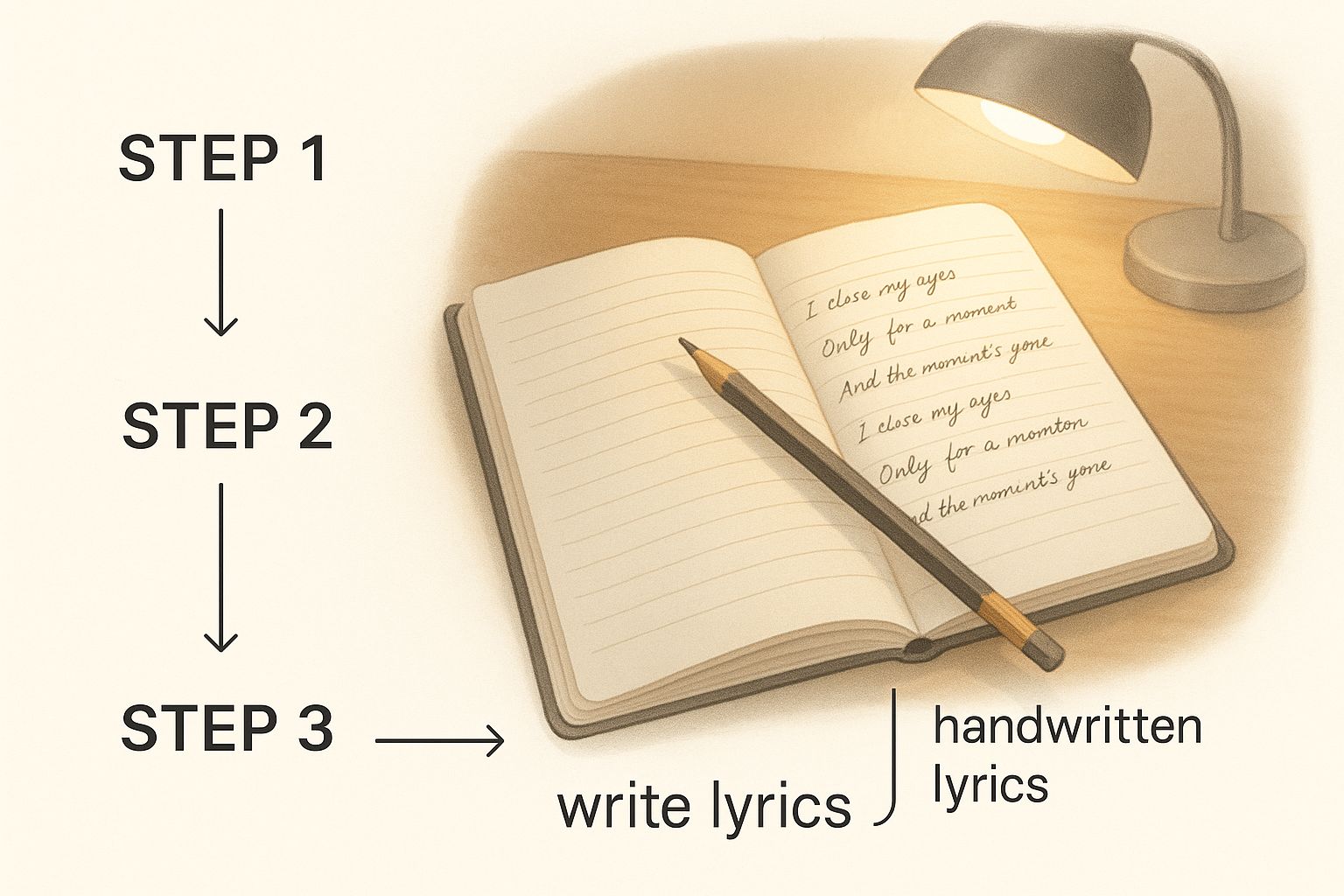
It’s a perfect visual reminder that even imperfect lyrics are the essential first step toward a finished song.
Making It Your Own
Once you have that initial sketch—whether you wrote it from scratch or used Magic Draft—the real work begins. Now it's time to infuse it with your personality. Read through the lines and start asking the right questions:
Does this actually sound like me?
Where can I inject a specific memory or a personal detail?
Which lines land perfectly, and which ones feel a little weak?
This is your chance to replace generic phrases with your own unique imagery and experiences. You can mess with the rhyme scheme, flip the phrasing, and rewrite entire sections until it feels authentic to your vision. The AI might provide the framework, but you have to provide the soul.
Sometimes, the best way to get your ideas out is to just say them out loud. If you're struggling to type, exploring dictation software can be a great way to capture your thoughts as they come, making the process feel more natural.
Remember, the first draft is not the final draft. It’s a low-stakes sandbox where you’re free to experiment, make mistakes, and discover what your song truly wants to be.
With that pressure off, you’ll find you can move from a simple concept to a full song structure much faster. Ready to conquer that blank page for good?
Pairing Your Words with Melody and Chords
Lyrics are the heart of a song, but the music is what makes them sing. For a lot of songwriters, this is the most intimidating part of the whole process, especially if you don't have a deep background in music theory. But here’s the thing: you don’t need to be a virtuoso to create a killer musical backdrop.
The truth is, some of the most memorable melodies come from simple, gut-level feelings, not from a textbook. Your goal is to find a musical vibe that matches the emotion of your words. Are your lyrics angry and in-your-face? A fast, driving rhythm is probably the way to go. Are they quiet and contemplative? A slower, stripped-down melody might be perfect.
Finding a Melody by Feel
Before you even think about an instrument, just say your lyrics out loud. Seriously. Listen to the natural rhythm of the words. Where do you put the emphasis? What’s the natural rise and fall in your voice as you speak? That right there—that’s the beginning of your melody.
Now, start humming different ideas, keeping that natural spoken rhythm as your guide. Don't censor yourself or get stuck in your head. Just mess around with what sounds and feels right. So many great melodies were discovered by songwriters looping a simple beat and just singing gibberish until something catchy stuck.
This is another spot where Lyric Studio can give you a nudge in the right direction. When you set the genre and mood at the start—say, "Upbeat Pop" or "Chill R&B"—the AI is already generating ideas that fit that specific sound. It helps you hear the finished song in your head while you're still in the writing phase.
The best melodies often feel like they were discovered, not invented. Trust your instincts and let the emotion of your lyrics guide you to the right notes.
Building a Simple Chord Progression
You really don’t need a music degree to build a solid chord structure. In fact, some of the biggest hits ever are built on just three or four simple chords. These repeating patterns, called chord progressions, create the harmonic foundation for your melody to sit on.
For genres like pop, hip-hop, and R&B, a handful of common progressions do most of the heavy lifting. You can create an incredible musical bed just by arranging these basic building blocks in different ways. If you're looking for a starting point, it’s worth exploring some of the most effective and easy-to-learn chord progressions for beginners that have powered countless hits.
The goal isn't to reinvent music theory, but to find a simple, solid structure that lets your lyrics and melody take center stage. Once you have that foundation in place, your song really starts to breathe.
Ready to bring your words and music together? Download Lyric Studio free on iOS. (Note: In-app purchases may apply.)
Fine-Tuning Your Song: The Art of Revision
Finishing that first draft is a huge win. Seriously, pop the champagne. You've brought something new into the world. But here's a secret every seasoned songwriter knows: the real magic happens in the rewrite. This is where a good idea transforms into a song that truly connects with people.
Think of it like a film editor in the cutting room. You've got all the raw footage, and now it's time to find the story, trim the fat, and make sure every single second on screen serves the final piece.
Putting Your Own Work Under the Microscope
Okay, this part can be tough. It requires taking a step back and looking at your own creation with fresh eyes, which is easier said than done. The best way I've found to do this is to simply read your lyrics out loud.
Listen to the rhythm of the words. Does anything feel clunky or awkward? Are there lines that make you stumble? Those are the spots that need a little love.
To keep yourself honest, try asking a few direct questions:
Is my story coming through? Is the message I think I'm sending actually what's on the page?
Do the words sing well? Forget the melody for a second and just feel the natural cadence of the phrases.
Is every line pulling its weight? Or did I just throw in a few lines to fill space or force a rhyme?
This is where having a tool like Lyric Studio in your corner really pays off. Instead of getting stuck, you can use its context-aware thesaurus to find a more powerful verb or lean on the rhyme suggestions to fix a clunky line without derailing your entire verse.
The goal of polishing a song isn't to achieve some mythical idea of perfection. It’s about making intentional choices so that every word, every chord, and every pause works together to amplify the core feeling of the song.
Taking It From a Draft to a Finished Track
With the lyrics tightened up, zoom out and look at the song's overall shape. How does the energy flow? A common rookie mistake is to have the verses and chorus all at the same intensity level. You want to build momentum heading into your chorus and create a dynamic journey for the listener.
Sometimes the fix is as simple as swapping the second and third verses or adding a short pre-chorus to lift the energy. Don't be afraid to move entire sections around.
This polishing stage is also about thinking like a pro. In the past, songwriters often just waited for royalty checks. But that's not the world we live in anymore. A 2025 report from MIDiA Research points out that today’s songwriters are more like entrepreneurs, building their own brands and audiences directly. Polishing your songs isn't just an artistic exercise; it's the first step in building a catalog of music you can confidently stand behind and promote. You can read more about this shift in the songwriter's role in this analysis from Synchtank.
Ultimately, learning to revise is about learning to trust your gut. It's a skill you build with every song you finish. Each time you push through the revision process, you're not just improving the song—you're becoming a better, more confident writer.
Ready to turn that rough diamond into something that shines?
Download Lyric Studio free on iOS. (Note: In-app purchases may apply.)
Got Questions? Let's Talk Songwriting.
Stepping into the world of songwriting can feel a little overwhelming at first. As you start figuring out how to actually write a song, a ton of questions will probably pop into your head. That's totally normal. Let's tackle some of the most common ones I hear from aspiring writers.
What Comes First, Lyrics or Music?
This is the classic chicken-or-the-egg question of songwriting. The real answer? There is no right answer.
Some of the greats, like Elton John, almost always get a finished lyric from their partner (in his case, the brilliant Bernie Taupin) and then compose the music. On the flip side, you have legends like Paul McCartney, who famously dreamed the melody for "Yesterday" and figured out the words later.
My advice is to just experiment. See what feels right for you. Try starting with a lyrical idea one day and a simple melody the next. You might even find yourself doing both at once—humming a tune while a great line just falls into place. Don't get hung up on a rule that doesn't exist.
Can I Write a Song if I Don't Play an Instrument?
Yes. Absolutely, one hundred percent. Your voice is an instrument, and the voice recorder on your phone is all you need to get started.
So many incredible songs started as a simple hummed melody. The writer just captured that initial spark and then worked with a producer or another musician to build the chords and arrangement around it.
This is also where Lyric Studio can really help. With features for genre and mood customization for hip-hop, pop, R&B, and more, you can find a vibe that fits your idea and use it as a creative launchpad, even if you don't know the first thing about music theory.
The most important thing is capturing the initial idea. Don't let a lack of formal training be the reason you don't create. The collaborators and technology you need to bring it to life are out there.
How Do I Know if My Song Is Good?
This is a tough one, because "good" is so subjective. But a song that truly connects with an audience usually has a few key ingredients: a core of real emotion, a clear idea, and something that sticks in your head—a catchy melody or a killer lyrical hook.
Honestly, the first person your song needs to impress is you. If you get to the end and you like what you've made, that's a huge win.
The music business itself has changed so much. Streaming is king now, and by mid-2025, U.S. music industry revenue already hit $5.6 billion, with most of that coming from streams. While that creates new challenges, it also means you have a direct line to listeners. You don't need a record label gatekeeper to find an audience anymore. You can learn more about how the songwriter's role is shifting in this new landscape.
Ultimately, the best thing you can do is finish your songs. Every single one you complete—even the ones you think are just okay—makes you a better writer. It’s a craft, and it gets better with practice.
Ready to turn those ideas into actual songs? Lyric Studio is built to help you smash through writer's block with everything from smart lyric suggestions to a "Magic Draft" feature that can get you started in seconds.
Download Lyric Studio free on iOS and see for yourself. (Note: In-app purchases may apply.)

SCAN TO GET