Back to articles
How Do You Rap to a Beat: A Beginner's Guide
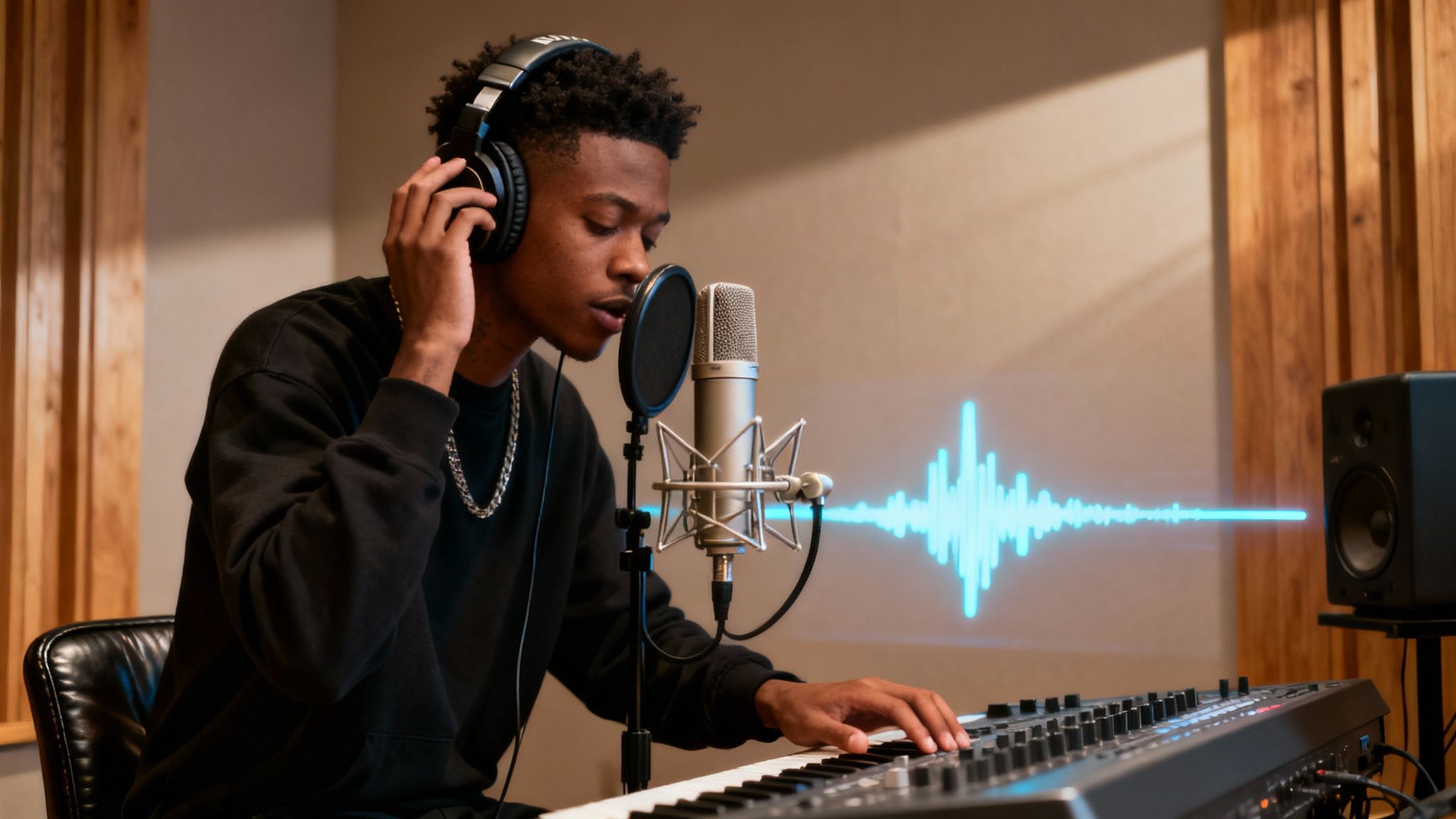
Rapping to a beat is a lot more than just talking over some music. It’s about merging your voice with the instrumental until they become one cohesive track. The real magic happens when you lock your lyrics into the beat's pulse, making your words land exactly where they feel right. This all starts with learning to listen—really listen—to the music's core structure.
How to Find the Rhythm in Any Beat
Before you even think about spitting your first bar, you have to get familiar with the musical canvas you're about to paint on. A beat isn't just random noise; it's a carefully constructed pattern with a predictable pulse. Your first job is to find that pulse and make your voice an instrument that rides along with it.
You can usually break down the rhythm by zeroing in on the main drum sounds.
The Kick Drum: That’s the deep, booming "thump" you feel in your chest. It’s the heartbeat of the track, often landing on the 1st and 3rd beats of a bar.
The Snare Drum: This is the sharp, snappy "crack" that cuts through the mix. The snare provides the backbeat and usually hits on the 2nd and 4th beats. It gives the rhythm its punch.
The Hi-Hats: These are the crisp, ticking sounds (like "tss-tss-tss") that keep the time. They fill in the gaps and drive the beat forward.
When these three elements work together, they create the "pocket"—that perfect rhythmic groove where your vocals should sit.
Finding Your Place in the Beat
The vast majority of hip-hop is in what's called a 4/4 time signature. All that means is there are four beats in every measure (or "bar"). The easiest way to get the feel for this is to just count along: "one, two, three, four... one, two, three, four..."
Listen closely, and you'll notice the snare usually hits on the "two" and "four." Once you can count along and predict where those snares will land, you’re well on your way. You'll start to feel when a new bar is about to begin, which is crucial for timing when you start and stop your verses.
Here's a quick cheat sheet to help you break it down.
Finding Your Place in the Beat
Beat Component | What to Listen For | Its Role |
|---|---|---|
Kick Drum | The deep "boom" or "thump" | The foundation, often on beats 1 and 3 |
Snare Drum | The sharp "crack" or "clap" | The backbeat, gives the rhythm its snap on beats 2 and 4 |
Hi-Hats | The fast, ticking "tss-tss" | Keeps time and drives the groove forward |
Learning to pick out these individual sounds trains your ear to deconstruct any beat, making your flow sound deliberate and locked-in, not just like you're rapping on top of it.
This process is a fundamental skill for any rapper. If you're also curious about making your own instrumentals from scratch, our guide on beat making for beginners is a great place to start.
It's interesting to see how things have evolved. Back in the day, hip-hop pioneers often rapped over funk and soul drum breaks that were somewhere between 80 to 110 BPM (beats per minute). Fast forward to today, and you'll find modern trap beats pushing tempos up to 130 to 150 BPM.
The best way to learn is by doing. You can find a huge library of beats to practice with in Lyric Studio. It’s the perfect environment to start identifying these core elements and finding your rhythmic pocket right away.
Writing Lyrics That Lock Into the Music
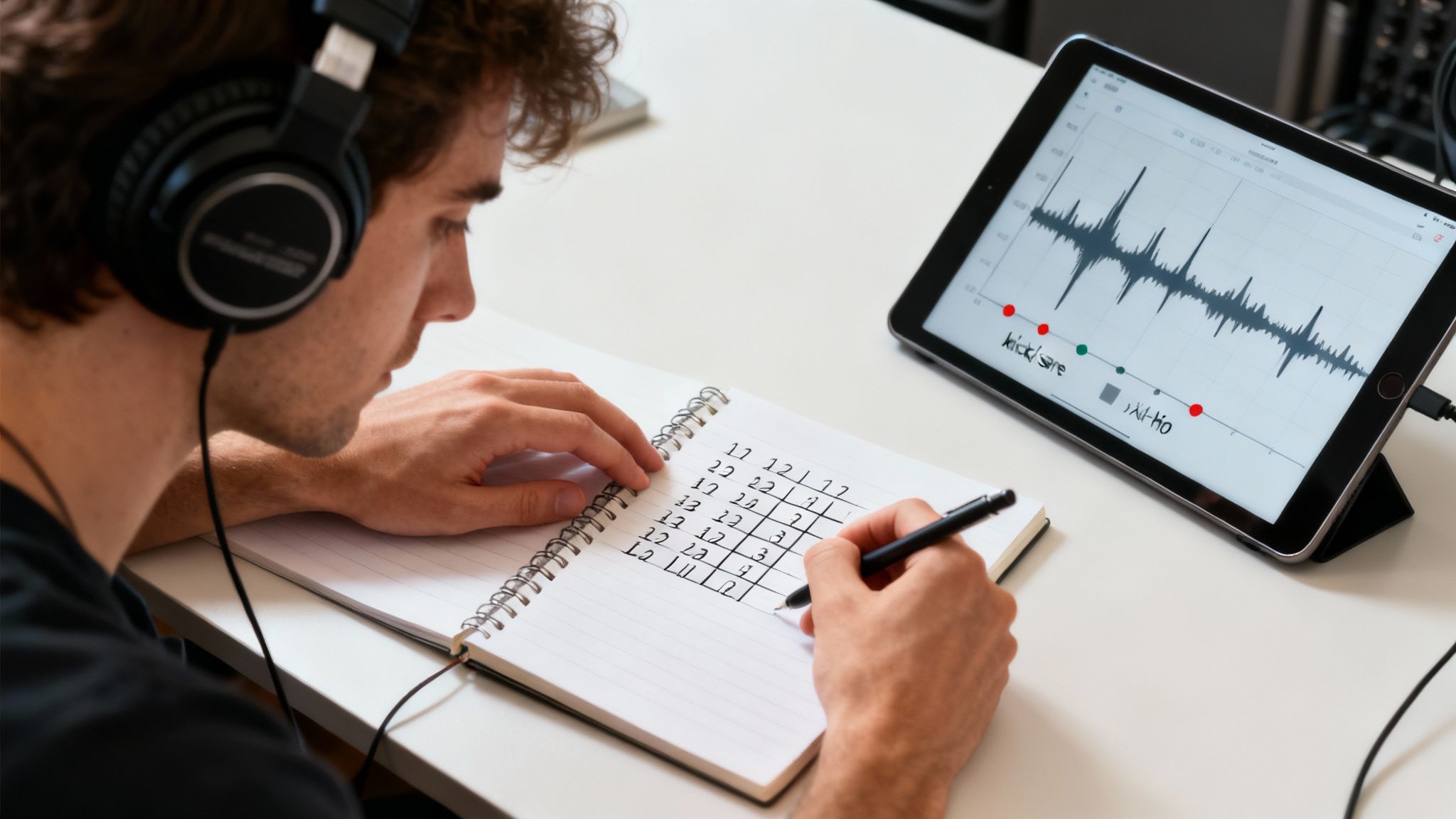
Alright, you can feel the pulse of the beat. Now comes the fun part: writing lyrics that feel like they were born from the music, not just layered on top.
First, tune into the beat’s energy. Does it hit hard and make you want to move? Or is it more chilled out and thoughtful? The vibe of the instrumental should be your guide. Trying to drop aggressive bars over a mellow, soulful beat will just sound jarring and out of place. Let the music set the scene for your story.
Structuring Rhymes and Syllables
Beyond the overall mood, the actual structure of your words makes a huge difference. This is where rhyme schemes and syllable counts come in. A classic AABB rhyme scheme is a solid place to start—it's simple, effective, and helps you get your ideas down.
A great way to level up your flow is to pay attention to syllables. Try to keep the syllable count similar in your rhyming lines. If your first line has 12 syllables, the line it rhymes with should feel about the same length. It creates a rhythm that just sounds right.
This little bit of technical focus is what makes your lyrics really lock in with the beat's grid.
We all hit that wall sometimes. Staring at a blank page when you have a fire beat is frustrating. This is where a creative assistant like Lyric Studio can be a game-changer. It’s not about writing the song for you; it's about giving you AI-driven, context-aware lyric suggestions that adapt to your theme when you need a creative nudge.
With integrated rhyme and thesaurus tools, you can find that perfect word without breaking your creative stride. And once you've got those lyrics down and they're hitting just right, you might even want to create a compelling lyric video to give them a visual punch.
Ready to turn that beat into a full track? Download Lyric Studio free on iOS (note: in-app purchases may apply) and see how it can help you build verses that connect.
Developing Your Unique Rhythmic Flow
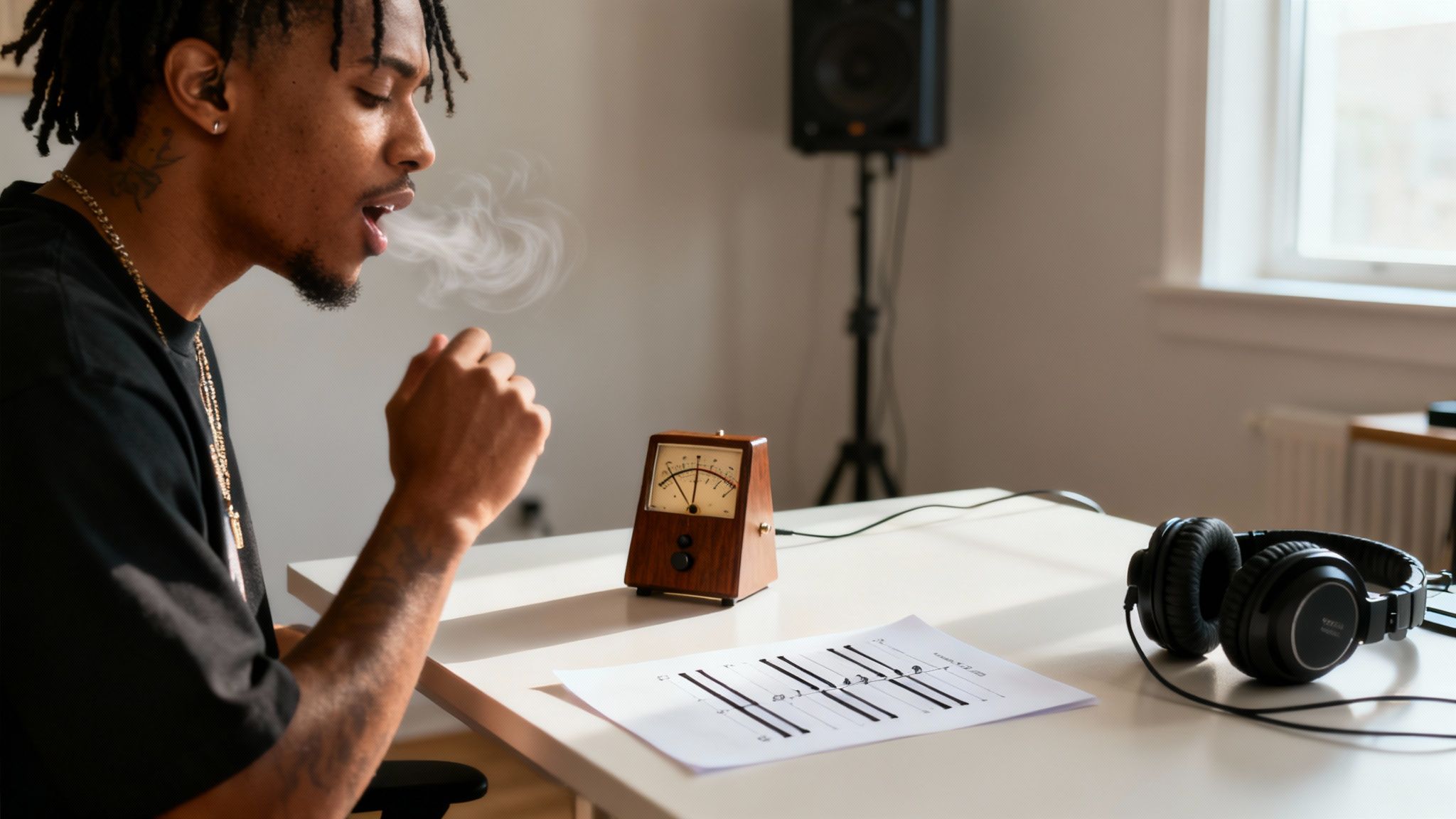
Your flow is your signature. It’s that one-of-a-kind rhythm and cadence that makes someone hear a track and know instantly, "Oh, that's you." It's more than just rhyming; it’s about how your voice becomes another instrument, weaving in and out of the beat.
This is where you move past the basics and start developing some real style. A great way to start is by getting playful with your rhythm. Don't just plant every word squarely on the kick and snare. Try dancing around the beat a little.
This is where you get into concepts like syncopation, which is just a fancy word for intentionally rapping slightly off-beat to create a cool, push-and-pull effect. Try landing a key word just before or after the snare hits. You'll be amazed at how this tiny shift adds tension and makes your verses feel so much more alive.
And don't forget about silence. A pause isn't just dead air; it's a powerful tool. A well-timed pause can add drama, build suspense, or just give your listener a second to digest a killer line you just dropped.
Finding Your Natural Cadence
Every great rapper has a natural cadence—a pocket where they feel most comfortable. Think about it: some artists have that laid-back, almost conversational flow, while others are all about cramming complex, multi-syllable rhymes into every bar. There’s no right way to do it. The only goal is to find what feels authentic to you.
Here are a few things you can try to find your own groove:
Play with Speed: Take a verse you wrote and rap it slowly. Then at a normal pace. Then as fast as you can without tripping over your words. This is a great way to figure out your natural tempo range.
Shift the Emphasis: Go back to a single line and rap it several times, but stress a different word each time. You’ll see how changing the emphasis completely alters the feeling and meaning of the bar.
Vary Your Pitch: Your voice's pitch can be an instrument, too. Try raising your pitch at the end of a line to build excitement or lowering it to add weight and seriousness.
Your flow is the personality you inject into the beat's rhythm. It’s a combination of speed, pauses, and emphasis. The key is to make intentional choices that serve the story you're telling and the emotion you want to convey.
It's easy to get stuck in a rhythmic rut, using the same flow over and over. When that happens, you need something to shake things up. Lyric Studio’s “Magic Draft” feature can be a game-changer here. It can instantly generate a first verse-and-chorus, giving you a totally new rhythmic pattern to jump-start your songwriting.
This isn't just about feeling the music; there's a science to it. Staying "in the pocket" means aligning your syllables precisely with the beat, often down to the sixteenth notes in a standard 4/4 bar. In fact, studies have shown that skilled rappers maintain a timing accuracy within 20 to 40 milliseconds of the beat. That level of precision is what separates the pros from the amateurs.
Ready to find your signature sound? Download Lyric Studio free on iOS (note: in-app purchases may apply) and start experimenting with your flow today.
Mastering Breath Control and Vocal Delivery
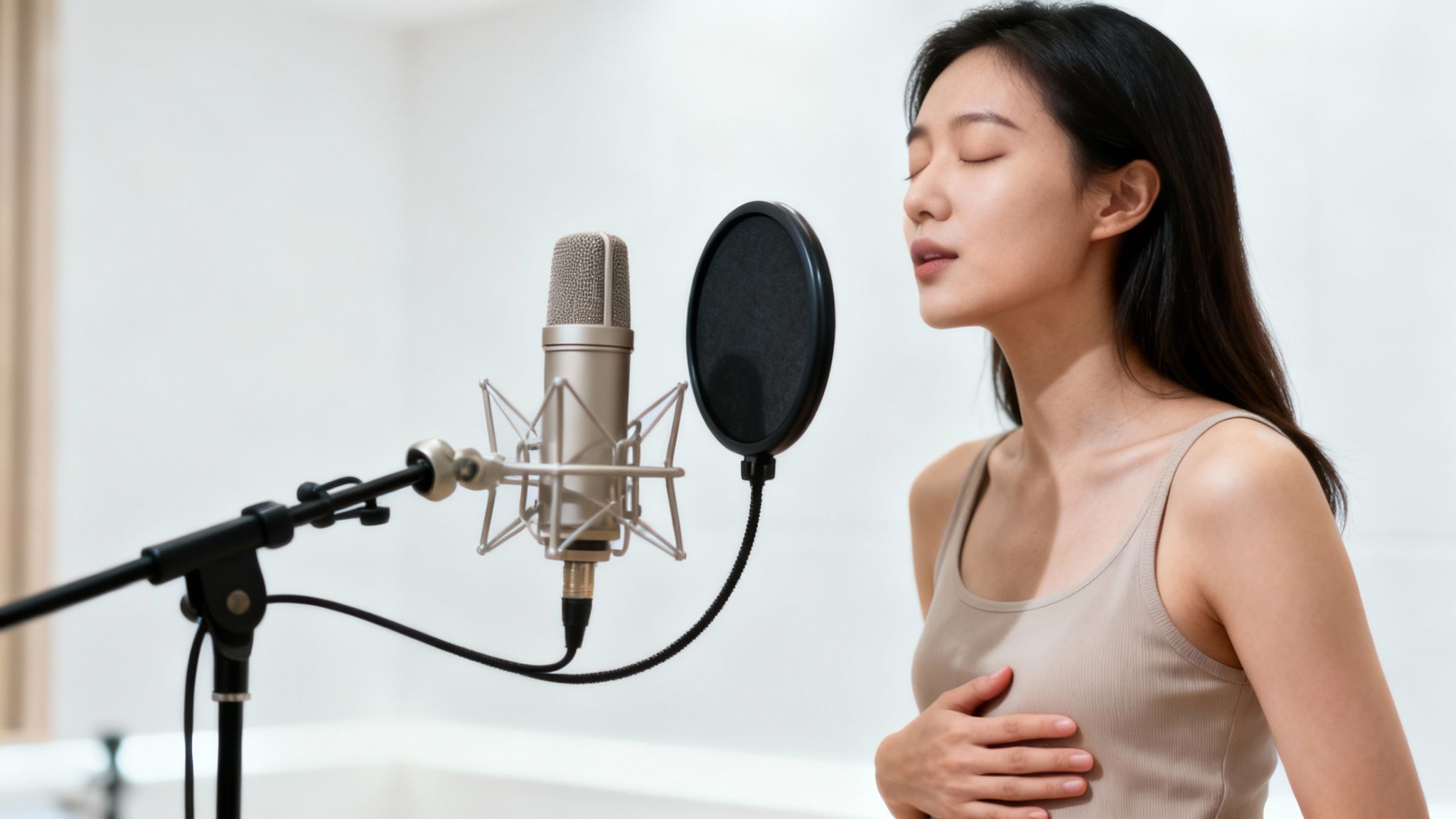
You can have the best lyrics and the sickest flow on the planet, but if your delivery is weak, the entire track falls apart. Your voice is the final instrument—the one that has to sell the story and make the listener feel something. It all starts with something we do every second but rarely think about: breathing.
Rapping eats up a lot of air, and gasping for breath mid-verse is a dead giveaway of an amateur. It kills your power and throws your timing way off. The secret isn't just breathing more, it's breathing from the right place. Most of us take shallow breaths from our chest, but you need to learn to breathe from your diaphragm, the muscle right below your lungs. That's where the real power comes from.
Simple Breathing Exercises
Here’s a classic vocal coach trick: lie on your back, put a book on your stomach, and just breathe. When you inhale through your nose, focus on making the book rise. Your chest should barely move. Then, exhale slowly through your mouth and let the book sink back down.
Doing this for just a few minutes a day builds the muscle memory you need to support those long, complex bars without sounding like you just ran a marathon.
Of course, having enough air is only half the battle. Enunciation is what makes sure people actually understand what you're saying. If your words are mumbled, your punchlines will fly right past everyone.
The goal is to make every single syllable hit clearly without sounding stiff or robotic. A great way to practice this is to rap with a pencil held between your teeth. It feels ridiculous, but it forces your tongue and lips to work overtime, and you’ll notice a huge improvement in your clarity.
Adding Dynamics to Your Delivery
A great vocal performance is never one-note. It's not about being loud all the time; it's about using dynamics to pull the listener in and keep them hooked.
Play with Your Volume: Try dropping your voice to an almost-whisper to build suspense in a verse, then punch the chorus with more power and force. The contrast is what makes it impactful.
Switch Up Your Intensity: Not every line needs to be delivered with aggressive energy. Mix in a more relaxed, conversational tone to match the mood of the lyrics. Let the emotion guide you.
Getting these skills down is what separates the pros from the beginners. And when you're ready to put it all together, you can Download Lyric Studio free on iOS (note: in-app purchases may apply) to get AI-powered lyric suggestions that can help match the delivery and vibe you're going for.
Putting It All Together: From Practice to Performance
Knowing the theory is one thing, but actually delivering on a track is what separates the bedroom hobbyists from real artists. This is the moment you bring everything together—your lyrics, your flow, your delivery—and create a performance that feels confident and polished. The secret? Building that muscle memory through a smart practice routine.
Before you even touch the beat, start by rapping your verses acapella. Just you and the words. This lets you get a feel for the internal rhythm of your lines and lock down the cadence without the distraction of an instrumental.
From Rehearsal to Recording
Once rapping acapella feels like second nature, it's time to record yourself over the beat. Now comes the most important part: listening back. You have to be your own harshest critic here.
Does your energy actually match the vibe of the track? Are you hitting the pocket or are you a little behind? Pinpoint the exact spots where the timing feels off or a line just doesn't hit right. Isolate those sections and drill them over and over.
Repetition is your best friend. The goal isn't just to memorize your lyrics; it's to make the delivery feel completely effortless. When the flow is second nature, you free yourself up to inject real emotion and personality into it.
If you're building a space to create, our guide on setting up a home recording studio can help you get the right gear to capture your sound with clarity.
Mastering how to rap on a beat is what separates you from the noise. With Hip-hop/R&B making up about 24.6% of all audio streams in the U.S., a polished, professional delivery is non-negotiable if you want to stand out. You can read the full analysis on hip-hop's market share to see just how big the stage is.
Ready to put in the work? Download Lyric Studio free on iOS (note: in-app purchases may apply) to start writing, rehearsing, and perfecting your next track.
Common Questions About Rapping to a Beat
As you start finding your voice, you're going to hit some bumps in the road. It's totally normal. Getting a handle on these common questions will help you clear those hurdles and get back to what really matters: making music.
Let’s break down some of the things that trip up new rappers.
How Do I Know if I Am On Beat?
This is the big one. The easiest way to check is to just record yourself rapping over the beat. Seriously, pull out your phone and hit record.
When you listen back, be honest with yourself. Are your words landing with the kick and snare? Or does it sound like you're chasing the beat or jumping ahead of it? If your delivery feels like it's dragging or rushing, you’re probably off.
Another pro tip? Use a metronome. It sounds basic, but practicing your bars to a simple click track is a game-changer. It trains your internal clock so that when you get on an actual instrumental, staying in the pocket feels automatic.
What Is the Difference Between Flow and Rhythm?
It's easy to get these two mixed up, but the difference is pretty simple once you see it.
Rhythm is the music's backbone. It’s the steady pulse of the beat itself—that underlying grid you’re rapping over.
Flow is what you do on top of that grid. It’s your unique delivery, the way you stretch or punch your syllables, your use of pauses, and the cadence of your voice.
Think of it this way: the beat provides the rhythm, but you bring the flow. That’s where your personality as an artist really shines through.
Can I Write Lyrics Before Finding a Beat?
You absolutely can, but be warned: it often makes things harder, especially when you're just starting out.
When you write to a beat, you're automatically matching its mood, tempo, and energy. Everything is built to fit from the ground up.
If you write your lyrics first, you have to work backward. You're stuck trying to find a beat that fits the flow you already have in your head. Sometimes you get lucky and find the perfect match, but more often than not, you'll find yourself having to tweak lines or completely change your delivery to make it work. It's doable, but it's a different kind of challenge.
Getting stuck is part of the process, but you don't have to stay there. Using a creative assistant can provide the nudge you need to get back on track and finish your song.
Ready to put these answers into action? Lyric Studio has AI-driven, context-aware lyric suggestions and a “Magic Draft” feature that can help you spark ideas that fit any beat perfectly. Download Lyric Studio free on iOS and start building your skills today.

SCAN TO GET