Back to articles
A Guide to Writing Lyrics to a Song
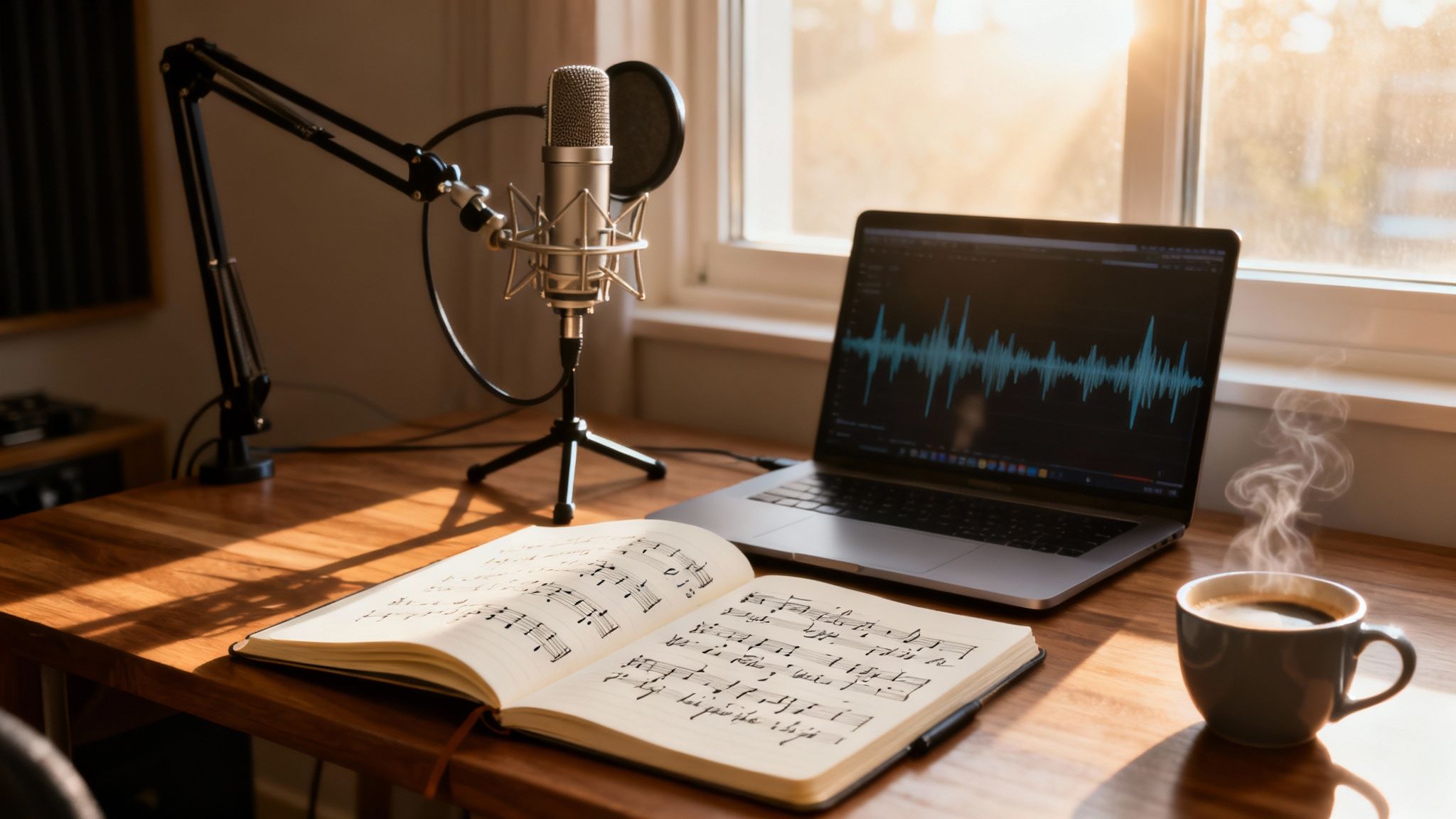
Every song starts somewhere. It might be a killer line that pops into your head in the shower, a feeling you can’t shake, or a story you just have to tell. That initial spark is everything. The real work, though, is figuring out how to build a whole song around it without losing that magic.
This is where you move from a fleeting idea to a solid song concept. It’s about taking that raw energy and giving it a purpose and direction.
From Fleeting Idea to Song Concept
The best songs feel like they have a strong center of gravity. That's your core theme. Think of your initial idea as the sun, and all your other lines, images, and rhymes are planets orbiting around it. This central theme holds everything together and makes sure every word you write is pushing the same message forward.
Without a clear concept, you risk ending up with a collection of cool-sounding lines that don't add up to anything meaningful. Taking a moment to define your theme is the difference between a decent song and a great one.
A strong song concept needs a few key ingredients to really work. It's more than just a topic; it's about defining the perspective, emotion, and message you want to deliver.
Key Elements of a Strong Song Concept
Element | Description | Example |
|---|---|---|
Core Idea | The single, central thought or feeling. | "I miss my hometown." |
Perspective (The "Who") | Who is telling this story? Are they looking back in sadness, nostalgia, or anger? | "A young person who moved to the big city and now feels lost." |
Central Emotion | The dominant feeling you want the listener to experience. | Melancholy and a touch of hope. |
The Hook/Message | The one takeaway line or idea that sticks with the listener. | "The city lights don't shine as bright as my front porch." |
Once you have these pieces in place, you’ve built a solid foundation. You're no longer just throwing words at a page; you're telling a focused story.
Turning Inspiration Into Action
Okay, so you have your idea. Now what? This is often where the infamous writer’s block creeps in. That blank page can feel pretty intimidating.
If you’re feeling stuck, sometimes you just need a little nudge to get the words flowing. Some writers find that exploring different AI text generation prompts can be a fun way to break out of a rut and spark new connections. For more classic approaches, we’ve got a whole guide on how to overcome writer's block.
This initial creative stage is getting a lot of attention lately. The AI-generated song lyric market alone was valued at around $415 million globally in 2024, showing just how many people are looking for new ways to start writing.
The goal isn't just to find words, but to build a world around your core idea. Ask yourself: What is the central emotion? Who is telling this story? What is the one thing I want the listener to feel after hearing this song?
Get a Creative Head Start
If you want to skip the "blank page" phase altogether, a creative assistant built for songwriters can be a huge help. In Lyric Studio, the "Magic Draft" feature acts as your creative co-pilot right from the start. Just feed it your idea, a genre, and a mood, and it instantly generates a first verse and chorus to jump-start your songwriting.
This isn’t about an app writing the song for you. It’s about giving you something to react to. You can edit, rewrite, and completely change it, but you're never starting from zero. It’s an incredible way to jump straight into the fun part: making the song your own.
Building a Memorable Song Structure
Once you’ve got a solid core idea, it’s time to give it a skeleton. A song's structure is really the emotional roadmap for your listener, guiding them through the story you’re trying to tell. If you don't have a clear framework, even the most brilliant lines can feel aimless and get lost.
Think of it like telling a good story. You wouldn't just ramble; you'd have a beginning, a middle, and an end to make it satisfying. In songwriting, those parts are your verse, chorus, and bridge. Each section has a specific job, and knowing what each one does is crucial for writing a song that really hits home.
The classic Verse-Chorus-Verse-Chorus-Bridge-Chorus structure is popular for a reason. It's an incredibly effective way to build a narrative while hammering home the song's main message.
The Anatomy of a Song
Let's break down the role each part plays in the song.
The Verse: This is where you do your storytelling. You introduce characters, set the scene, and push the plot forward with vivid details and imagery. Each verse needs to reveal something new to keep things interesting.
The Chorus: This is the heart and soul of your song. It’s got your central theme and the main hook—that unforgettable part that gets stuck in everyone’s head. The lyrics and melody here are typically repeated each time.
The Bridge: The bridge is your chance to switch things up. It can offer a new perspective, a shift in emotion, or even just a different musical vibe. The whole point is to break the verse-chorus cycle before you come crashing back into that final chorus with renewed energy.
This visual gives you a great overview of how these pieces fit together to take your listener on a journey.
This flow—moving from detailed storytelling in the verse to that big payoff in the chorus—is what makes a song feel both cohesive and emotionally powerful.
Putting Structure Into Practice
When you map your lyrical ideas to a structure, it keeps your writing focused. Let's say your chorus is all about feeling free. Your verses could then describe the specific moments or situations that made you feel trapped. The bridge might be a moment of reflection on what "freedom" actually means to you now.
A song should feel like a journey. The verse sets you on the path, the chorus is the destination you keep returning to, and the bridge is the scenic overlook that gives you a fresh perspective on the whole trip.
If you really want to dig into crafting a chorus that people can't forget, check out our guide on what makes a good hook.
Having a structure doesn’t stifle creativity; it channels it. It makes sure your song builds momentum and delivers its message with the most impact. Ready to start building? You can map out your ideas and find the perfect words with a powerful creative assistant.
Download Lyric Studio free on iOS to start structuring your next hit today. (In-app purchases may apply)
Crafting Verses and Choruses That Connect
Alright, you've got your song structure mapped out. Now for the fun part: writing the actual words that will bring it to life. We’re talking about the verses and the chorus—the two pillars of your song.
Think of it this way: your verses are the narrative engine, pushing the story forward, while the chorus is the emotional anchor that keeps bringing the listener back to the core message. They have to work together to tell your story and make someone feel it.
Writing Verses That Tell a Story
The biggest mistake new songwriters make is telling the listener how they feel. Don't do that. Your job is to show them.
Instead of saying you were sad, describe the "cold coffee" on the table or the "rain tracing patterns on the glass." Use sensory details—sights, sounds, smells—to pull the listener right into the room with you. This is how you make a story feel real and relatable. Each verse should build on the last, revealing a little more of the picture and moving the narrative along.
Think like a film director setting a scene. What details does your audience need to understand the mood?
Set the Scene: Where is this happening? A "dusty attic" feels entirely different from a "crowded subway." Location is character.
Introduce Action: What's going on? Is someone "packing a suitcase" or just "staring at their phone"? Action creates movement and makes your lyrics feel alive.
Reveal Emotion: Use those actions and descriptions to hint at what's going on inside. A "clenched fist" says a lot more than just writing, "I was mad."
This is where a tool like Lyric Studio can be a game-changer. Its AI-driven, context-aware lyric suggestions don't just spit out random rhymes. If you’re writing about a breakup, it picks up on that vibe and suggests imagery and phrases that fit, helping you find those perfect, powerful details you might not have thought of on your own.
Building a Chorus That Sticks
Now, the chorus. This is it. This is the part people will have stuck in their heads all day—if you do it right. The chorus is your song's entire message, boiled down to its most potent, memorable form. It has to be powerful and catchy.
It’s interesting, a study that analyzed over 350,000 songs from 1970 to 2020 found that lyrics have actually gotten simpler and more repetitive. And that’s not a bad thing! It shows that simplicity and repetition are your best friends when it comes to making a chorus stick. If you're curious, you can read the full research about modern lyric trends and see how things have changed.
Your chorus should be so clear that if someone only heard those lines, they would still understand the core feeling of your song. It’s your mission statement, set to a melody.
Whether you're writing a big pop anthem or a quiet acoustic ballad, the chorus is what listeners will hold onto. It's the anchor, the hook, the heart of it all.
Ready to get those verses and choruses just right? Lyric Studio can help you find the words that match the sound in your head.
Download Lyric Studio free on iOS and start writing something unforgettable. (In-app purchases may apply)
Finding the Perfect Rhyme and Rhythm
Fantastic lyrics do more than just tell a story—they have to sing. The sound and flow of your words are every bit as important as what they mean. This is where rhyme and rhythm come in; they’re the backbone that makes your lyrics feel natural and stick in someone's head.
Most of us start out hunting for perfect end rhymes, like pairing "fire" with "desire." But there's a whole sonic toolbox available to add real texture and depth to your work. Moving past the obvious is how you start writing lyrics to a song that sounds truly professional.
Thinking Beyond Simple Rhymes
Perfect rhymes have their place, but lean on them too much, and your lyrics can start to sound predictable, almost like a nursery rhyme. If you want to elevate your writing, it's time to play with some more sophisticated techniques.
Near Rhymes (or Slant Rhymes): Think of words that almost rhyme but don't quite connect perfectly, like "shape" and "late." They give you that satisfying rhyming feeling without being so on-the-nose, which can add a really modern, subtle touch.
Internal Rhymes: Rhymes don't have to live at the end of the line! Tucking rhyming words inside a single line creates a fantastic internal rhythm. Think of the classic example: "The rain in Spain stays mainly on the plain."
Assonance: This is all about repeating vowel sounds. Notice the "i" sound in a line like "high tide." It’s a subtle echo that sonically glues your lines together without you even realizing it.
Using these tools adds layers and complexity, making your lyrics way more interesting to hear and perform.
Choosing Your Rhyme Scheme
The pattern you create with your rhymes—your rhyme scheme—dramatically affects the song's entire vibe. Different patterns create completely different moods.
For example, an AABB scheme (where two lines in a row rhyme) feels direct and simple, which is why you hear it so often in pop music. On the other hand, an ABAB scheme (where every other line rhymes) can feel more like a conversation. If you want to dive deeper, our guide on what is a rhyme scheme breaks down all the different patterns you can use.
Your rhyme scheme is like the drumbeat for your words. A simple, steady pattern creates one feel, while a more complex, syncopated one creates another. Choose the one that best serves the emotion of your song.
Your Secret Weapon for Word Choice
We've all been there: staring at a line, trying to find a word that says what you mean and fits the rhyme. It can completely stall your creative momentum. This is exactly where a creative assistant changes the game.
Lyric Studio has integrated rhyme and thesaurus tools that live right inside the editor. Instead of just dumping a generic list of rhymes on you, it gives you context-aware suggestions that actually fit your song's theme. This helps you stumble upon unique word pairings that feel authentic, not forced.
That means less time digging through rhyming dictionaries and more time actually creating. You can stay in the flow and experiment with options until you land on the perfect one.
Tired of having a dozen browser tabs open just to find a rhyme? Let an AI partner help you discover the words that will bring your lyrics to life. Download Lyric Studio free on iOS and start crafting lyrics with exceptional sound today. (In-app purchases may apply)
How to Polish Your Lyrics Like a Pro
Think of your first draft as a block of marble. The song is in there, but now it's time to chisel away the excess and reveal the real art underneath. This is where a good song becomes a great one—in the editing.
One of the oldest tricks in the book is also one of the best: read your lyrics out loud. Seriously. Does a line feel clumsy coming out of your mouth? Do you stumble over a certain phrase? Your ears will catch the awkward rhythms and clunky words that your eyes glide right over on the screen.
The Art of Self-Editing
When you start to revise, your mantra should be "ruthless clarity." Every single word has to fight for its place in the song. If a line isn't adding to the story or the feeling, it's probably just taking up space.
For every line you’ve written, ask yourself:
Is this essential? Does it push the narrative forward or hit an emotional nerve?
Is there a stronger way to say this? Could I swap a plain word for something with more color and punch?
Is this phrasing natural? Does it sound like something a real person would actually say?
This isn't about adding more; it's about subtraction. Cutting the fluff makes the words you keep hit that much harder.
Getting a Second Opinion
Once you've taken your lyrics as far as you can on your own, it's time to brave the outside world. Sharing your work can feel a bit like standing on a stage in your underwear, but a fresh perspective is priceless for finding the blind spots you’ve missed.
Find a friend you trust or another writer and ask for their honest take. This isn’t about them judging your talent—it's about seeing how your words actually land with a listener. Try to listen with an open mind, even if you don't agree with everything they say. Their reaction is valuable data.
Polishing a song isn't about fixing mistakes. It's about refining your core idea until it’s as potent and clear as it can possibly be. The best editing just helps your original vision shine brighter.
In today's streaming world, clarity is everything. Industry data actually shows that accurate lyric transcriptions can increase fan engagement by up to 60% on streaming platforms. It’s a powerful reminder that making sure your message is polished and easy to follow matters more than ever. You can find more stats on fan engagement over at TranscribeTube.com.
Your AI Editing Partner
This is where having a smart tool in your corner can make all the difference. Think of Lyric Studio as your tireless co-writer, always ready to help you tighten up a line or find a better word.
If a phrase feels stale, the AI-driven, context-aware lyric suggestions can spark new ideas for wording that fits your song’s mood perfectly. Its built-in thesaurus helps you sidestep tired clichés, and the genre & mood customization keeps the suggestions locked into your artistic style. It’s like having an objective partner who can offer instant alternatives, helping you spot weaknesses and discover stronger ways to say what you mean.
Ready to turn that rough draft into something you’re proud of?
Download Lyric Studio for free on iOS and see what a little polishing can do. (In-app purchases may apply)
Common Lyric Writing Questions
Every songwriter I know, from absolute beginners to seasoned pros, runs into the same creative roadblocks. It's just part of the process. Let's tackle some of the most common questions that pop up when you're trying to get your thoughts down on paper.
What if I Have an Idea but No Idea Where to Start?
This is the classic songwriter's dilemma. You've got a killer concept, a feeling, or even just a single line, but turning that spark into a full song feels like staring at a blank map.
Don't panic. The first thing to do is just get messy with it. Open a notebook or a doc and just brain-dump every word, image, or stray thought related to your idea. No editing, no judging.
Once you have a cloud of ideas, try to find the core message. What's the one thing you absolutely must say? This is where a tool like Lyric Studio can be a lifesaver. Its “Magic Draft” feature is built for exactly this moment. You feed it your main theme, and it gives you a verse and chorus to work with. It's not the final song, but it's a launchpad—something real you can react to, tear apart, and build from.
How Do I Make My Lyrics Sound Original?
Originality isn’t about inventing a new language; it's all about the details. Anyone can write "I'm sad." A songwriter shows it by writing something like, "The coffee's cold and the rain is tracing patterns on the glass." See the difference? Specific, sensory details are your best friends.
Dig into your own unique experiences. The little things you notice, the way you see the world—that's what makes your story feel real and unlike anyone else's.
A great trick is to sidestep the obvious word choices. Instead of reaching for the first rhyme that comes to mind, use a smarter tool. Lyric Studio has a built-in thesaurus and gives you suggestions that actually understand the mood of your song, helping you find those fresh, unexpected phrases that make a lyric pop.
Does Using an AI Tool Mean I'm Not the Real Songwriter?
Absolutely not. Think of it this way: a guitarist uses a fuzz pedal to find a new sound, and a producer uses a sampler to chop up a beat. Is the music any less theirs? Of course not. An AI lyric assistant is just another tool in your creative toolbox.
Lyric Studio is designed to be your co-pilot, not the pilot. It can handle the grunt work—like brainstorming rhymes or rephrasing a clunky line—which frees up your mental energy to focus on the heart of the song: your story, your emotion, your message. You're always the one making the final calls.
What Comes First: Music or Lyrics?
Ah, the age-old debate. The honest answer is there is no right answer. It all comes down to what gets you inspired.
Sometimes, a powerful lyrical idea demands to be written first, and the music is then built around it to serve the story. Other times, you'll stumble upon a beautiful chord progression or a catchy melody, and you'll find yourself fitting words to the feeling the music gives you. The best process is the one that works for you, and it might even change from song to song.
This creative exploration is also a good time to think about the bigger picture of your music. You might even want to explore some ideas for naming your band to help solidify your artistic identity.
Ready to stop wondering and start writing? Lyric Studio is built to help you find your own answers with AI-powered suggestions, genre and mood settings, and all the tools you need to turn those nagging questions into finished songs.
Download Lyric Studio free on iOS. (In-app purchases may apply)

SCAN TO GET