Back to articles
How to Write Your Own Song Lyrics: A Practical Guide
The secret to writing your own song lyrics? Just start. You need to grab that initial idea and run with it, completely ignoring that inner critic telling you it's not perfect yet.
The most effective way to get moving is to just get a verse and chorus down on the page. It doesn't have to be brilliant, but it gives you something real to work with instead of just waiting for lightning to strike.
From Fleeting Idea to Your First Verse
Every song you love started as a tiny spark—a feeling, a memory, maybe just a cool phrase that popped into someone's head. The real enemy for songwriters isn't a lack of ideas; it's the fear of writing them down. We get stuck waiting for the perfectly polished concept, but real creativity is messy. It's all about momentum.
So, instead of getting locked in a staring contest with a blank page, what if you could just skip that part? The best way to get the ball rolling is to get a first draft on the page, fast. This isn't about having a computer write your song for you. It’s about using a creative assistant to build a launchpad you can use to blast off, shaping and twisting it until it sounds like you.
Curing the Blank Page Problem
Think of it as the ultimate creative warm-up. For instance, in Lyric Studio, the “Magic Draft” feature is built for exactly this. You can pick a genre and a mood—say, melancholy pop or confident hip-hop—and it will instantly generate a complete first verse and chorus right away. This feature is a fantastic way to jump-start your songwriting and get past that initial hurdle.

Suddenly, you've got a huge advantage:
You Have a Real Starting Point: You're not wrestling with an abstract idea anymore. You've got actual lines, a rhyme scheme, and a theme you can react to.
Your Creativity Becomes Focused: Instead of trying to pull something from thin air, you're asking better questions: "What works here? What would I say differently? How can I make this my story?"
Writer’s Block Becomes a Non-Issue: The pressure of writing that perfect first line—often the hardest part—is just gone.
The goal here is simple: stop thinking and start doing. Having a rough draft in front of you gives you clay to mold.
This whole approach flips the script. The intimidating task of starting from nothing turns into a fun editing session where you're already in motion.
To help you get started, here's a quick look at how you can take that initial spark and turn it into a solid first draft.
Turning Your Initial Idea into a Song
Phase | Actionable Step | How Lyric Studio Helps |
|---|---|---|
Concept Spark | Don't overthink it. Just jot down a feeling, a memory, or a single line that comes to you. | Use the integrated thesaurus to brainstorm related words and phrases if you feel stuck. |
First Draft Generation | Get a verse and chorus down quickly to build momentum and avoid the blank page. | Select a genre and mood, then use the “Magic Draft” feature to generate an instant starting point. |
Refinement & Personalization | Read through the draft. Identify what you like and what you want to change. Start rewriting lines to inject your voice. | The generated draft gives you a solid structure to edit, so you can focus on making it your own. |
With these actions, you're not waiting for inspiration—you're creating it.
As you get deeper into your songwriting, learning the fundamentals of storytelling can be a game-changer. Even resources on script writing for beginners can offer powerful insights into creating a narrative that pulls listeners in. For a more structured approach, you can also check out these 5 steps to easily write song lyrics for more guidance.
Ready to see how quickly your ideas can come to life? Download Lyric Studio free on iOS and turn that thought in your head into a real verse today. In-app purchases may apply.
Building a Strong Song Structure
Think of your song's structure as its skeleton. It’s the invisible framework that holds everything together and gives your story its shape. A great structure guides your listener from the first line to the last, making the journey feel intentional and satisfying. Without it, even the most brilliant lyrics can feel like a jumble of disconnected ideas.
There's a reason most hit songs—whether pop, hip-hop, or rock—follow a familiar pattern. It's not about being unoriginal; it's about speaking a language the listener already understands. This lets your message land with maximum impact.
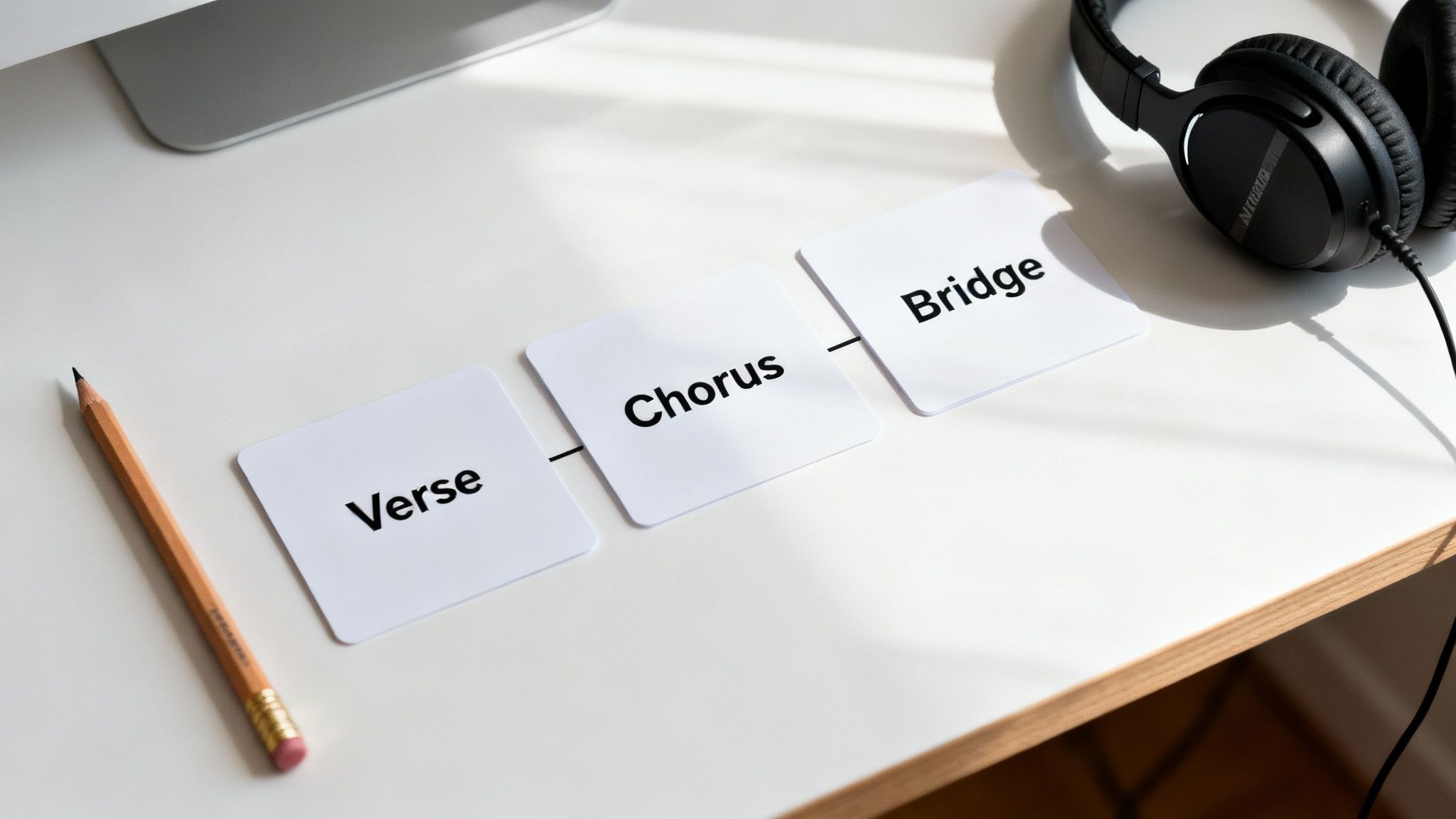
The Building Blocks of a Song
Every song is built from a few core components, and each one has a specific job to do. Once you get a feel for what each part does, you can start using them to build emotional momentum in your own writing.
The Verse: This is your storytelling section. Each verse pushes the narrative forward, adding new details, imagery, and context. Think of yourself as a film director setting the scene, shot by shot.
The Chorus: Here it is—your song's central theme. The chorus is the big, memorable idea that you want stuck in everyone's head. It’s usually the catchiest part and often contains the title of your song.
The Bridge: The bridge is your secret weapon for keeping things interesting. It’s a departure from the main song, offering a fresh musical or lyrical perspective. It can be a moment of reflection, a twist in the story, or an emotional shift before you slam back into that final chorus.
Think of your song as a journey. The verses are the path you’re walking, the chorus is the familiar landmark you keep returning to, and the bridge is that scenic overlook that gives you a whole new perspective.
Mapping Your Ideas
Okay, so you have the pieces. How do you put them together? A time-tested, powerhouse structure is Verse-Chorus-Verse-Chorus-Bridge-Chorus. This pattern is a masterclass in tension and release. The verses build anticipation, the chorus delivers that sweet, emotional payoff, and the bridge adds a final twist before you bring it all home.
The chorus really is the heart of your song's structure. If you want to dive deeper, we've got a whole guide on how to write a chorus that will stay with your listeners long after the music stops.
If mapping all this out feels a little daunting, don't worry. This is where a creative assistant like Lyric Studio can really help. The AI-driven suggestions are designed to understand song structure. It can feed you context-aware lines for your verses and then help you pivot to craft that killer chorus, making sure your whole song feels connected.
Ready to build your song from the ground up? Download Lyric Studio free on iOS and start sketching out your next hit. In-app purchases may apply.
Mastering Rhyme, Rhythm, and Flow
Great lyrics are more than just words on a page; they have to sing. This is where the real music in your language comes alive, turning simple phrases into something an audience can't forget. It's a delicate dance between what you're saying and how it sounds when you say it.
We all know the simple end rhymes like "cat" and "hat," but the real craft is in exploring more complex patterns. The way you structure your rhymes can completely change the emotional weight of a song. A straightforward AABB scheme often feels upbeat and direct—think classic pop songs. An ABAB scheme, on the other hand, can create a more sophisticated, flowing vibe.
Go Beyond Perfect Rhymes
To make your lyrics feel more natural and less predictable, it's a good idea to play around with different kinds of rhymes. This is a key trick to writing lyrics that sound modern and authentic.
Slant Rhymes: You might know these as "near rhymes." They're words with similar but not identical sounds (like "shape" and "late"). Using them adds a subtle, almost literary touch.
Internal Rhymes: This is a classic hip-hop technique, but it works everywhere. Placing rhyming words inside a single line creates a powerful, percussive effect (e.g., "I make the crowd get loud when I'm on stage").
Getting comfortable with these techniques means you won't have to force a clunky word into your song just to make a perfect rhyme stick. If you want to dive deeper, our guide on what is a rhyme scheme breaks it all down.
Find Your Rhythmic Flow
Just as crucial as rhyme is the rhythm of your lines—the cadence and meter. This is mostly about the number of syllables you use and where the natural stresses fall. Keeping your syllable count consistent from line to line creates a smooth, predictable flow, while changing it up can build tension or add a punch of emphasis.
The best way to check your rhythm? Read your lyrics out loud. Seriously. Do the words tumble out awkwardly, or do they roll off the tongue? If a line feels clunky when you say it, it will feel clunky when it's sung.
A song's flow is its heartbeat. If the rhythm is off, the listener feels it, even if they don't know why. The goal is to make your words dance with the melody, not fight against it.
This is where a little creative help can make all the difference. Instead of grinding to a halt to search for that one perfect word, you can get instant suggestions. Lyric Studio’s integrated rhyme and thesaurus tools offer smart, context-aware options that actually fit your song's theme. It frees you up to focus on what matters: crafting lines that sound incredible.
Think about it—collaboration is huge in music today. Top-charting tracks often have more than five songwriters credited. This trend shows that blending different skills in lyricism and flow leads to a stronger final song. Lyric Studio can be your digital co-writer, always ready with a fresh idea when you need one.
Ready to find your perfect flow? Download Lyric Studio free on iOS and get instant access to a world of rhymes to help you nail your rhythm. Note that in-app purchases may apply.
Using Imagery to Tell a Compelling Story
The songs that stick with us for years are the ones that make us feel something. They don't just say, "I'm heartbroken." They paint a picture of an unmade bed, the sting of cold air on a lonely walk, or a photograph gathering dust on a shelf. This is the classic rule of "show, don't tell," and it’s the secret to writing lyrics that truly land.
When you use vivid, sensory details, you pull your listener right into the world you've created. You're not just telling them a story; you're making them live it. Close your eyes for a second and think about the scene you're writing. What does it look like? What can you hear? Can you smell the rain or feel the sun? Tapping into the senses is how a simple lyric becomes a powerful, cinematic moment.
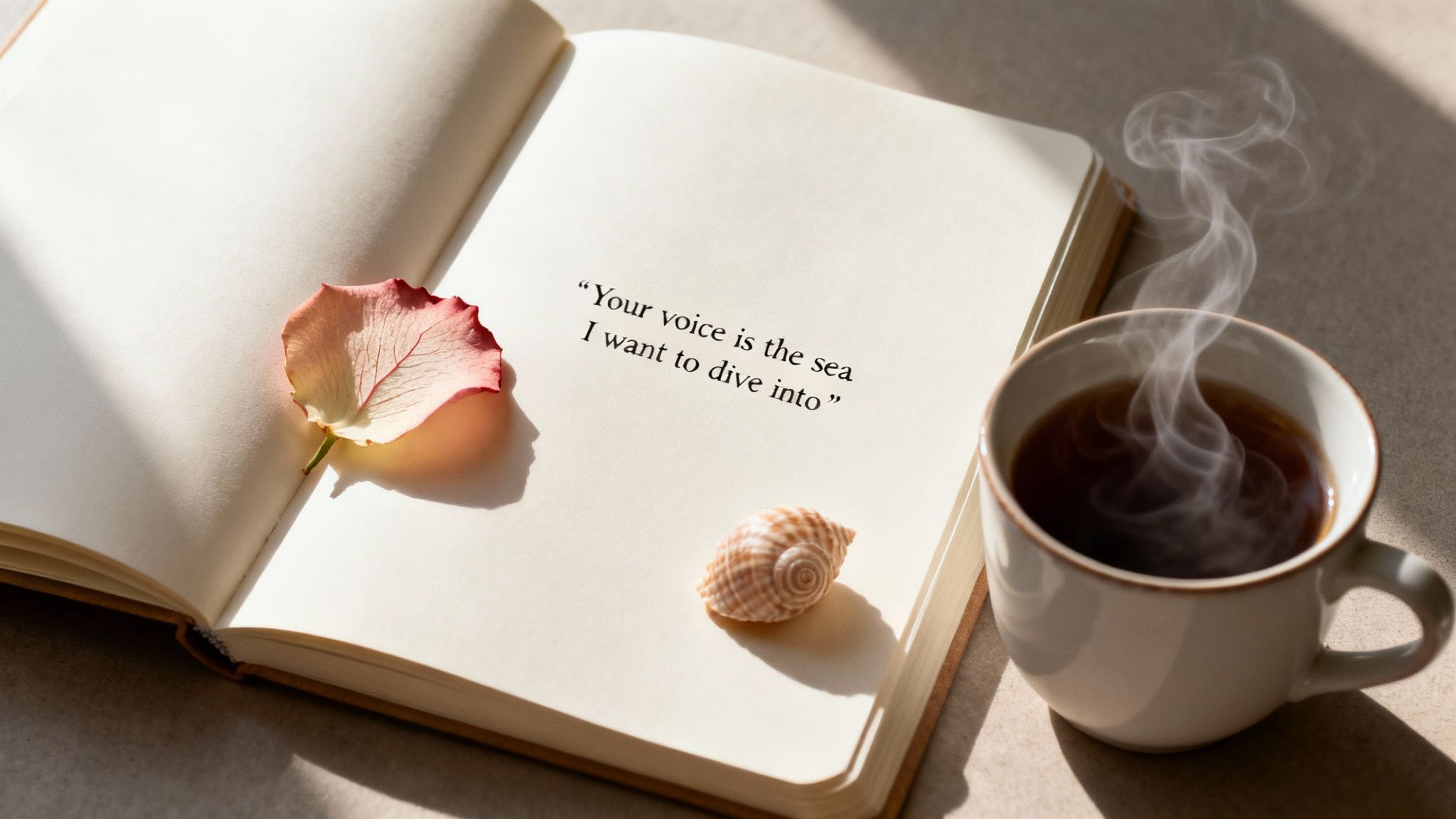
Painting Pictures with Words
Think of yourself as a filmmaker, but your camera is your pen. Your job is to create a mini-movie in the listener's head. You don't need a massive vocabulary for this, just an eye for concrete details that make a scene feel real.
Instead of writing about abstract ideas, try grounding your lyrics in things you can see, hear, and touch.
Sight: Don't just say the "car was old." Show us the "rust creeping up the driver's side door" or the "spiderweb cracks in the dashboard."
Sound: A "quiet night" is okay, but "the only sound was the floorboards creaking" is so much better. It builds tension and mood.
Touch & Smell: These two are absolute powerhouses for triggering memories. A line about the "chill of a marble floor" on bare feet or the "smell of burnt coffee" can instantly transport someone to a specific time and place.
This is where a creative partner like Lyric Studio can be a game-changer. It gets the vibe you're going for and offers AI-driven, context-aware lyric suggestions that adapt to your song's theme and emotion. It can help you brainstorm those unique, descriptive phrases that make a story pop, pulling you out of a rut when you're searching for the perfect image.
Adding Depth with Metaphors and Similes
Once you’ve got the hang of sensory details, you can start layering in more meaning with figurative language. Metaphors and similes are your best friends for this. They're shortcuts to explaining a huge, complicated feeling by comparing it to something everyone already understands.
A song is a story, and the best stories make us see the world in a new way. Imagery is the tool that lets you build that new world, line by line.
Just look at the difference it makes:
Direct Statement: "My heart is broken." (We get it, but it's a bit cliché.)
Simile: "My heart feels like a shattered window." (Now we have a visual—sharp, fragmented, and cold.)
Metaphor: "My heart is a shattered window." (Even more direct and powerful.)
The simile and metaphor don't just tell us; they show us the damage. They turn a universal feeling into a unique, personal experience. If you're struggling to find a fresh comparison, Lyric Studio's integrated thesaurus and rhyme tools can help you break out of old habits and find stronger word choices.
In a world of endless streaming, that emotional connection is everything. As MIDiA Research points out, songwriters are increasingly relying on their songs gaining traction on digital platforms, where lyrics that resonate on a gut level are what make a track stand out. You can dive deeper into the data on the songwriter's shifting role to see how the industry is changing.
Ready to start painting with words? Download Lyric Studio free on iOS and get the tools you need to build worlds and tell unforgettable stories. Please note that in-app purchases may apply.
Time to Edit: Polishing Your Lyrics into a Masterpiece
Getting that first draft down is a massive victory, but let’s be real—the real work starts now. This is the editing phase, where you get to chisel away at your raw ideas and uncover the brilliant song hiding underneath. It’s what separates a decent tune from a track that truly sticks with people.
Your first pass is all about emotion and getting ideas onto the page, no matter how messy. Editing, though, requires a different hat. It’s time to be a bit more of a surgeon, looking at your work with a critical eye and asking the hard questions. Does this line really need to be here? Could I say that better? This is how you make sure your message hits hard, without any clutter getting in the way.
Get Some Distance for a Fresh Look
Honestly, one of the best editing tricks in the book is just to walk away. Seriously. After you’ve poured everything into a song, you’re way too close to it to judge it fairly. Tuck it away for a day or two, then come back.
You’ll be amazed at what you notice. That one clunky rhyme or awkward phrase that you couldn't quite put your finger on before will suddenly stick out like a sore thumb. This little break helps you switch from creator mode to editor mode, letting you see which lines are killer and which are just filler.
Read Everything Out Loud
Lyrics aren’t meant to just sit on a page; they're made to be heard. So, reading them out loud is a non-negotiable step. This is the fastest way to find problems with rhythm and flow that your eyes might have skipped over.
As you read, listen for a few things:
Awkward phrasing: Do you find yourself tripping over certain words or lines?
Weird rhythm: Does the syllable count feel off, making a line sound rushed or empty?
Weak rhymes: Do the rhymes sound a little too cheesy or forced when you say them?
This simple act ensures your words will sound as good sung as they look on paper. When lyrics flow naturally, it’s so much easier for a listener to get lost in the song.
A great lyric should feel like something someone would actually say. If it sounds weird when you speak it, it’s probably going to sound weird when you sing it.
Cut What You Don't Need, Strengthen What You Do
So much of great songwriting is about what you take away. The goal here is to be ruthless. Cut every single word that isn’t absolutely essential to the story or the emotion you’re trying to convey. Every line has a job to do—either push the story forward or dig deeper into the feeling. If it's not doing one of those two things, it’s on the chopping block.
I know, it can be painful, especially if you’re attached to a clever line you wrote. But great editors know they sometimes have to "kill their darlings" for the good of the song. A tight, polished song is more critical than ever. With global publishing revenues growing and the U.S. market projected to reach $8.6 billion by 2025, competition is fierce. Streaming has changed the game, and you can learn more about how music industry revenues are distributed among creators.
Ready to give your lyrics the professional shine they deserve? Download Lyric Studio free on iOS and get all the tools you need to refine your song. Just a heads-up, in-app purchases may apply.
A Few Common Questions About Writing Lyrics
Everyone hits a wall sometimes. Whether you're just starting out or you've been writing for years, certain questions always seem to pop up. Let's get them answered so you can get back to what really matters: telling your story.
"I'm Totally Stuck. How Do I Find Inspiration?"
Inspiration isn't some magical lightning strike; it's about paying attention. When you feel blocked, the best thing you can do is change your input. Go listen to a genre you normally wouldn't touch. Read some poetry. Just go sit on a park bench and eavesdrop on conversations around you.
I always recommend keeping a running note on your phone. Jot down interesting phrases, weird feelings, or striking images you come across during your day. You'd be surprised what can spark a song later on.
And if you're really in a bind, a creative nudge can make all the difference. For example, Lyric Studio has a feature called “Magic Draft” that can whip up a whole new verse and chorus for you. Its AI suggestions are context-aware, meaning they'll match the mood and theme you're already working on, helping you smash through that creative wall.
"Which Should I Write First, the Lyrics or the Melody?"
Ah, the classic chicken-or-the-egg question of songwriting. The truth? There is no right answer. Some of the best songs in history started as poems on a napkin, while others began as a melody hummed into a phone. Both ways are totally valid.
My advice is to just go with what feels right for the idea you have in that moment. Don't get hung up on a rigid process. The real goal is to make sure the words and the music feel like they belong together, working as a team to drive home the song's emotion.
Don't worry about the "correct" process. The only process that matters is the one that gets your song written. Experiment with both methods and see which one serves your idea best.
"How Do I Know When My Song Is Actually Done?"
A song feels finished when every single word pulls its weight. It's done when the story you wanted to tell, or the emotion you wanted to convey, comes through loud and clear.
Here's a great final test: read your lyrics out loud, with no music. Do they flow? Do they make sense on their own? If they stand up as a piece of writing, you're in a good place.
You'll know you're close when your edits get smaller and smaller. When you stop making big structural changes and start fussing over tiny word choices, you're pretty much there. In the end, you just have to trust your gut.
"Can I Write Lyrics if I Don't Play an Instrument?"
Absolutely, 100%. Many of the most legendary lyricists weren't musicians. Your job as a lyricist is to be a master of words and a storyteller. You can pour all your energy into crafting a powerful narrative and then team up with a musician or producer to set it to music.
This is exactly where a creative assistant like Lyric Studio is a game-changer for writers. It lets you focus on what you do best—the lyrics—while giving you the structure and creative prompts to build out a full song.
Ready to conquer writer's block and bring your song ideas to life? Lyric Studio is your personal songwriting assistant, always ready with fresh inspiration. Download Lyric Studio free on iOS and start writing your next hit today. Please note that in-app purchases may apply.

SCAN TO GET