Back to articles
A Modern Guide to Write Song Lyrics

Learning how to write song lyrics is all about starting with one powerful idea. Think about it—the best songs aren't just collections of cool-sounding words. They come from a specific emotion, a vivid memory, or a clear message you’re dying to share. It's about turning something personal into a story everyone can feel.
Finding Your Core Song Idea
Every great song starts with that initial spark. But we've all been there, staring at a blank page, waiting for a lightning bolt of inspiration that never comes. It's frustrating. Instead of just waiting around, you need to actively hunt for ideas in the world around you. This is all about digging up concepts that actually mean something to you, which gives your lyrics an authentic, solid foundation.
Many of the best songwriters are just really good at documenting their own lives. Journaling your thoughts, digging through old memories, or even just writing down weird snippets of conversations you overhear can be a goldmine for material. The point isn't to write a perfect line right away, but just to gather the raw emotional data.
Tapping Into Everyday Inspiration
You don't need some huge, dramatic life event to find something meaningful to write about. Honestly, sometimes the most relatable stories are hiding in plain sight.
Observe the world around you. Go spend an hour people-watching at a coffee shop or a park. Try to imagine their stories, their joys, or their heartbreaks.
Play the word association game. Start with a single word—like "home," "shadow," or "promise"—and just follow the rabbit hole wherever your mind goes.
Explore a specific feeling. Pick one emotion, like nostalgia, ambition, or regret. What does that feeling look like? What does it sound like?
This is where a little creative assistance can make a huge difference. If you're stuck trying to nail down a solid theme, Lyric Studio can help you brainstorm different angles and concepts that fit the mood and genre you're going for. If you want to dive deeper into this, check out our guide on how to overcome writer’s block.
The most powerful lyrics often feel like a confession. They come from a place of raw honesty, turning a personal truth into a shared experience for the listener. A strong core idea is the root of that truth.
Here’s a glimpse of how Lyric Studio can help you find a theme and just get something on the page.

As you can see, the "Magic Draft" feature can instantly get a first draft going just by picking a genre, mood, and topic. It gives you a creative launchpad to build from. When you establish a solid foundation right from the start, you're setting yourself up to write lyrics that feel purposeful and emotionally resonant.
Ready to find your next great idea? Download Lyric Studio free on iOS. (Note that in-app purchases may apply.)
Giving Your Song a Strong Skeleton
So you've got your big idea. Now what? It's time to give it a skeleton—a structure that will hold everything together and take your listener on a journey. Think of song structure as the blueprint for your track. It’s how you guide the story, build tension, and make your hook land with maximum impact. Without a solid structure, even the most brilliant lines can feel like they're floating in space.
Most of the songs you love probably follow a classic pattern: Verse-Chorus-Verse-Chorus-Bridge-Chorus. There's a reason this format is so popular—it just works. The verses are where you tell your story. You paint the pictures, set the scene, and move the plot forward. They're the "what happened" parts of your song.
The chorus, on the other hand, is your thesis statement. It’s the emotional core, the main idea boiled down into its most powerful and memorable form. This is the part people will sing in the shower. It doesn't need to push the story forward; it just needs to hit home.
Building Emotional Peaks and Valleys
A great song isn't just a story; it's an emotional ride. Your structure is how you control that ride, creating highs and lows that keep the listener hooked. This is where the other pieces of the puzzle come in.
Pre-Chorus: Think of this as the ramp-up to the big moment. It’s a short section that builds energy and signals to the listener that the chorus is about to drop.
Bridge: The bridge is your chance to shift gears. It can offer a new perspective, a plot twist, or just a different musical flavor. It gives the listener a little break before you bring them back to that final, powerful chorus.
Outro: This is how you say goodbye. You can fade out, repeat the catchiest line one last time, or leave the listener with a final thought that lingers long after the music stops.
This workflow visual gives you a good idea of how these pieces fit together.
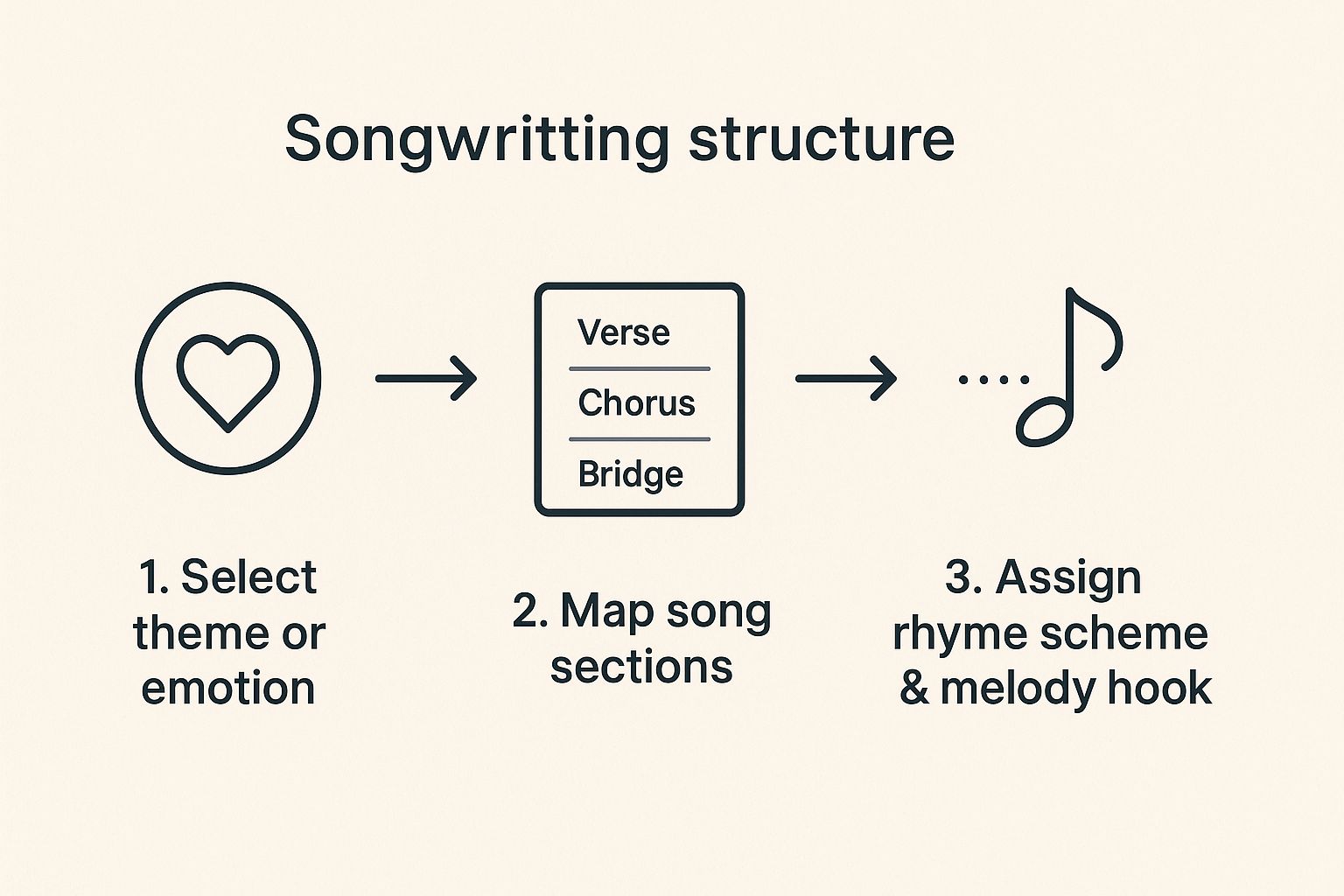
As you can see, everything flows from your core idea. Once you map out the sections, making decisions about rhymes and melodies becomes a whole lot easier.
To help you get a handle on this, here's a quick breakdown of what each part of a song is really for.
Essential Song Structure Components
Song Section | Primary Purpose | Lyric Studio Tip |
|---|---|---|
Verse | Tells the story; provides details, context, and moves the narrative forward. | Use AI-driven suggestions to find different ways to describe a scene or feeling in your verses. |
Pre-Chorus | Builds tension and anticipation leading into the chorus. | Keep it short and focused. Its main job is to set up the chorus, not be the star. |
Chorus | Delivers the central theme or hook; the most memorable part of the song. | Your chorus should be simple and powerful. Test its strength by seeing if it stands alone. |
Bridge | Offers a shift in perspective, emotion, or music; provides a break. | Experiment with a different mood or point of view here to add depth to your story. |
Outro | Concludes the song; leaves a lasting impression on the listener. | Try fading out with a key lyrical phrase or instrumental hook to make it stick. |
Seeing it laid out like this really clarifies how each piece serves the whole. It's a proven roadmap for creating a song that feels complete.
You Don't Have to Start from a Blank Page
Let's be real—staring at an empty document trying to figure out where to even start can be paralyzing. Sometimes, you just want to get to the good part: writing the actual lyrics. This is where a creative assistant like Lyric Studio makes a huge difference.
A song's architecture is its emotional guide. Verses draw you in with details, the chorus anchors you with the main feeling, and the bridge gives you a new window to look through before bringing you home.
If you're stuck on the framework, check out the “Magic Draft” feature in Lyric Studio. You just plug in your genre and mood, and it instantly generates a first verse and chorus. This gives you a solid foundation to build on, so you can stop worrying about the architecture and start focusing your creative energy on telling your story.
Ready to build a song that connects? You can download Lyric Studio free on iOS. (Note that in-app purchases may apply.)
Crafting Verses and Choruses That Stick
Now that you have a map for your song, it’s time to start building the house. The verses and the chorus are the foundation—they work together to tell your story and create a hook that people can’t get out of their heads.
Think of your verses as the storytelling engine. They're where you paint the picture, dropping in the vivid details and imagery that pull the listener right into your world. The real magic isn't just telling someone you were sad; it's showing them the "rain blurring the streetlights" or the "cold coffee sitting on the table." Those specific, sensory details are what make a song feel real. Each verse should build on the one before it, adding a new layer to the story and setting the stage for the big emotional release in the chorus.
Building an Unforgettable Chorus
If the verses are the story, the chorus is the headline. It's the heart of your song, the emotional core, and the part you want everyone to be singing long after the music stops. Unlike the verses, the chorus doesn't need to push the plot forward. Its job is to hammer home the central message with punch and clarity.
So, what makes a chorus stick? It usually comes down to a few key things:
A killer melodic hook: The tune itself should be catchy and something people can easily sing along to.
Simple, powerful words: Go for language that hits hard and connects emotionally without being overly complicated.
Smart repetition: Repeating the title or a key phrase is what makes a chorus so memorable.
A great chorus today does more than just sound good. In an age where people search for lyrics online, crafting a chorus with a distinct, searchable phrase can make it easier for fans to find your music. This might seem small, but it can actually impact your visibility.
Your verse is the story you're telling. Your chorus is the reason you're telling it. Make the story compelling and the reason unforgettable.
Finding the Perfect Words
Choosing the right words is what separates a decent lyric from a truly great one. Sometimes, a single word can pivot the entire feeling of a line. This is where getting a little creative help can push you past the first idea that comes to mind and into something truly original.
This is exactly what Lyric Studio was built for. Its AI-driven, context-aware lyric suggestions are designed to adapt to your song's specific theme, emotion, and genre. Whether you're working on a gritty hip-hop track or a smooth R&B ballad, the suggestions feel like they belong in your song.
The integrated rhyme and thesaurus tools are also a lifesaver. Instead of just getting a list of generic rhymes, you get options that actually make sense for the story you're telling. Every line should serve the song, and these tools help you refine your word choice without ever leaving your creative zone. We dive deeper into this process in our guide on how to write a chorus that resonates.
Stop wrestling with clunky rhymes and start crafting verses that truly connect. Download Lyric Studio free on iOS. (Note that in-app purchases may apply.)
Using Rhyme and Rhythm to Create Flow
Before you even think about a melody, rhyme and rhythm are what make your lyrics sing. They’re the secret sauce, the invisible current that pulls a listener through your song. A solid rhythmic structure gives your words momentum and a sense of satisfying predictability that just feels right.
Ever written something that looks great on paper but sounds clumsy when you sing it? That’s usually a rhythm problem. It’s not just about making words at the end of lines sound alike. The best songwriters use the natural pulse of language to build and release tension, matching the song's emotional core. A good first step? Read your lyrics out loud. Seriously. Can you feel a beat? Or are you tripping over your own words?
Moving Beyond Basic Rhymes
We all start with the classic AABB scheme—think cat/hat, sun/fun. It’s simple and effective, but lean on it too much, and your lyrics can start to sound a little too much like a children's book. If you want your writing to feel more mature and conversational, it’s time to expand your toolkit.
Here are a couple of techniques to try:
Internal Rhymes: This is a fantastic way to add texture. Instead of just rhyming at the end of a line, you drop a rhyme right in the middle. Something like, "The city lights burn so bright tonight." It adds a subtle musicality that makes your lines pop.
Slant Rhymes: Also known as near rhymes, these are words that are close but not a perfect match, like "shape" and "late." They give you that rhyming feeling without sounding forced or cheesy, which is perfect when you’re writing about something a little more serious.
Getting the hang of these takes some practice, but they are absolutely essential for elevating your lyrics. If you want to dive deeper, we have a whole guide on what a rhyme scheme is and how to use it.
Rhyme should be a tool that serves the story, not a rule that traps it. The best rhymes feel discovered, not constructed, adding to the emotion without drawing attention to themselves.
Finding the Perfect Rhyme Without Losing Your Flow
You know the feeling. You're deep in the zone, the words are flowing, and then... you hit a wall. You need a word that rhymes with "ocean," but everything you find in a rhyming dictionary feels clunky and pulls the song completely off course. It’s a surefire way to kill your creative vibe.
This is exactly where Lyric Studio can make a huge difference. The app's tools don't just spit out a generic list of words. The integrated rhyme and thesaurus tools give you context-aware suggestions that actually make sense for the story you're trying to tell. It helps you uncover that perfect internal or slant rhyme that enhances your idea instead of hijacking it.
It lets you stay in that creative headspace while a smart assistant handles the heavy lifting. Ready to write lyrics that feel effortless? Download Lyric Studio free on iOS and see how simple it can be to give your songs that professional polish. (Please note, in-app purchases may apply.)
Polishing Your Lyrics Until They Shine
Your first draft is never the final one. Think of it as the raw clay—the real art happens when you start sculpting. This is where you'll spend your time refining those initial, raw ideas into lyrics that really land with a punch, lyrics that are clear, powerful, and stick in someone's head long after the song is over. It's the revision process that turns a decent song into a great one.
The best way to start? Walk away. Seriously. After you’ve poured everything onto the page, give yourself a day or two. When you come back, you'll see it with fresh eyes, and all the awkward phrases, clunky rhythms, and tired clichés will jump right out at you. Then, read your lyrics out loud. This is a non-negotiable step. You’ll instantly hear which lines flow beautifully and which ones trip over themselves.
A Practical Checklist for Editing
Once you've got that first draft down, it's time to learn how to edit writing like a pro. The idea isn't to kill your original spark but to fan it into a flame.
Here’s a simple checklist I run through when I'm in the editing trenches:
Cliché Hunt: Are you leaning on old standbys like "a heart of stone" or "blinding light"? Push yourself to find a fresh, unexpected way to say it. What does your version of that feeling sound like?
Point of View Check: Is the song's perspective solid? If you start with "I," it's usually best to stay there unless you're making a deliberate creative choice to shift. A wandering POV can confuse the listener.
Verb Power-Up: Look for weak or passive verbs and swap them for something with energy. Instead of "the street was dark," you could try something like "shadows swallowed the street." See the difference?
Word Economy: Does every single word pull its weight? Can you replace a generic word with one that's more specific and paints a clearer picture?
Getting Past Creative Roadblocks
Even when you're revising, it’s completely normal to get stuck. You might know a line feels off, but the right words just won't come to you. Don't sweat it—this is part of the grind, not a sign you're failing.
Your first draft is about getting the story down. Your revisions are about making sure the story is worth listening to. Don’t be afraid to cut what doesn't serve the song.
When you feel that creative well running dry, a tool like Lyric Studio can be a lifesaver. It’s not there to write for you, but to act as a creative assistant when you need it. The AI-driven, context-aware lyric suggestions can help you explore different ways to phrase a tricky line or find a better word.

Sometimes, just seeing a few new options from its rhyme and thesaurus tools is all it takes to break through a block and get your momentum back.
At the end of the day, great songs are the foundation of the music industry. Polishing your lyrics is what gives your work the best possible chance to connect with people. If you're ready to make your lyrics truly shine, download Lyric Studio free on iOS. You'll get the tools you need to revise like a pro. (Just a heads-up, there might be in-app purchases).
Common Questions About Writing Song Lyrics
As you dive into songwriting, a ton of questions will pop up. It’s completely normal. The journey of turning ideas into a finished song can feel a little tangled at first, so let's walk through some of the most common things songwriters ask.
What's More Important: Lyrics or Melody?
Ah, the classic chicken-or-the-egg debate of songwriting. The honest answer? They’re a team. One isn't more important than the other because they work together to create an emotional gut punch. A fantastic melody can make simple lyrics soar, and powerful words can give a good melody unforgettable meaning.
The goal is to find that sweet spot where the music and the lyrics feel like they were born together. Don't get hung up on which to start with. Just follow your inspiration. Sometimes a line will pop into your head and bring a melody with it; other times, you’ll be messing around with a few chords, and a story will start to form.
How Long Should It Take to Write a Song?
There's no stopwatch in songwriting. Some legendary hits were famously scribbled down in less than an hour, while other masterpieces took years of tweaking and rewriting. The real goal isn't speed—it's connection.
Instead of rushing, focus on getting your core idea across in a way that feels true. And when you inevitably get stuck (we all do), tools like Lyric Studio can give you a nudge. Its “Magic Draft” feature is great for those moments when you’re staring at a blank page; it can spin up a first verse and chorus to get the ball rolling, helping you jump-start the songwriting process.
Can I Write Lyrics if I Don't Play an Instrument?
Absolutely. You don't need to be a guitar wizard or a piano virtuoso to be a great lyricist. Songwriting is a distinct craft, and many of the most successful writers in the industry are wordsmiths who partner with musicians and producers to create the final track.
Think of your lyrics as a form of poetry. Focus on the story, the rhythm of the words, and the imagery. A powerful lyrical concept is a huge asset, and you can always find a collaborator to help build the music around it later.
How Do I Know if My Lyrics Are Any Good?
"Good" lyrics do their job—they tell a story, paint a picture, or make you feel something. They usually have a natural flow and stick in your head. One of the best gut checks is simply to read your lyrics out loud.
Ask yourself:
Does it sound natural when I say it?
Is the main idea clear and easy to grasp?
Does it land emotionally?
Another pro tip is to get some outside perspective. Share your work with a trusted friend or join a songwriting group. Fresh ears can often catch clunky phrases or confusing lines you’ve become blind to after reading them a hundred times.
How Do Songwriters Actually Get Paid?
It’s crucial to understand the business side of things, not just the creative part. Most songwriters don't sell their songs for a one-time fee; they earn royalties. This is income generated whenever their song is played publicly, sold, or streamed. A big chunk of this comes from mechanical royalties, paid out each time a song is reproduced. It's a complex topic, but understanding the basics is key to building a career.
Writing songs is an art, but it's also a craft. The more you practice, the more you read, and the more you listen, the sharper your instincts will become.
At the end of the day, the only real way to get better is to keep writing. Don't be afraid to experiment, tell your stories, and trust that you'll refine your process with every song you finish.
Ready to get a creative boost on your next song? Lyric Studio is like having a co-writer on call, offering AI-driven, context-aware lyric suggestions and integrated rhyme and thesaurus tools to help you turn that spark of an idea into a finished lyric. Download Lyric Studio free on iOS. (Note that in-app purchases may apply.)

SCAN TO GET