Back to articles
Song Structure Rap Your Guide to Building Hits
At its most basic, song structure in rap is the framework you use to build a track. It’s the blueprint that lays out where the verses, hook, and bridge go, guiding the listener through your story from the opening beat to the final fade-out.
Why Rap Song Structure Matters
Think of a rap song's structure as the skeleton holding everything together. Without a solid frame, even the most brilliant lyrics and hardest-hitting beats can feel like a jumbled mess. A good structure creates a journey for the listener, making your message land harder and giving your track that unforgettable quality that makes people hit repeat.
This isn't just a random arrangement; it's a proven formula with deep roots. Most rap songs are built on a foundation of "bars" — musical measures — that serve specific purposes. A classic setup might use 8 or 16-bar verses for storytelling, broken up by an incredibly catchy chorus (or hook) that drills the main idea into your head. You can dive deeper into the history of this musical structure to see how it evolved.
This is what that flow typically looks like, showing how all the pieces connect to create a whole song.
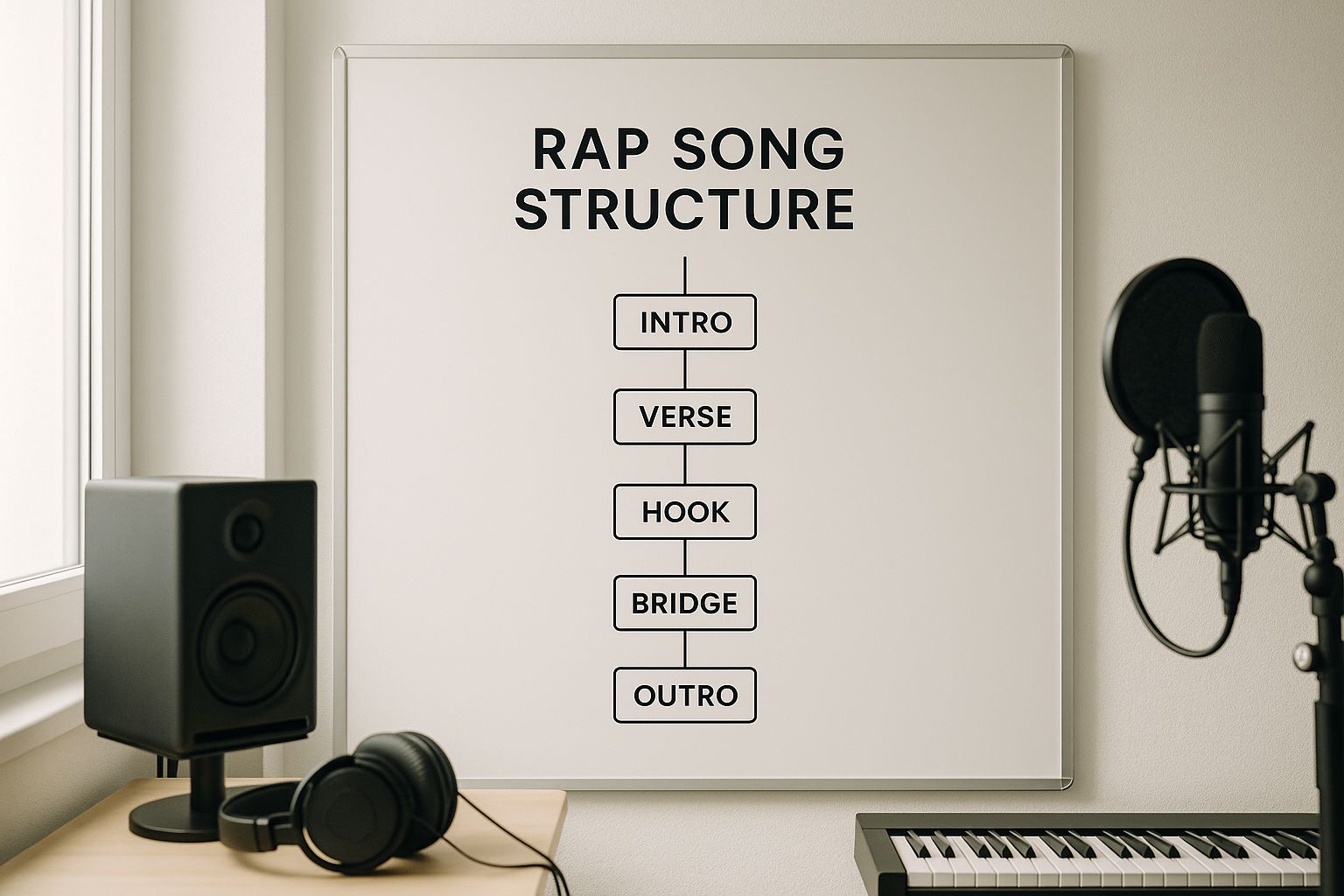
As you can see, there's a logical progression that builds momentum through the verses and offers a satisfying payoff with the hook.
Core Components of a Rap Song
Every great rap track is built from a few key pieces, and each one has a specific job to do. To help you get a quick handle on these elements, here's a quick-reference table.
Core Components of Rap Song Structure
Song Section | Primary Purpose | Typical Length (Bars) |
|---|---|---|
Intro | Sets the tone and grabs the listener's attention right away. | 4-8 |
Verse | The main storytelling section where you flex your lyrical muscle. | 8-16 |
Hook/Chorus | The catchy, repeatable part that drives home the song's main idea. | 4-8 |
Bridge | A change of pace that offers a new perspective or sound. | 4-8 |
Outro | The conclusion that wraps things up or fades the track out. | 4-8 |
Getting these parts to flow together is the art of songwriting. Here's a breakdown of what each one brings to the table:
Intro: This is your first impression. It sets the mood and hooks the listener from the jump.
Verse: This is where you tell your story, lay out your arguments, and show off your lyrical skills.
Hook/Chorus: This is the heart of the song—the part everyone sings along to. It’s got to be memorable.
Bridge: The bridge breaks up the pattern, offering a fresh perspective or a different musical feel before heading back to the final hook.
Outro: This is how you close the show, whether it's with a final thought, a beat that fades out, or a powerful last line.
Struggling to get that first draft on paper? The “Magic Draft” feature in Lyric Studio can be a lifesaver. It instantly generates a first verse-and-chorus to jump-start your songwriting and help you break through writer's block.
Ready to start building your next track? Download Lyric Studio free on iOS and get your ideas structured. Please note that the app is free to download, but in-app purchases may apply.
Crafting Verses That Tell Your Story
So, you've got a killer hook that grabs everyone's attention. Fantastic. But if the hook is the headline, your verses are the actual story. This is your chance to really connect, to show off your lyrical chops, and give that catchy chorus some real weight. A great verse doesn't just fill space; it pulls the listener right into your world.
Think of it like this: each verse is a chapter in a short story. Your first verse needs to set the scene. What's the vibe? Who are we talking about? What's the core idea? From there, your next verses need to build on that foundation, adding new details, raising the stakes, or maybe just flipping the perspective. This progression is what keeps people locked in, eager to hear what you'll say next.
Building Your Narrative Bar by Bar
The backbone of any strong verse is simple: it tells a story or makes a point that sticks. This isn't just about stringing rhyming words together; it’s about making every single line earn its place. Your job is to lead the listener on a journey, building up a wave of momentum that crashes perfectly into the hook.
A few tricks of the trade can make your storytelling pop:
Show, Don't Tell: This is a classic for a reason. Instead of saying you were angry, describe the clenched fists and the heat rising in your chest. Paint a picture with sensory details so the listener feels it with you.
Establish a Perspective: Are you speaking as yourself, or are you taking on a character? Sticking to a consistent voice makes your story far more believable and immersive.
Vary Your Pacing: You control the energy. Speed up your delivery and use more complex lines to create excitement, or slow things down to build tension and let a heavy-hitting line really land.
Rhyme Schemes and Flow
Okay, so you've got a story. Now, let's talk about the technical skill that separates the good from the great. This is where your rhyme schemes and flow come into play. A simple AABB rhyme scheme is fine—it gets the job done. But when you start playing with more intricate patterns like internal rhymes or landing complex multisyllabic rhymes, your verses instantly sound more professional and dynamic.
Your flow is the rhythm and personality of your delivery. It's how your words dance with the beat. A dope flow is just as crucial as the lyrics themselves; it's what gives the verse its entire mood and energy.
Ever get stuck looking for that perfect word or a rhyme that doesn't sound forced? Lyric Studio can be a game-changer here. It offers AI-driven, context-aware lyric suggestions that adapt to your song's theme and emotion. With its integrated rhyme and thesaurus tools, you can tighten up your word choice and build slick rhyme schemes without killing your creative momentum.
Ready to make your story hit harder? Download Lyric Studio free on iOS and see how its creative assistant can help you craft unforgettable verses. Please note that in-app purchases may apply.
Writing a Hook That Captures Attention
If your verses tell the story, the hook is the explosive headline that grabs everyone's attention. A truly great hook is the heart and soul of a hit song—it's that magnetic, unforgettable part that people just can't shake. This piece of your song structure rap needs to be simple, repetitive, and insanely catchy.
Think of it like the song's main takeaway. It’s where you boil down your core message, feeling, or idea into a few powerful bars that burrow into the listener's brain. While the verses lay out all the details, the hook is the massive payoff. It’s the part everyone is waiting for and the first thing they'll sing along to.
The Anatomy of an Unforgettable Hook
So, what’s the secret sauce that makes a hook stick? It’s usually a powerful mix of simple lyrics and a rhythm that just hits right. Forget the intricate wordplay of your verses for a moment; a killer hook is all about being direct and memorable from the very first listen. You're aiming for instant impact.
Most legendary hooks share a few key ingredients:
Repetition: Drilling a key phrase or melody into the listener's ear is the quickest path to making it memorable. It gives them an anchor to hold onto.
Simplicity: Hooks almost always use simpler words and rhyme schemes than the verses. This makes them easy for anyone to catch on to and chant back.
Strong Rhythm: The cadence and flow of a hook have to be infectious. A lot of the time, the rhythm becomes just as iconic as the lyrics themselves.
The best hooks are born from a single, powerful idea. They manage to bottle up the entire song's vibe into one concise, repeatable package, making it the most recognizable part of your track.
Kickstarting Your Chorus Creation
We've all been there—staring at a blank page, trying to pull that perfect hook out of thin air. It can feel like hitting a wall. But sometimes, all it takes is a single spark to get the whole song moving.
That's where having the right tools can be a game-changer. Just getting a rough idea on the page can unlock everything else. For instance, if you're struggling to find that initial spark, Lyric Studio's “Magic Draft” feature can generate a full first verse-and-chorus based on your topic. It gives you a solid foundation to tweak, build on, or just use as a jumping-off point to find your own flow. For a deeper dive, check out our guide on how to write a chorus.
Ready to build a hook that no one can forget? Download Lyric Studio free on iOS and start playing with its genre and mood customization to craft the perfect chorus for your next banger. Please note that the app is free to download, but in-app purchases may apply.
Using Bridges to Build Musical Tension
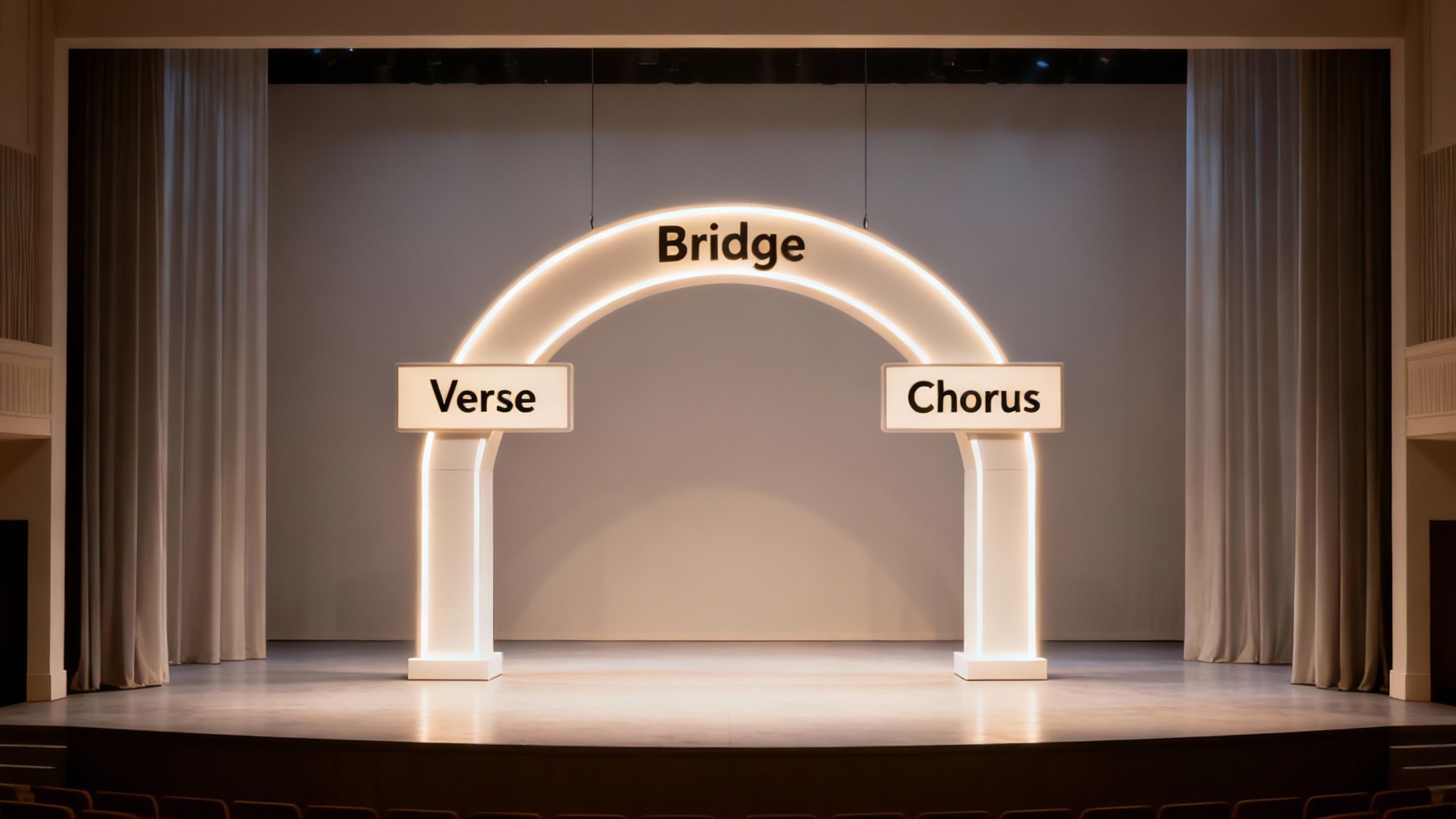
Sure, powerful verses and a killer hook are the meat and potatoes of any great rap song. But the transitional sections? That's what separates a good track from an unforgettable one. The bridge and the pre-chorus are your secret weapons for breaking up repetition and building a palpable sense of anticipation.
Think of it like a highway. Your verses and hooks are the main road, the part everyone knows. The bridge is the scenic overlook—a moment to pull over, change the pace, see things from a different angle, and maybe even introduce a new melody before getting back on the main path. That little detour makes hitting that final hook feel so much bigger.
The Power of the Pre-Chorus
The pre-chorus is the on-ramp that launches the listener straight into the hook. Its whole job is to build up energy and let everyone know the song's biggest moment is just seconds away.
A well-written pre-chorus creates a feeling of rising action, maybe with a melody that climbs or a drum pattern that gets a little more intense. This makes the drop into the chorus feel like a huge, satisfying release. Without it, jumping from a verse right into a hook can sometimes feel a bit sudden.
What Makes a Bridge Work
The bridge is where you get to throw a curveball and really surprise your audience. It’s a complete departure from the verse-hook-verse pattern, usually showing up after the second chorus. This is your chance to switch up the lyrical theme, introduce a new melody, or even strip the beat back to something completely different.
A great bridge is all about contrast. It shatters the pattern you've established, giving the listener's ear something fresh before snapping back into that final, triumphant chorus. That contrast is what makes a song feel dynamic and keeps it from getting predictable.
For those who really want to push the envelope, you can even play with the bar counts within these sections. Rap structures often follow a predictable length, but some of the best artists bend those rules to create unique rhythmic tension. You can learn more about these advanced metrical techniques on mtosmt.org.
Getting these transitions right is the key to taking your listener on a complete musical journey. If you want to dive deeper, check out our guide on how to write a bridge.
How Lyrical Complexity in Rap Has Evolved
A killer track is more than just a well-arranged puzzle of verses and hooks. The real magic is in the lyrical depth you weave into those bars. Over the years, rap has morphed from simple, catchy rhymes into a full-blown display of lyrical gymnastics, with pioneers constantly raising the bar for wordplay and flow.
Back in the day, early hip-hop was all about straightforward, end-rhyme patterns. Think about the party-rocking vibe where the genre first blew up—the rhymes were easy to catch, the focus was on the rhythm, and the stories were direct. But it didn't take long for artists to realize the mic could be a tool for something much more intricate.
The Rise of Multisyllabic Rhymes
Everything changed when MCs started looking beyond simple, one-syllable rhymes. Suddenly, artists were lacing their tracks with multisyllabic rhymes—matching up multiple syllables across different words. Think "lyrical miracle" or "lyrical spiritual." This wasn't just a small tweak; it was a quantum leap in technical skill that opened up a universe of creative and unexpected word combinations.
And this isn't just a feeling, it's a fact backed by data. A deep dive into rap songs from 1978 to 2012 showed a clear trend: both the percentage of multisyllabic words and the average syllables per word went up steadily. Legends like Nas and Talib Kweli were packing way more lyrical density into their lines than the early groups, proving that the game was now all about verbal acrobatics. If you're a data nerd, you can dig into these fascinating findings on rap analysis for yourself.
Mastering Your Own Lyrical Complexity
So, what does this history lesson mean for you? It’s a challenge to get experimental with your own writing. A solid structure is your skeleton, but compelling lyrics are the heart and soul that make a song truly connect. Start playing with internal rhymes, assonance, and more complex rhyme schemes to take your verses from basic to breathtaking.
The real art is making complex lyrics sound effortless. The best rappers can deliver intricate, multisyllabic patterns that flow so smoothly with the beat you might not even notice the technical skill on the first listen.
This is where having the right tools in your corner can make a huge difference. Lyric Studio comes with integrated rhyme and thesaurus tools that help you find those next-level word choices without ever losing your creative rhythm. Its AI-driven, context-aware lyric suggestions actually learn your song's vibe, feeding you perfect, intricate rhymes that will make your lyrics pop.
Ready to level up your wordplay and push your own lyrical boundaries? Download Lyric Studio free on iOS and start building more complex, unforgettable bars today. Please note that while the app is free to download, in-app purchases may apply.
Putting It All Together: The Art of Song Structure
You can have the hardest verses and the catchiest hook, but the real magic is in how they all fit together. A truly great track flows like one continuous story, not just a bunch of cool parts stitched together. Learning how to weave your intro, verses, and outro into a single, unified piece is the final piece of the song structure rap puzzle.
Think of the transitions as the glue. If you jump from a verse to a hook too abruptly, it can feel jarring and pull the listener right out of the vibe you've created. Smooth, deliberate transitions, on the other hand, keep them locked in and guide them through your song effortlessly. The goal is to make the jump from one section to the next feel completely natural, almost invisible.
Making Your Transitions Seamless
So, how do you bridge those gaps? There are a few classic techniques artists use to move between sections, each with its own feel. Some build hype, others create a moment of calm, and some just signal that a change is coming.
Here are a few popular ways to do it:
Instrumental Breaks: Let the beat breathe for a moment. A short, lyric-free instrumental can be the perfect way to reset the energy before launching into the next verse or hook.
Beat Drops and Switch-Ups: This is a classic for a reason. Suddenly changing the drum pattern or completely dropping the bass for a beat or two builds massive anticipation right before a chorus smashes back in. For more on this, our guide to beat making for beginners is a great resource.
Ad-Libs and Vocal Effects: Sometimes, all you need is a signature sound. A well-placed ad-lib ("Yeah!") or a simple vocal echo can be a clear signpost for the listener that a new section is about to begin.
The real skill is keeping the energy consistent across the whole track while letting each section do its job. Every transition needs to feel like it's there for a reason, pushing the song forward and adding to its impact.
When you get these connections right, your song completely transforms. It stops being just a song and becomes an experience—one that keeps your audience hooked from the first beat to the very last fade-out. To get started, you can even use Lyric Studio’s genre & mood customization to find a sound that helps tie all your parts together.
Ready to build your next hit from the ground up? Download Lyric Studio free on iOS and let its AI-powered creative assistant help you structure your masterpiece. Please note that the app is free to download, but in-app purchases may apply.
Got Questions About Rap Song Structure?
Diving into song structure rap can feel like learning a new language. You've probably heard about the classic verse-hook-verse blueprint, but that's just the starting point. It’s totally normal to wonder about the nitty-gritty details, like how long a verse really needs to be or if it's okay to just throw the rules out the window.
Think of it this way: mastering the fundamentals gives you a solid foundation to build on. But the real magic happens when you learn how to twist and adapt those rules to create something that’s uniquely you. Let’s tackle some of the most common questions that come up when artists are mapping out their tracks.
How Many Bars Should My Verse and Hook Be?
This is easily the question I hear the most, and for good reason. Timing is everything. While there are no hard-and-fast laws here, there are definitely some industry standards that just feel right to the listener's ear.
Verses: A standard rap verse is almost always 16 bars. That’s the sweet spot—it gives you enough room to tell a story, drop some complex rhymes, and really get your point across without boring your audience. For a more aggressive, in-your-face track, a shorter 8-bar verse can hit like a punch.
Hooks: Your hook needs to be catchy and stick in people's heads, so it's usually shorter. An 8-bar hook is the gold standard. It’s long enough to be memorable but short enough that people won't get tired of hearing it. If you've got a killer one-liner, sometimes a super tight 4-bar hook is all you need to get the job done.
Is It Okay to Break the Traditional Structure?
One hundred percent. The verse-hook formula is a proven guideline, not a prison. Honestly, some of the most legendary hip-hop tracks became classics because they broke the mold. Some songs have no hook at all, letting the raw lyricism carry the whole thing. Others use long, cinematic intros or outros to set a specific vibe.
The trick to breaking the rules is to do it with a clear purpose. Don't just be different for the sake of being different. Make sure every structural choice you make—like adding a surprise verse at the end—serves the story or the feeling you want the song to have.
Playing with the structure is how you discover your own unique sound. Go ahead and try adding a second bridge. Or maybe put a verse after the final chorus to leave your listener thinking. At the end of the day, the structure is just a tool to help you tell your story more effectively.
Ready to start piecing together your next masterpiece? Lyric Studio can help you polish every part of your song with AI-powered suggestions that actually make sense for your style. Download Lyric Studio for free on iOS and get building. Please note that the app is free to download, but in-app purchases may apply.

SCAN TO GET