Back to articles
6 Slant Rhyme Example Types to Elevate Your Songwriting

If you’ve ever felt trapped by a rhyme, forcing a lyric that sounds cheesy or unnatural just to make a perfect match, you're not alone. Relying only on exact rhymes like "cat" and "hat" can make your songwriting predictable and limit your creative expression. This is where the power of near rhymes, or slant rhymes, comes in. They open up a world of sophisticated and emotionally resonant word choices that perfect rhymes often block.
This article provides a deep dive into different types of slant rhyme, showcasing them with clear examples from poetry and modern music. We'll break down not just what a slant rhyme example is, but how and why it works so effectively. You'll learn to identify and use techniques like consonance, assonance, and pararhyme to add texture and depth to your own work. The goal is to give you a practical toolkit for crafting more memorable and authentic lyrics.
When you need a creative partner to find that perfect near rhyme, Lyric Studio can help. Its AI-driven, context-aware lyric suggestions and integrated rhyme tools are designed to expand your vocabulary and help you discover unique word pairings you might have missed. Ready to move beyond basic rhymes? Download Lyric Studio free on iOS and start writing more compelling lyrics today. (Note: in-app purchases may apply).
1. Eye Rhyme
Kicking off our list is a unique and intellectually stimulating type of slant rhyme: the eye rhyme. Also known as a visual rhyme, this technique creates a connection that is seen rather than heard. It occurs when two words are spelled similarly, suggesting they should rhyme, but are pronounced differently. This clever device plays with a reader's expectations, creating a subtle, almost subconscious, disruption.
An eye rhyme is a powerful tool because it operates on a different sensory level than traditional rhyme. While perfect rhymes please the ear, eye rhymes engage the mind, forcing a moment of cognitive dissonance that can add depth and texture to your lyrics or poetry.
How Eye Rhyme Works: A Strategic Breakdown
The effectiveness of an eye rhyme lies in the gap between visual expectation and auditory reality. This creates a small but significant moment of surprise or tension for the listener or reader.
Visual Similarity: Words like 'love' and 'move' share the same 'ove' ending, making them look like a perfect pair on the page.
Phonetic Dissimilarity: When spoken aloud, the illusion breaks. 'Love' (/lʌv/) and 'move' (/muːv/) have completely different vowel sounds. This contrast is the core of the technique.
Thematic Reinforcement: This disconnect can be used strategically. For example, pairing 'laughter' and 'slaughter' creates a chilling effect, where the visual similarity makes the phonetic and thematic contrast even more jarring.
This concept map breaks down the core components of how an eye rhyme creates its unique effect on an audience.
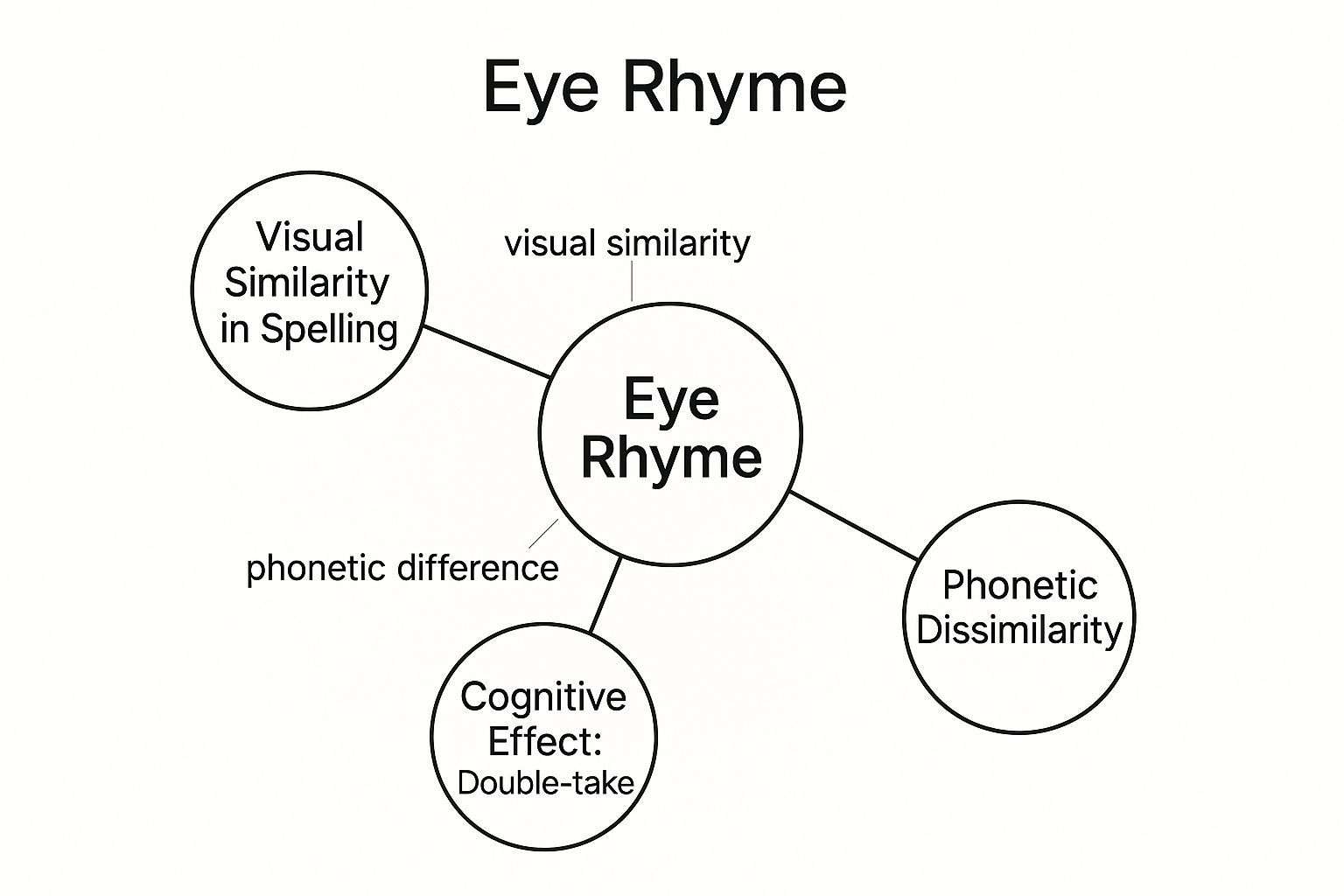
The infographic illustrates that an eye rhyme's power comes from uniting similar spellings with dissimilar sounds, prompting a cognitive "double-take" from the reader.
Actionable Takeaways for Your Songwriting
While less common in modern pop and hip-hop, using an eye rhyme can make your lyrics stand out. It shows a command of language that can add a classic or literary feel to your work.
Strategic Insight: Use eye rhymes at the end of a verse to create a feeling of unease or unresolved tension. The listener expects a satisfying sound, but the near-miss leaves them hanging, making the next line even more impactful.
To master this, you need a strong vocabulary and a creative assistant that can help you see these visual connections. The integrated rhyme and thesaurus tools within Lyric Studio can help you spot words with similar spellings but different sounds, giving you the building blocks for this sophisticated technique. Explore different word endings to uncover these hidden pairings and add a new layer of complexity to your songwriting.
Ready to experiment with advanced lyrical devices? Download Lyric Studio free on iOS and use its AI-driven suggestions to find the perfect eye rhyme for your next track.
2. Consonance
Next, we delve into one of the most foundational and versatile types of slant rhyme: consonance. This technique creates a near rhyme by repeating similar consonant sounds in words, particularly at the end, while their vowel sounds differ. It's a subtle but powerful way to create sonic cohesion and rhythm, providing a pleasing echo that is less direct and predictable than a perfect rhyme.
Unlike eye rhyme, which plays with visual expectation, consonance is purely auditory. It's a workhorse of poetry and songwriting, popularized by masters like Emily Dickinson and Dylan Thomas. The effect is a satisfying, crunchy texture that ties lines together without sounding forced or simplistic, making it a perfect slant rhyme example for modern lyricists.
How Consonance Works: A Strategic Breakdown
Consonance creates its effect by building a pattern of familiar sounds, which adds a layer of musicality to the language. This subtle repetition creates harmony and reinforces the rhythmic structure of a line or verse.
Shared Consonants: The core of the technique is the repetition of consonant sounds. In the pair ‘milk’ and ‘walk,’ the final ‘k’ sound creates the link.
Vowel Dissimilarity: The vowel sounds are intentionally different. The short 'i' in 'milk' (/ɪ/) contrasts with the 'aw' sound in 'walk' (/ɔː/), preventing a perfect rhyme and creating a more complex auditory experience.
Rhythmic Connection: This shared consonant sound, especially at the end of words, creates a percussive beat. Pairs like 'pitter' and 'patter' use the 't' and 'r' sounds to build a rhythmic and thematic connection that mimics the sound of rain.
This blueprint shows how consonance forges a link through sound rather than meaning or spelling, giving your lyrics a cohesive and polished feel.
Actionable Takeaways for Your Songwriting
Consonance is a fantastic tool for making your lyrics sound more sophisticated and intentional. It's especially effective in genres like hip-hop and R&B, where complex rhythmic and phonetic interplay is highly valued. It allows for more freedom in word choice than perfect rhyme.
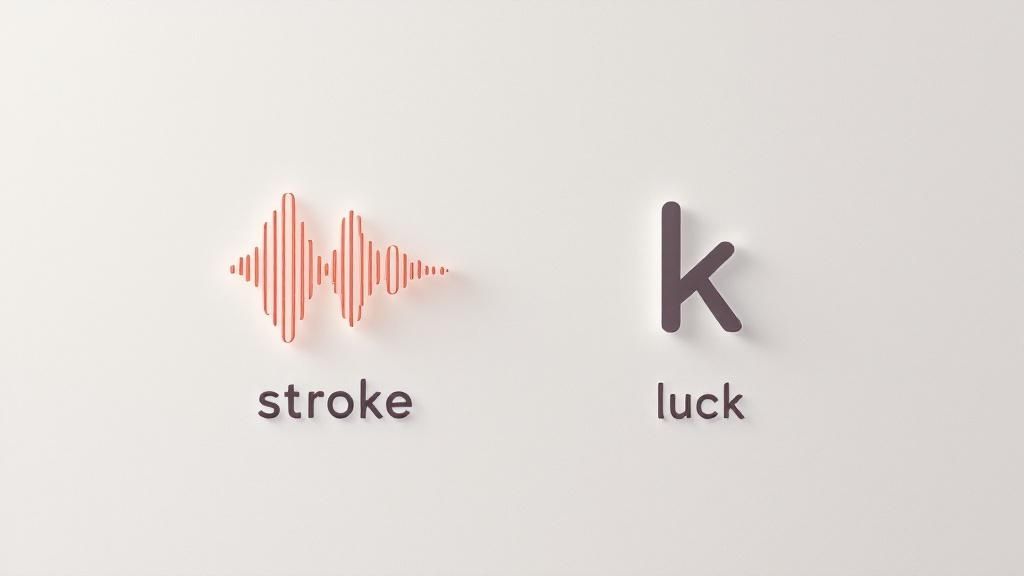
Strategic Insight: Use consonance to link words within a single line (internal rhyme) or at the end of consecutive lines. For instance, pairing 'stroke' and 'luck' at the end of two lines creates a satisfying, near-miss closure that feels artful and deliberate, avoiding the nursery-rhyme feel of perfect rhymes.
To implement this, you need to think about the sounds of words, not just their meanings. The integrated rhyme tools in Lyric Studio are designed for this, helping you find words that share specific consonant sounds. You can use its genre and mood customization for hip-hop, pop, R&B, and more to discover pairings that perfectly fit your song's vibe.
Ready to add sonic texture to your lyrics? Download Lyric Studio free on iOS and use its AI-powered suggestions to weave intricate patterns of consonance into your next masterpiece.
3. Assonance
Next up is one of the most musical and versatile types of slant rhyme: assonance. This technique creates harmony by matching the vowel sounds in nearby words, even when the consonant sounds are different. Instead of a hard, perfect rhyme at the end of a line, assonance weaves a subtle sonic connection throughout a phrase, creating a smooth and cohesive feel. It's a foundational tool used by poets like Edgar Allan Poe and modern lyricists to control a song's emotional atmosphere.
Assonance operates on an auditory level, enhancing the musicality of language. While perfect rhymes provide a clear resolution, assonance offers a softer, more fluid connection that can link words across an entire line, not just at the end. This makes it an incredibly powerful slant rhyme example for shaping the mood and flow of your lyrics.
How Assonance Works: A Strategic Breakdown
The power of assonance comes from its ability to create internal harmony through repetition of vowel sounds. This repetition establishes a mood or tone through the inherent quality of the sounds themselves, whether they are long and mournful or short and sharp.
Vowel Sound Repetition: The core of the technique is repeating a specific vowel sound in words that are close to each other. For example, in the pair 'hear' and 'year,' the long 'e' sound (/ɪər/) is the common thread.
Consonant Dissimilarity: Unlike perfect rhymes, the consonants surrounding the repeated vowel sound do not need to match. Words like 'light' and 'fine' share the long 'i' sound (/aɪ/) but have completely different consonants.
Mood Creation: The choice of vowel sound directly impacts the listener's emotional response. Long, open vowels like the 'o' in 'home' and 'know' can create a somber, pensive, or flowing feeling. In contrast, short, punchy vowels can create a sense of urgency or energy.
This deliberate sound-painting allows you to guide the listener’s emotional journey with precision, making it a favorite tool of masterful storytellers in music and poetry.
Actionable Takeaways for Your Songwriting
Assonance is essential for adding a professional, polished quality to your lyrics. It makes your lines more satisfying to listen to and can subtly reinforce your song's central theme. It's a workhorse technique that can be used in any genre, from hip-hop to folk.
Strategic Insight: Combine assonance with alliteration (repeating consonant sounds) to create an even stronger phonetic punch. Pairing a repeated vowel sound with a repeated consonant sound creates a memorable and rhythmically compelling phrase that sticks in the listener's mind.
To master assonance, you need to think about lyrics sonically, not just semantically. The AI-driven tools in Lyric Studio are perfect for this. As you write, the app's context-aware lyric suggestions adapt to your theme and emotion, helping you spot opportunities for assonance you might have missed. Its integrated thesaurus and rhyme features allow you to explore options that fit both your meaning and your desired sound.
Ready to add a new layer of musicality to your lyrics? Download Lyric Studio free on iOS and use its context-aware suggestions to find the perfect assonant pairings for your next song.
4. Pararhyme
Next up is pararhyme, a sophisticated and structurally powerful type of slant rhyme. Often called consonantal rhyme, this technique creates a near rhyme by keeping the consonant sounds identical while changing the vowel sound in between. This device forges a strong, almost architectural connection between words, yet the differing vowels introduce a subtle discordance.
Pararhyme produces a haunting, often unsettling effect. Popularized by war poet Wilfred Owen, it mirrors a world where things are similar but fundamentally broken or mismatched. This makes it an incredibly effective tool for conveying complex emotions like tension, unease, or unresolved grief, making it a standout slant rhyme example for serious and impactful songwriting.
How Pararhyme Works: A Strategic Breakdown
The power of pararhyme comes from its strict consonant framework, which clashes with its vowel freedom. This creates a sound that is both familiar and strange, echoing themes of discord or inner conflict.
Consonant Framework: Words like 'hall' and 'hell' share the exact same starting ('h') and ending ('ll') consonant sounds. This creates a rigid phonetic skeleton.
Vowel Variation: The vowel sounds, however, are completely different. 'Hall' (/hɔːl/) uses a long 'aw' sound, while 'hell' (/hɛl/) uses a short 'e' sound. This contrast within a fixed structure is the core of the pararhyme.
Psychological Effect: The listener's ear recognizes the consonant pattern, anticipating a perfect rhyme. The unexpected vowel shift disrupts this expectation, creating a feeling that is incomplete or off-kilter, which can powerfully reinforce lyrical themes.
This method allows a writer to maintain a structured feel without the predictability of perfect rhyme, adding a layer of intellectual and emotional depth.
Actionable Takeaways for Your Songwriting
Pararhyme is perfect for lyrics that explore darker or more contemplative themes. It adds a literary weight and a sense of gravity that can make your words resonate on a deeper level.
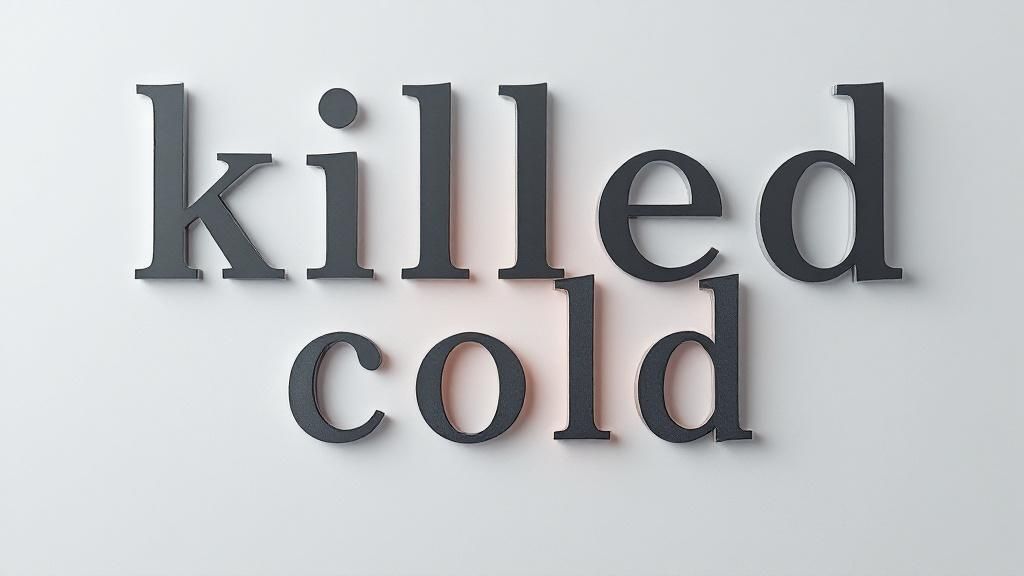
Strategic Insight: Use pararhyme to connect concepts that are related but tragically different. For instance, rhyming 'killed' with 'cold' links the act with its grim, unfeeling consequence. The consonant lock makes the connection undeniable, while the vowel shift highlights the emotional distance.
Mastering this requires a keen ear for phonetic detail. The AI-powered tools within Lyric Studio can help you pinpoint words that share consonant structures but have different vowel sounds. By using its mood and genre customization, you can discover powerful pararhymes like 'mystery' and 'mastery' that perfectly suit the tone of your song. When you need to jump-start your creativity, the "Magic Draft" feature can instantly generate a first verse-and-chorus to get you started.
Ready to build more complex and emotionally resonant lyrics? Download Lyric Studio free on iOS and use its integrated tools to find the perfect pararhyme to elevate your songwriting.
5. Forced Rhyme
Next on our list is perhaps the most audacious and playful type of slant rhyme: the forced rhyme. This technique occurs when a writer intentionally bends the rules of pronunciation, grammar, or word order to make a rhyme work. While it can be seen as a lyrical flaw in some contexts, when used with skill and a wink to the audience, it becomes a powerful comedic or attention-grabbing device.
A forced rhyme is a bold move because it breaks the fourth wall of songwriting. It signals to the listener that you're prioritizing a clever connection over linguistic purity. Masters of this form, like Eminem or the humorous poet Ogden Nash, use it to create unforgettable, often hilarious, moments that highlight their wit and command of language.
How Forced Rhyme Works: A Strategic Breakdown
The effectiveness of a forced rhyme hinges on its deliberate and often humorous artificiality. It’s a rhyme that tries so hard it becomes brilliant, drawing attention to the wordplay itself.
Phonetic Manipulation: This is the most common approach. It involves mispronouncing a word to fit the rhyme scheme. For instance, Eminem famously rhymed 'orange' with 'door-hinge' by slightly altering the pronunciation of both.
Syntactic Restructuring: This involves changing the natural order of words in a sentence to land a rhyming word at the end of a line. While sometimes clunky, it can be used for stylistic effect, giving a line a quirky, poetic feel.
Creative Compounding: This method, a favorite of Dr. Seuss, involves inventing words or smashing them together. Rhyming 'silver' might seem impossible, but a creative lyricist could contort a phrase like "will have her" into 'willver' to make the connection.
This slant rhyme example shows that by knowingly breaking the rules, you can create a unique and memorable effect that strengthens the listener's engagement with your lyrics.
Actionable Takeaways for Your Songwriting
Using a forced rhyme can inject a dose of personality and humor into your songs, but it must be done with intention. It works best when the listener understands that you know you're breaking a rule for a specific effect.
Strategic Insight: Reserve forced rhymes for moments of comedic relief or to emphasize a particularly clever or absurd point. Its jarring nature makes the line stand out, so use it to spotlight a key idea in your verse. When you make it clear the rhyme is intentional, it reads as cleverness, not a mistake.
Crafting these kinds of rhymes requires a flexible approach to language. The integrated thesaurus and genre customization in Lyric Studio can help you brainstorm unconventional pairings and see how far you can stretch a word's sound. By playing with AI-driven, context-aware suggestions, you can discover a new way to make that "un-rhymable" word finally fit, all while Lyric Studio acts as your creative assistant, not a replacement for your originality.
Ready to add some clever wordplay to your tracks? Download Lyric Studio free on iOS and use its smart tools to craft the perfect forced rhyme that will make your audience smile.
6. Identity Rhyme
Next up is an intellectually playful technique that pushes the boundaries of rhyme itself: the identity rhyme. This device occurs when a word rhymes with itself. While that might sound simplistic, its power lies in using the same word to convey different meanings or in leveraging homonyms, which are words that sound the same but are spelled differently and have distinct definitions. This creates a moment of clever wordplay that rewards close listeners.
Identity rhyme is a sharp tool for adding emphasis or introducing irony. It forces the audience to consider a word's multiple facets, adding layers of meaning that a simple perfect rhyme might miss. It’s a bold choice that signals a confident and thoughtful command of language.
How Identity Rhyme Works: A Strategic Breakdown
The effectiveness of an identity rhyme comes from its ability to use repetition not for simplicity, but for complexity. It leverages the listener's familiarity with a word to introduce a new perspective or a clever twist.
Exact Repetition for Emphasis: Repeating a word like 'time' in consecutive lines ("There is no time / to turn back time") can create a powerful, resonant effect, drilling a core theme into the listener's mind.
Homonymic Wordplay: This is where the technique truly shines. Using words like 'son' and 'sun' or 'right' and 'write' creates a sophisticated slant rhyme example. The sounds are identical, but the contrasting meanings create a rich, poetic link that deepens the narrative.
Contextual Shift: An identity rhyme can also work by using the exact same word but shifting its contextual meaning. For instance, pairing 'fair' (meaning beautiful) with 'fair' (meaning just) prompts the listener to connect these two distinct concepts.
This technique uses sameness in sound to highlight differences in meaning, creating a satisfying intellectual puzzle for the audience.
Actionable Takeaways for Your Songwriting
While seemingly simple, identity rhymes are a mark of lyrical sophistication often found in the works of masters like Shakespeare and modern lyrical wordsmiths. Using them can add a classic, literary depth to your songs and make a specific line unforgettable.
Strategic Insight: Use a homonymic identity rhyme to bridge two different ideas in a chorus. For example, pairing 'reign' and 'rain' can create a powerful metaphor about power and sorrow. This wordplay makes your hook smarter and more memorable.
To master this, you need to think beyond just sound. The integrated thesaurus in Lyric Studio is perfect for this, as it helps you explore word families and uncover homonyms you might not have considered. Use the AI suggestions to see how a single word can be used in different contexts, unlocking new avenues for your lyrical storytelling.
Ready to add some clever wordplay to your music? Download Lyric Studio free on iOS and use its AI-powered tools to discover compelling identity rhymes that will make your lyrics stand out.
Slant Rhyme Types Comparison
Rhyme Type | Implementation Complexity 🔄 | Resource Requirements 💡 | Expected Outcomes 📊 | Ideal Use Cases 💡 | Key Advantages ⭐ |
|---|---|---|---|---|---|
Eye Rhyme | Medium: Requires balancing spelling and pronunciation differences | Moderate: Need understanding of archaic or variant pronunciations | Creates visual appeal and cognitive dissonance | Written poetry with subtle tension or surprise | Adds visual interest, expands word choice |
Consonance | Low to Medium: Focus on matching consonant sounds, flexible | Low: Mainly auditory sensitivity and practice | Produces subtle harmonic sound texture | Poetry, rap, and lyrics needing natural rhythm | Natural speech flow, sophisticated sound effects |
Assonance | Medium: Requires vowel sound matching knowledge | Low: Focus on vowel phonetics and stress | Generates internal harmony, mood, and tone | Mood-setting in poetry and song lyrics | Creates emotional tone and unity |
Pararhyme | High: Requires matching consonant frames with vowel variation | Moderate: Requires advanced phonetic awareness | Produces unresolved, haunting sound qualities | Dark, serious poetry, tension building | Distinctive, memorable, creates near-rhyme effect |
Forced Rhyme | High: Involves artificial alteration of pronunciation/grammar | Moderate to High: Requires creativity and skill | Can produce humor or draw attention to words | Comic poetry, rap, light verse | Enables rhyming of hard words, comedic effect |
Identity Rhyme | Low: Uses same word or homonyms | Low: Knowledge of homonyms and word meanings | Emphasizes concepts and enables wordplay | Emphasis, irony, exploration of multiple meanings | Simple to implement, powerful for emphasis |
Your Next Step: From Theory to a Finished Song
We’ve journeyed through the subtle, powerful world of imperfect rhymes, exploring how a single slant rhyme example can transform a predictable lyric into a memorable and emotionally resonant line. From the visual trickery of eye rhymes to the sophisticated echoes of pararhyme, you've seen how legendary artists and poets bend the rules to create something truly unique. The key is understanding that rhyme isn't a rigid cage; it’s a flexible tool for adding texture, surprise, and authenticity to your work.
The examples we analyzed, from Emily Dickinson’s use of assonance to create quiet melancholy to a modern hip-hop artist’s reliance on consonance for percussive flow, all share a common thread: intentionality. These artists didn’t just stumble upon near rhymes. They chose them strategically to serve the song’s mood, message, and rhythm.
Key Takeaways for Your Songwriting
Let's distill the core strategies you can apply to your own lyrics starting today:
Prioritize Emotion Over Perfection: A perfect rhyme that feels forced or generic is weaker than a slant rhyme that perfectly captures the intended feeling. If a near rhyme says what you mean, use it.
Use Sound as a Unifying Tool: Think of assonance (vowel sounds) and consonance (consonant sounds) as sonic glue. Repeating these sounds across lines that don't traditionally rhyme creates a cohesive and professional-sounding structure.
Break Listener Expectations: Our ears are trained to anticipate perfect rhymes. Using a slant rhyme, especially at the end of a verse, can create a subtle tension or a moment of surprise that makes your lyrics more engaging and less predictable.
Expand Your Lyrical Vocabulary: When you stop limiting yourself to perfect rhymes, your word choices expand exponentially. This freedom is essential for avoiding clichés and expressing complex ideas with precision.
Mastering these rhyme schemes is a crucial step, but it's just one part of a larger creative process. To take your understanding of rhyme from theory to a finished product, explore more comprehensive guides on how to write a song that cover structure, melody, and arrangement. Applying your new rhyme skills within a solid song structure is where the magic truly happens. Your next step is to stop analyzing and start creating. Take these concepts and put them to work in your next verse or chorus.
Ready to move from theory to practice? Lyric Studio is an AI-powered creative assistant that helps you discover the perfect slant rhyme in seconds. Its context-aware suggestions and integrated rhyme tools make it easy to apply these advanced techniques, breaking through writer's block and refining your creative vision. Download Lyric Studio free on iOS and start writing more compelling lyrics today.

SCAN TO GET