Back to articles
A Guide to Recording Rap in Studio Like a Pro
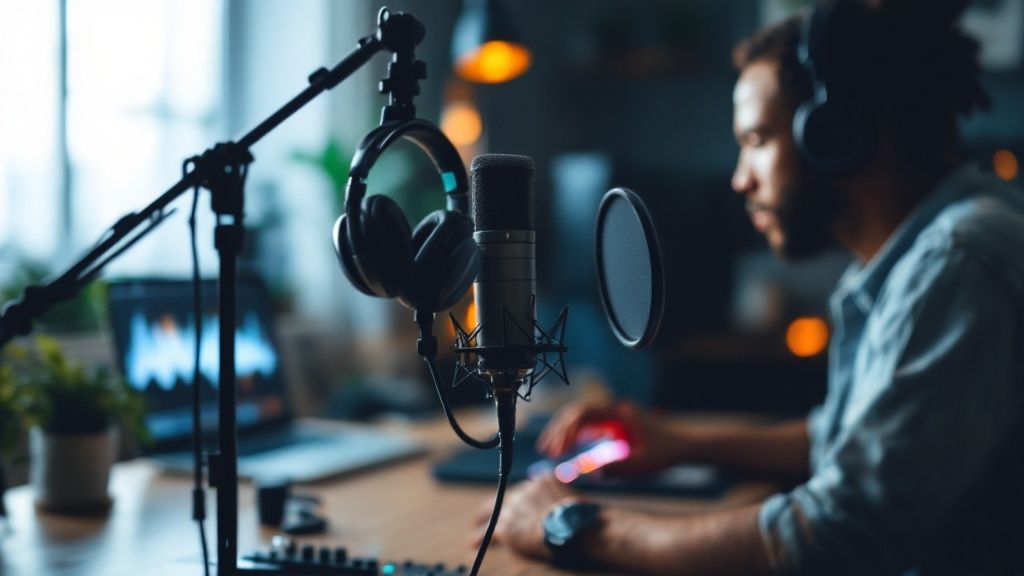
Recording rap that sounds professional starts way before you step to the mic. A killer track is 90% preparation and only 10% performance. Your space, your gear, and your setup have a much bigger impact on the final product than you might think.
So, before you even think about hitting record, you need to get the fundamentals right. That means taming your room's acoustics and picking the right microphone for your voice.
Building Your First Home Recording Studio
You don't need access to a multi-million dollar studio to make great music. Seriously. Some of the biggest records in hip-hop started in a bedroom corner. The secret is knowing where to put your money and how to get the most out of the space you have.
Your main job is to capture a clean, dry vocal. This means you’re fighting two things: background noise (your A/C unit, the street outside) and room reflections (sound bouncing off your walls). A professional studio is built to be acoustically "dead" for this very reason, and we can mimic that on a budget.
Setting Up Your Space for Success
Before you even look at a microphone, look at your room. A smaller room with carpet, a bed, and maybe some curtains is actually a great start. It's much better than a big, empty room with hardwood floors. All those soft surfaces soak up sound and stop it from bouncing around, which is exactly what you want.
You can make a huge difference with a few simple tricks:
Hang Heavy Blankets: Got some thick moving blankets? Hang them on the walls around where you’ll be recording. Instant vocal booth.
Smart Mic Placement: Never face the microphone towards the middle of the room. Instead, point it at something that absorbs sound, like an open closet full of clothes.
Stay Out of Corners: Setting up in a corner is a classic rookie mistake. It traps all the low-end frequencies and makes your vocals sound boomy and muddy.
This is the basic workflow to get a clean take every time.
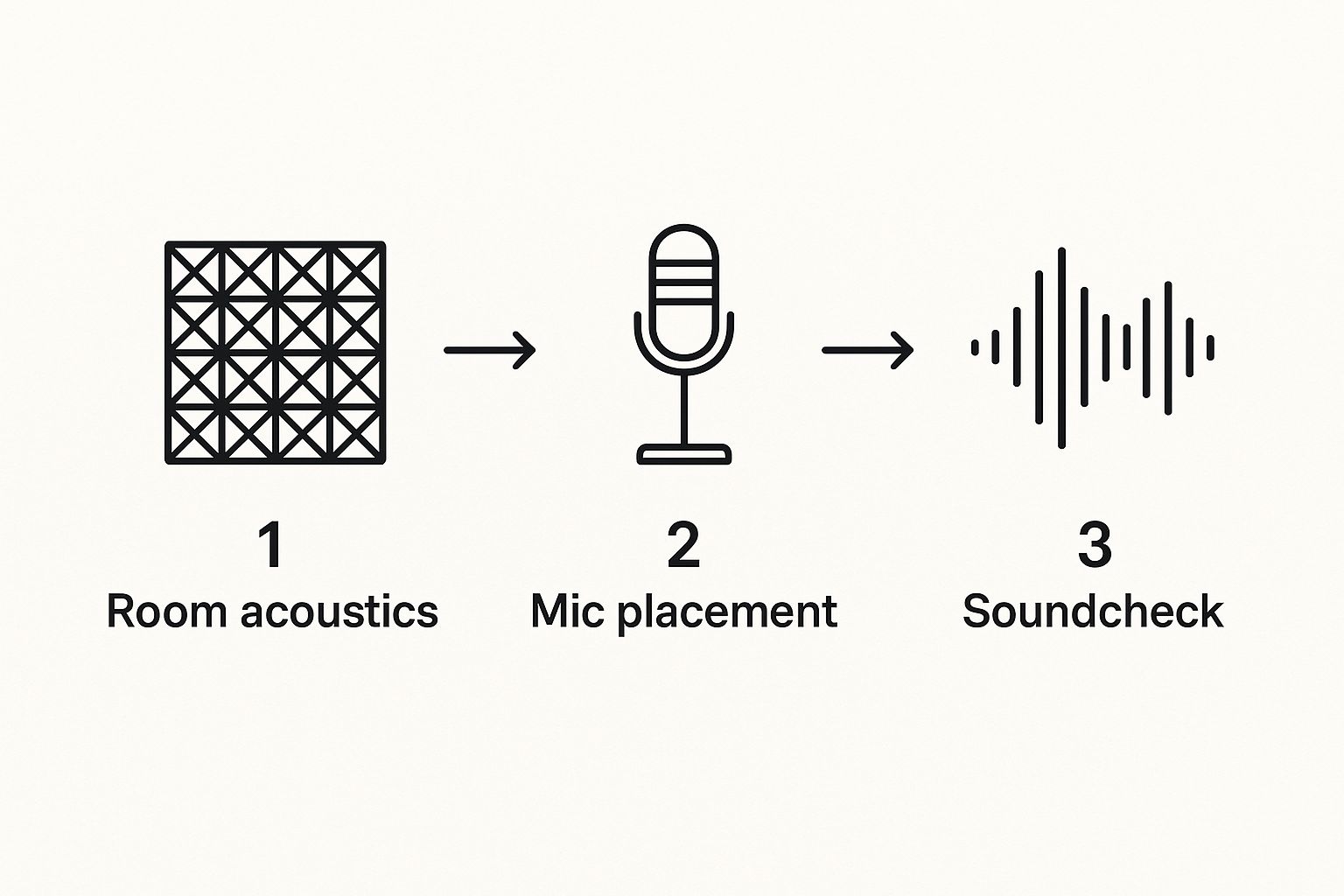
From treating the room to doing that final soundcheck, this process helps you catch problems before they ruin a perfect take.
Essential Gear That Delivers Results
Okay, your space is sorted. Now for the fun part: the gear. It's easy to get lost in a sea of options online, but you only need to focus on a few key pieces to get started.
Don't forget, your Digital Audio Workstation (DAW) is your command center, and there are plenty of powerful free software alternatives that will get the job done without costing you a dime.
When it comes to hardware, this is what you absolutely need.
Essential Gear for Your First Rap Studio
Here’s a look at the core components of any vocal recording setup. You can get started for a few hundred dollars, but I’ve included some pro-level options to show you what you can grow into.
Equipment Type | What It Does | Beginner Pick | Pro-Level Pick |
|---|---|---|---|
Microphone | Captures your voice. The most important piece of your signal chain. | Audio-Technica AT2020 | Neumann TLM 102 |
Audio Interface | Connects your mic to your computer and converts the signal. | Focusrite Scarlett 2i2 | Universal Audio Apollo Twin |
Headphones | Let you hear yourself and the beat without the mic picking it up. | Audio-Technica ATH-M20x | Beyerdynamic DT 770 Pro |
This gear list isn't exhaustive, but it covers the non-negotiables. Investing in these three items will give you a solid foundation to build on.
Your signal chain—the path from your microphone, through your interface, and into your headphones—is the absolute heart of your studio. A smart investment here pays off on every single song, giving you clean, present vocals that are a dream to mix.
This is where you should spend your money. A great mic can't save a terrible room, but a cheap mic will definitely ruin a good one. Quality over quantity, always.
Once your setup is ready and your lyrics are tight, you'll be able to capture your best performance. And if you need a little help polishing those bars, Download Lyric Studio free on iOS. The app acts as a creative assistant, offering AI-driven lyric suggestions and ideas to make sure every line hits hard before you step into the booth.
How To Prepare Your Lyrics For Recording
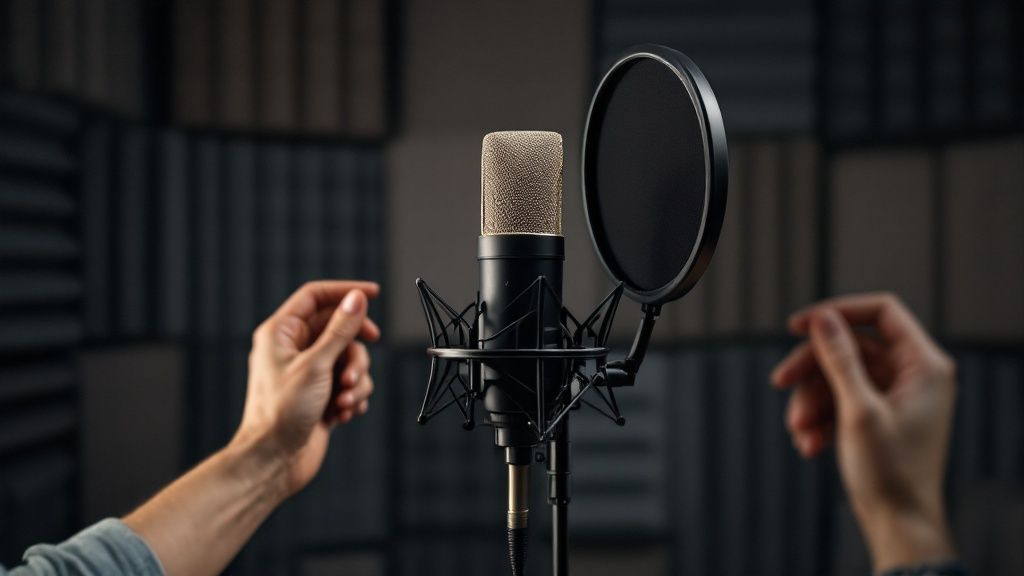
A killer vocal take doesn't just happen when you hit record. It starts way before you ever step into the booth. The time you put into prepping your lyrics is every bit as important as your time on the mic. This is where you turn words on a page into a performance that actually connects with people.
Think of your lyrics as the song's blueprint. If that foundation is shaky, no amount of fancy gear or expert mixing is going to save it. A truly great track starts with strong storytelling, tight rhymes, and a rhythm that locks right into the pocket of the beat. When you're recording rap in studio, that prep work makes all the difference in the world.
Refining Your Message And Flow
Before you even think about how you'll deliver the lines, just read them out loud. Forget the beat for a minute. Do they tell a clear story? Does each bar flow logically from the last? This is your chance to hunt down weak words, clunky phrases, or rhymes that sound a little too forced. Every single word has to earn its spot.
If you hit a creative wall—and we all do—modern tools can be a secret weapon. Instead of just staring at a blank screen, a creative assistant like Lyric Studio can give you a nudge.
AI-Driven Suggestions: The app gives you lyric ideas based on your theme and vibe, helping you find that perfect line without sacrificing your own voice.
Integrated Rhyme Tools: You get a powerful thesaurus and rhyme dictionary built right in, which is perfect for sharpening your word choice and making your rhyme schemes hit harder.
This isn't about letting a tool write for you; it's about sharpening your own creative instincts. As a rapper, your lyrics are everything. Looking into guides on content creation in the creator economy can even give you fresh ideas on how to organize and polish your writing before you record.
A huge mistake I see is artists writing lyrics that look good on the page but sound awkward out loud. Your goal is to create something that sounds incredible over a beat, so you have to practice saying it. Constantly.
Mastering Your Delivery Before The Booth
Once the lyrics are locked in, the real work begins. You need to memorize your bars until they feel like second nature. This is non-negotiable. It frees you up to focus on the emotion and energy of your performance in the studio instead of fumbling to remember what comes next.
Work on your breath control. Mark up your lyric sheets with little reminders of where to breathe. It helps you get through long passages without gasping for air and can save you hours of frustrating retakes. Matching your words to the instrumental is also a huge piece of the puzzle, and knowing the ins and outs of your flow will make your studio session a breeze.
Struggling to get started? A feature like the “Magic Draft” in Lyric Studio can be a real lifesaver. It instantly generates a first verse and chorus to get the ball rolling, giving you a solid framework to build on. That means more time perfecting your delivery and less time fighting with writer's block.
Ready to turn your ideas into record-ready lyrics? Download Lyric Studio free on iOS and start writing your next track today. The app is free to download and may include in-app purchases.
Getting That Perfect Vocal Take
Alright, this is it. You've soundproofed your space, dialed in your gear, and your lyrics are fire. Now it's time to step up to the mic and lay it all down. All that prep work comes down to this moment, and getting a clean, powerful vocal is what separates the pros from the amateurs when it comes to recording rap in the studio.
The very first thing you need to lock in is your gain staging. That’s just a fancy term for setting the mic's volume on your audio interface. You're looking for that sweet spot: a signal that's strong and clear, but not so hot that it distorts or "clips" when you get loud. Aim for your loudest bars to hit around -6dB on your recording software's meter. This leaves you plenty of room to play with when you start mixing.
Mic Technique Is Everything
How you stand in front of that microphone matters just as much as what you're saying into it. Your distance, your angle, your energy—it all gets baked into the final sound. Making small tweaks here can completely change the clarity and presence of your voice.
Here are a few things to keep in mind:
Find Your Distance: For most rappers, standing about 6-8 inches away from the mic is the sweet spot. Get too close, and the "proximity effect" can make your voice sound muddy and boomy. Stand too far back, and you’ll sound thin and distant.
A Pop Filter is Non-Negotiable: Seriously, just use one. It's a simple screen that diffuses the bursts of air from "P" and "B" sounds (plosives). Without it, those pops can completely blow out a take and are a nightmare to fix later.
Work the Mic: Don't just stand there like a statue. If you’ve got a loud, aggressive line coming up, pull back an inch or two to prevent clipping. For those quieter, more intimate bars, feel free to lean in a little closer.
Mastering this comes from knowing your lyrics by heart, which is why all that preparation is so important. If you’re ever fumbling with a line or can’t quite nail the flow, the AI-driven suggestions in Lyric Studio can be a lifesaver for finding a better way to phrase it, letting you stay focused on your performance.
Here's a studio secret that will instantly level up your tracks: vocal comping. Record at least three full takes of your verse. Then, listen back and slice together the best-delivered words and phrases from each one. You'll end up with a single, "perfect" performance that's tight, energetic, and sounds incredible from start to finish.
This kind of resourcefulness is built into hip-hop's DNA. Think about the early days, when pioneers like DJ Kool Herc were turning turntables into full-blown instruments because that's what they had. Years later, Dr. Dre changed the game with Straight Outta Compton, blending raw samples with groundbreaking studio techniques that made every voice hit hard. You can read more about the history of hip-hop production on Wikipedia to see how innovation has always been part of the culture.
Ready to make sure every bar is perfect before you hit record? Download Lyric Studio for free on iOS and get your lyrics locked in. The app is free to download, with optional in-app purchases.
Mixing Your Rap Vocals to Cut Through the Beat
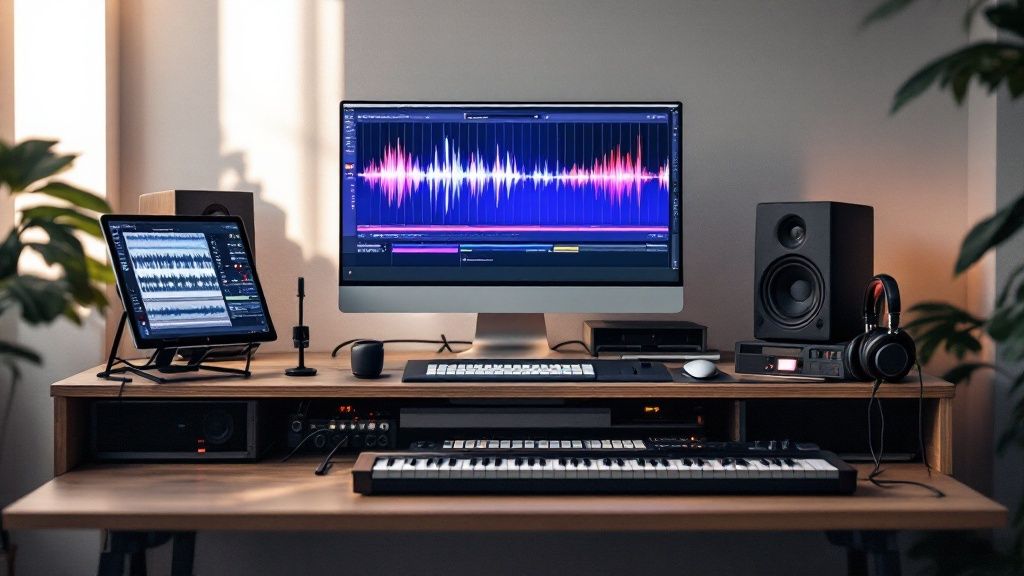
Alright, you've laid down the perfect take. The energy is there, the delivery is on point. But that's only half the battle. Now comes the mix, the crucial step where your raw performance gets molded into a polished track that really hits the listener. This is how you make your vocals sit right on top of the beat, instead of getting lost in it.
Mixing can feel like a dark art, but you don't need decades of experience to get a clean, powerful vocal sound. It really boils down to using a few key tools the right way. Your three best friends in any vocal mix are going to be EQ, compression, and a touch of effects.
Carving Out Space with EQ
Picture your beat and your vocal as two puzzle pieces fighting for the same spot. Equalization, or EQ, is how you trim the edges so they fit together perfectly. Its main job is to boost the frequencies that make your vocal sound good and cut the ones that make it sound muddy.
One of the most common problems you'll run into is a muddy or "boxy" sound, which usually hangs out in the low-mid frequencies (around 200-500Hz). Try making a gentle cut in that area, and you’ll often hear your vocal clear up instantly. You can also give the higher frequencies a little boost to add some "air" and presence, helping it slice right through the mix.
The goal with EQ isn't to reinvent your voice; it's to clean it up and enhance what's already there. Small, surgical adjustments almost always sound better than huge, drastic changes.
Adding Punch with Compression
With your vocal sounding clean, it's time to tame the dynamics. Think of a compressor as an invisible hand on the volume knob, automatically turning down the loudest parts of your delivery and bringing up the quietest ones. This creates a much more consistent, even performance where every single word is heard.
For rap vocals, compression is what adds that punch and attitude. It’s the secret sauce for getting that modern, in-your-face sound that defines so much of the genre. Without it, your voice can feel like it’s jumping in and out of the mix, losing its impact.
Creating Depth with Effects
Last up, you can add some space and character with effects like reverb and delay. Reverb simulates the sound of a physical space—anything from a tight vocal booth to a massive concert hall—while delay creates distinct echoes.
Reverb: A little goes a long way here. Drowning your vocal in reverb can make it sound distant and washed out. Stick with a subtle plate or room reverb to give it some life without pushing it to the back of the mix.
Delay: A quick, simple "slapback" delay can add a nice thickness and rhythmic feel. For a more polished sound, try syncing the delay time to the track's tempo.
The way artists approach recording rap in studio has evolved so much, especially since streaming became king. Producers are now laser-focused on creating tracks with crystal-clear vocals and hooks that sound massive on everything from earbuds to car stereos. If you're looking for the right tools for your setup, our guide on the best music production software for beginners can help you get started.
Struggling to write lyrics that are worth all this effort in the mix? Download Lyric Studio free on iOS. Its AI-driven suggestions and integrated rhyme tools can help you craft bars that truly stand out. The app is free to download, with optional in-app purchases available.
What We Can Learn from Hip Hop's Legendary Recording Studios
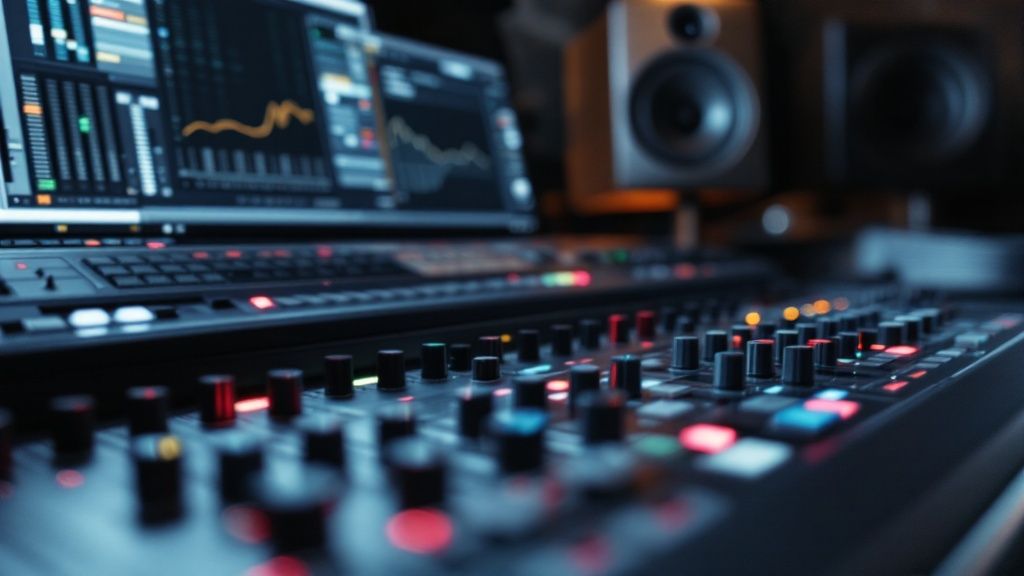
To really understand how to make great rap music, it helps to look back. The legendary studios that birthed the genre weren't just rooms full of expensive equipment—they were creative hubs where a whole culture and sound were hammered into shape. By studying how the pioneers made their classic records, you'll find core truths you can use when you're recording rap in studio today.
Those iconic spots had more than just good gear; they had a vibe. The atmosphere in a place like D&D Studios in New York or Can-Am Recorders out on the West Coast was a crucial ingredient. Artists would feed off that energy, pushing each other to lay down their absolute best takes.
Your Vibe is Everything
You can bring that same energy into your own space, no matter how simple it is. It's really about making your recording spot a place where you feel creative and can lock in. This might be as simple as changing the lighting, hanging up some art that gets you inspired, or just keeping the place from getting cluttered. You're building a personal sanctuary that puts you in the right headspace to make music.
Think about how a producer like DJ Premier used the limitations of his gear to forge that signature gritty sound. He didn't have a million plugins to choose from, so he mastered the tools he had. There’s a huge lesson there: true creativity thrives within constraints. You don't need the most expensive microphone to make a classic track. You just need to know your gear inside and out.
The real takeaway from these old-school studios is that technology is just a tool. The magic comes from the artist's vision, the energy in the room, and the raw hunger to create something authentic.
Old School Soul, New School Tools
The fundamentals of a great recording haven't changed. It’s always been about capturing a powerful performance, making sure the vocals cut through, and forging an emotional connection with the listener.
East Coast Grit: Studios like D&D were the heart of hip hop's golden era, a home for legends like Nas and The Notorious B.I.G.
West Coast Funk: Can-Am Recorders blew up after Dr. Dre recorded The Chronic there, defining the G-funk sound that ran the ‘90s.
These places weren't just studios; they were cultural landmarks that shaped the sound of an entire generation. You can discover more insights about these legendary studios on REVOLT to get a feel for how deep their influence runs.
The pioneers didn't have AI to bust them out of writer's block. But you do. You can channel that classic spirit using modern tools. When you're stuck on a line, Lyric Studio can offer context-aware suggestions that actually fit your style, helping you polish your bars without killing your flow. With its integrated rhyme and thesaurus features, every word can be sharp and intentional.
Ready to mix that old-school inspiration with today's tech? Download Lyric Studio free on iOS and start building your own legacy. The app is free to download, but in-app purchases may apply.
Still Have Questions About Recording Rap Vocals?
We've walked through everything from setting up your space to laying down the final mix. But if you’re just starting out, a few common questions always seem to surface right when you’re about to hit record. Let's clear up those last-minute doubts so you can move forward with confidence.
Think of these as the final roadblocks between you and a finished track. The good news? They're easier to get past than you think.
So, How Much Does a Home Rap Studio Really Cost?
Building your own spot is all about that initial investment, which frees you from paying by the hour at a commercial studio forever. You can get a seriously solid beginner setup—a good mic, an audio interface, and a decent pair of headphones—for somewhere in the $300 to $600 range.
The real win here isn't just saving money; it's the freedom to create whenever you feel it. To make that time count, a creative assistant like Lyric Studio can be a game-changer. It's free to download and helps you lock in your lyrics faster, though there might be some in-app purchases.
What's the Best DAW for Recording Rap?
Honestly, there's no magic "best" DAW. It's all about what clicks with your personal workflow.
FL Studio: A huge favorite in the hip-hop world, mainly because its beat-making process just makes sense to a lot of producers.
Logic Pro X: If you're on a Mac, this is an industry powerhouse. It’s known for having incredibly powerful tools for editing and comping vocals.
Ableton Live: Another top contender, especially if you ever plan on taking your music to a live stage.
The software you pick is less important than how well you learn it. My advice? Start with a free DAW like GarageBand or Cakewalk. Get a feel for the process before you drop any cash on a big-name program.
How Do I Get My Vocals to Sound Super Clear?
That crystal-clear vocal sound isn't one big secret; it's a bunch of small things done right. Start with your room—even basic acoustic treatment to cut down on echo makes a massive difference. From there, never record without a pop filter and try to stay a consistent distance from the microphone.
When you get to the mixing phase, this is where the magic happens. Use an EQ to carve out some of those muddy low-mid frequencies (usually hanging around 200-500Hz). Then, give the high-end a gentle boost for that "in-your-face" presence. A de-esser plugin is also your best friend for taming those sharp 's' sounds that can ruin a take.
Finally, make sure your vocals sit right on top of the beat, not buried underneath it. Of course, the clearest vocals start with the best lyrics. Using the integrated rhyme and thesaurus features in Lyric Studio can help you find the perfect words, making sure every line hits exactly how you want it to.
You’ve got the knowledge and the roadmap. Now you have what it takes to start recording rap vocals that sound like they came out of a pro studio. Ready to take your writing to the next level? Grab Lyric Studio and see what you can create.

SCAN TO GET