Back to articles
Mastering Multi Syllable Rhymes In Your Lyrics
So, what exactly are multi-syllable rhymes?
Put simply, they're rhymes that match two or more syllables. Think less “cat” and “hat” and more like matching “lyrical miracle” with “spiritual individual.” It’s an advanced technique that creates a more intricate, musical, and professional sound in your lyrics.
The Power of Rhyming Beyond Single Words
If you think of songwriting like building with Legos, a simple rhyme like "pain" and "rain" is a single brick. It works, it's functional, it's essential.
But multi-syllable rhymes are like those cool, pre-built Lego kits. They offer instant structure, detail, and a sense of completeness that makes your work immediately more impressive. This technique isn't just about matching the last word of a line; it's about matching the sound and rhythm of entire phrases.
Moving beyond basic rhymes adds a whole new layer of sophistication to your songwriting. Here's why:
It Creates a Stronger Rhythm: When you rhyme multiple syllables, you’re creating a distinct pattern. This locks your lyrics tightly into the beat, making your flow feel more deliberate and powerful.
It Enhances Musicality: The human ear loves patterns. The repetition of these rhythmic and phonetic sounds is naturally pleasing, turning your lyrics into another instrument in the track.
It Showcases Lyrical Skill: Nailing a clever multi-syllable rhyme is a clear sign of advanced wordplay. It helps you stand out and establishes your unique artistic voice.
This visual gives you a great breakdown of how leveling up your rhyme schemes adds serious value to your songs.
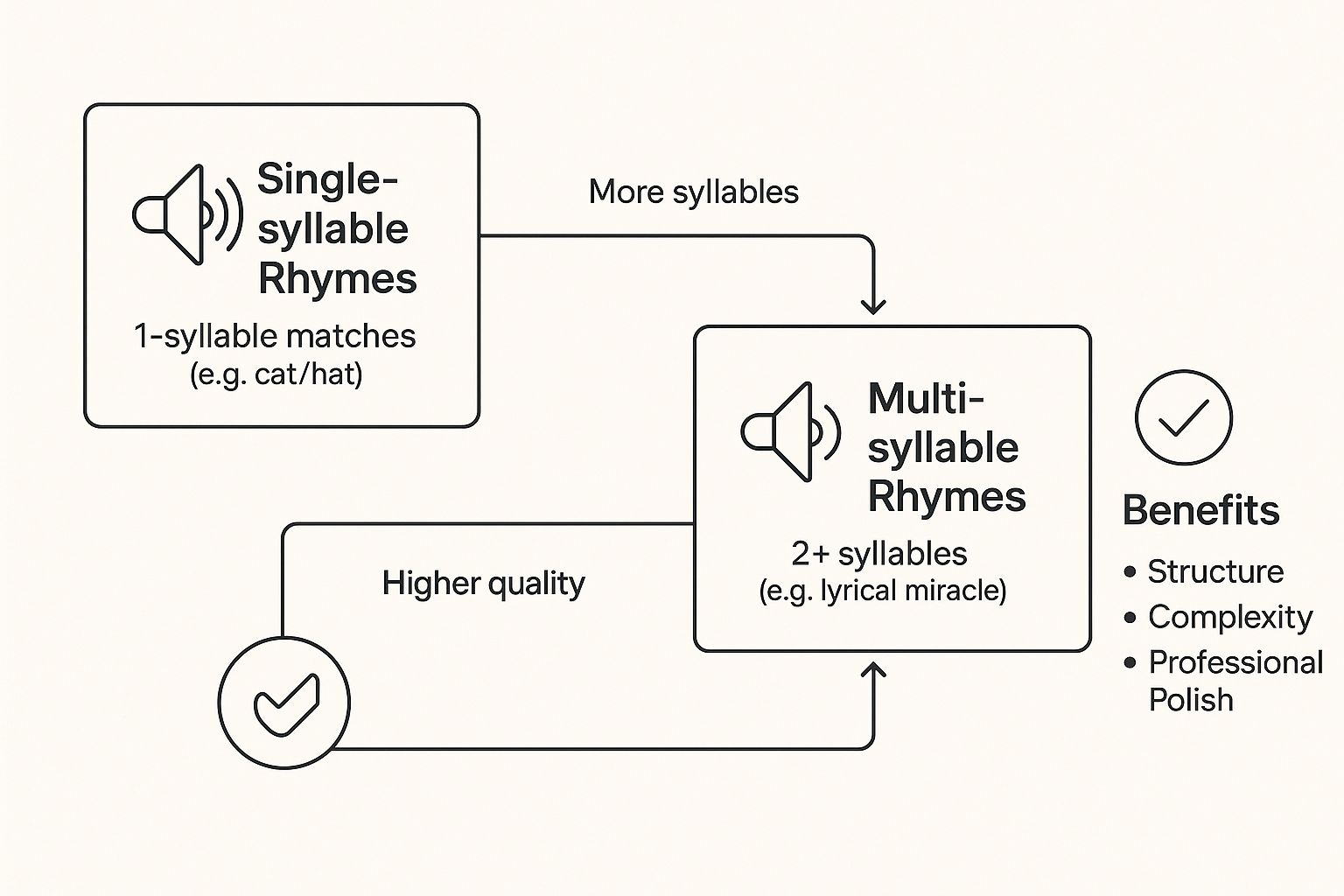
As you can see, making the jump from single to multi-syllable rhymes is a direct path to more structured, complex, and polished lyrics.
Single vs Multi Syllable Rhymes At a Glance
Sometimes, seeing things side-by-side makes the difference click. This table breaks down the core distinctions at a glance.
Aspect | Single Syllable Rhyme | Multi Syllable Rhyme |
|---|---|---|
Structure | Matches one stressed vowel sound. | Matches two or more syllables, including vowel and consonant sounds. |
Complexity | Simple, easy to create. | More complex, requires more thought and skill. |
Rhythm | Basic rhythmic impact. | Creates a strong, intricate rhythmic pattern. |
Example | Go / Show | Imagination / Fascination |
This quick comparison highlights how multi-syllable rhymes add depth and musicality that single syllables just can't match.
Why Complex Rhymes Define Modern Music
Historically, multi-syllable rhymes have always been a staple in poetry and music, but they truly came into their own in hip-hop. Over the decades, lyrical complexity in the genre has exploded, with artists constantly one-upping each other with intricate rhyme schemes. You can learn more about this trend and its origins in musical history.
This evolution didn't stay in one genre. It has since bled into pop, R&B, and rock, making complex rhyming a true cornerstone of modern songwriting.
Multi-syllable rhymes are a songwriter's secret weapon. They transform simple lines into memorable hooks and demonstrate a command of language that captures a listener's attention instantly.
Getting the hang of this is a game-changer, and you don't have to figure it all out on your own. With Lyric Studio, you get AI-driven, context-aware suggestions that help you find unique multi-syllable rhymes that fit your song's vibe perfectly. Its integrated rhyme and thesaurus tools are designed to be a creative assistant, making the process of finding those perfect words feel almost effortless.
Ready to take your lyrics to the next level? Download Lyric Studio free on iOS and start writing rhymes that really connect. Just a heads-up, in-app purchases may apply.
How Complex Rhyme Structures Actually Work
To really get the hang of multi-syllable rhymes, you need to start thinking more like a musician and less like a writer. It's not about how words are spelled on a page; it’s all about how they sound when you say them out loud. The whole idea is to match the vowel sounds—and often the consonants around them—across several syllables in different words or phrases.
Think of it like breaking down a word into its sonic ingredients. Take "fascinating." It has three main vowel sounds: FA (like in "cat"), si (like in "sit"), and NA (like in "hay"). A slick multi-syllable rhyme would mirror those exact sounds in a totally different phrase, like “pass the rating.” The spelling is completely different, but when you say them, the rhythm and the vocal melody line up almost perfectly.
That's the secret right there. It's what makes these kinds of rhymes feel so good to hear. They create this incredible musical and rhythmic glue between your lines.
Deconstructing Different Rhyme Types
Now, not all multi-syllable rhymes are built the same way. They show up in a few different flavors, and each one adds its own unique texture to a song. Knowing the difference gives you a much bigger toolbox to pull from when you're writing.
Here are a few common structures to get you started:
Compound Rhymes: This is when you rhyme multiple separate words together. A classic example is rhyming “no time” with “go climb.” You're matching two individual words that, when put together, form a two-syllable rhyming phrase.
Chained Rhymes: This is a more advanced move where you link a bunch of rhyming phrases in a row, creating a kind of domino effect of sound. Think of a line like, “The rain in Spain falls mainly on the plain.” You can hear how multiple phrases echo each other one after another.
Near Rhymes (or Slant Rhymes): Let’s be real, finding a perfect multi-syllable rhyme isn't always easy. That’s where near rhymes are your best friend. They match some of the sounds, but not all of them. For example, rhyming "amazing grace" with "blazing space." The vowel sounds are close enough to feel connected, but they aren't a carbon copy.
Multi syllable rhymes are a puzzle where the pieces are sounds, not letters. The goal is to arrange these sonic pieces into a pattern that clicks, creating a rhythm that feels both surprising and inevitable.
Building Your Own Lyrical Patterns
Crafting these structures is a skill you can definitely learn. It all starts with picking a core phrase you want to work with and then dissecting its syllables and vowel sounds. Once you've got that, you can start brainstorming other words and phrases that share those same sonic building blocks. The overall pattern of your rhymes is a huge piece of this puzzle, too. You can dive deeper into arranging these patterns in our guide on what is a rhyme scheme.
This process can feel like a real workout, but it's exactly where a creative assistant can make all the difference. The integrated rhyme and thesaurus tools in Lyric Studio are designed for this exact job, serving up suggestions based on how words sound, not just how they’re spelled. The AI also gets the context, so it gives you options that not only sound right but actually fit the mood of your song. It helps you discover those killer connections without killing your creative momentum.
How Multi-Syllable Rhymes Improve Your Songs
Stepping up from simple, single-word rhymes isn't just a stylistic flourish—it's a move that can fundamentally change how your music feels. When you start using multi-syllable rhymes, you're doing more than just showing off your vocabulary; you're building a tighter, more professional-sounding song from the ground up. Think of it as your secret weapon for creating a signature style that really connects.
When you rhyme entire phrases instead of just the last word, you forge a much stronger rhythmic bond between your lyrics and the beat. This makes your flow feel deliberate and locked-in, pulling the listener through the track with a really satisfying groove. It’s the difference between lyrics that just float on top of the music and lyrics that feel like they're part of the rhythm section.
This technique also opens up huge possibilities for your storytelling. By linking complex ideas with similar sounds, you can really drive home specific emotions or highlight the most critical moments in your song's narrative.
Elevate Your Flow and Emotion
Getting good at multi-syllable rhymes gives you surgical control over your song’s emotional arc. By being intentional about which phrases you rhyme, you can spotlight the most important parts of your story, making sure your message hits home with your audience.
Creates a Stickier Hook: Let's be honest, complex rhymes are just more memorable. Those unique sound patterns make your choruses and key lines incredibly catchy and far more likely to get stuck in a listener's head.
Showcases Lyrical Craftsmanship: In a world full of simple, predictable rhymes, advanced wordplay immediately tells people you're serious about your art. It’s a clear sign that you’ve put in the work.
Enhances Rhythmic Punch: Syncing multiple syllables to the beat adds an almost percussive quality to your vocals. It makes each line land with more impact and confidence.
And once you've nailed the lyrics, you can take it even further. Enhancing your vocal delivery with tools like advanced vocal harmonizer algorithms can make those multi-syllable rhymes pop even more.
Multi-syllable rhymes act like sonic glue, bonding your lyrics to the instrumental. This connection doesn't just improve the flow; it intensifies the emotional weight of every line, making your song unforgettable.
This is exactly where a tool like Lyric Studio can become your best creative partner. Instead of spending hours racking your brain for the perfect words, its AI-powered rhyme and thesaurus suggestions give you options that actually make sense in context. You can quickly discover unique multi-syllable combinations that fit your song’s vibe, freeing you up to focus on the real art of songwriting.
Ready to make your lyrics more powerful? Download Lyric Studio free on iOS and start finding the perfect words to bring your creative vision to life. Please note that in-app purchases may apply.
A Practical Guide to Writing Your First Multi Rhymes
Alright, let's move from theory to action. Writing your first multi-syllable rhymes can feel like a huge hurdle, but it's more straightforward than you might think. It’s a skill you build with practice, not something you're just born with.
The key is to start small and really listen to the sounds. Let's walk through a simple, step-by-step process to get you crafting complex rhymes from the ground up.
Start With a Core Idea
First things first: pick a word or phrase that’s central to your song's theme. This is your anchor. For this example, let's use the phrase “on the stage.”
Now, break it down into its core sounds, paying close attention to the vowels.
ON (ah sound)
the (uh sound)
STAGE (ay sound)
Your goal is to find another phrase—any combination of words—that mirrors this ah-uh-ay sound pattern. Forget about spelling; it's all about what you hear.
Time to brainstorm. Think of words that match that final, most stressed syllable: "stage." Words like page, age, wage, or cage probably pop into your head. This gives you a great starting point to build backward from. What phrase could end with "page" and still match the ah-uh sounds?
This is where your creativity comes in. Maybe something like “follow the page” or “hollow the page.” Notice how “follow the” has a similar ah-uh rhythm to “on the.” It’s not a perfect match, but it’s close enough to sound incredible when sung or rapped.
Embrace Near Rhymes
Let's be real: perfect multi-syllable rhymes are rare gems. There are only so many perfect rhymes in the English language, especially for longer words. Most English words are actually "singletons," meaning they have no perfect rhyming match at all. This scarcity is what makes finding any multi-syllable connection feel so rewarding.
This is exactly why professional songwriters rely heavily on near rhymes, also known as slant rhymes. These are phrases that have similar, but not identical, vowel or consonant sounds.
Let's go back to our example, “on the stage.” A great near rhyme could be “lost for days.”
“On” and “lost” share that short "o" sound.
“The” and “for” don't match perfectly, but they're both unstressed syllables that keep the rhythm moving smoothly.
“Stage” and “days” lock it in with the same long "a" vowel sound, creating a strong anchor for the rhyme.
When you deliver that line with confidence, it will sound just as intentional and powerful as a perfect one.
The art of multi-syllable rhyming isn’t about finding a perfect twin for your phrase. It’s about finding a cousin—a phrase that shares the same family of sounds and rhythms.
Streamline Your Process With a Creative Partner
Manually brainstorming sounds and syllables is a fantastic exercise for your brain, but it can absolutely kill your creative flow. This is precisely where a tool like Lyric Studio shines. Its suggestions are designed to think in terms of sound, not just spelling.
When you hit a wall, the integrated rhyme tools offer up context-aware ideas for multi-syllable rhymes you might never have thought of on your own. Instead of just giving you words that rhyme with "stage," it offers entire phrases that match the sonic blueprint of "on the stage," helping you uncover connections so much faster. For more tips on speeding things up, check out our guide on how to make rhymes faster.
Ready to try it yourself? Download Lyric Studio free on iOS and see how its smart suggestions can help you build powerful rhymes without breaking your stride. Just a heads up, in-app purchases may apply.
Using AI To Break Through Songwriting Blocks
Every songwriter knows the feeling. You're staring at a blank page, the cursor blinking mockingly. You know what you want to say, but the words just aren't coming. It’s a universal frustration that can suck the creative energy right out of you, making even the most dedicated artist feel totally stuck.
This is where having a creative assistant can make all the difference. Instead of trying to force an idea that isn't landing, you get a gentle nudge in a new direction. It’s not about replacing your voice; it's about giving it a boost when you need it most.
Get a Creative Foundation in an Instant
What if you could get a complete first draft of a verse and chorus with a single tap? That's exactly what Magic Draft, a key feature in Lyric Studio, is designed to do. It’s built to smash through writer's block by giving you an immediate foundation to build from, often packed with multi-syllable rhymes and thematic ideas.
This isn’t about having a machine write the song for you. Think of it as getting a solid starting point that you can then twist, edit, and expand upon.
Kick-Start Your Session: Generate a full verse and chorus in seconds, helping you leap over that initial hurdle of starting from nothing.
Find New Angles: The AI-generated lyrics can spark fresh concepts, phrases, and rhyme patterns you might not have thought of on your own.
Make It Your Own: Treat the draft like raw clay. Keep the lines that resonate, toss what doesn’t, and mold it into something that sounds like you.
Writer's block often comes from the pressure to write the perfect first line. Tools like Magic Draft take that pressure off. They give you an imperfect but inspiring starting point, freeing you up to just play with words and create.
Inspiration That Fits Your Sound
Sometimes, the problem isn't a lack of ideas, but a gap between your concept and finding the right words to express it. Lyric Studio’s Genre & Mood customization helps close that gap by serving up inspiration that actually fits. Whether you're crafting a high-energy hip-hop track, a soulful pop ballad, or a smooth R&B vibe, the suggestions adapt to match.
This means you’re getting ideas that are lyrically and thematically relevant, not just random words. While AI is a fantastic assistant, it’s always smart to have a full creative toolkit. Exploring other strategies to overcome writer's block can help you stay versatile. To see how all these pieces fit together, check out our guide on how can AI help song writers.
Stop staring at that blank page. Download Lyric Studio free on iOS and use the Magic Draft feature to get your next song started. Please note, in-app purchases may apply.
Finding Your Signature Rhyme Style
Every great artist has a lyrical fingerprint—that special something that makes their words instantly recognizable. A huge part of that comes down to their rhyming habits. Developing your own style isn't about just picking words that sound alike; it's about consciously building patterns that become your trademark.
Think of it as creating your personal “rhyme network.”
This idea actually comes from a field called network analysis, which researchers have used to map the evolution of rhymes in poetry. By tracking which rhyme pairs show up together over time, they can literally see how poetic styles change. It's fascinating stuff, and you can dive deeper into how researchers use network analysis to understand rhyme.
Building Your Lyrical Identity
You can apply that same thinking to your own songwriting. When you start intentionally choosing certain types of multi syllable rhymes or favoring specific sound patterns, you begin to build a style that's both consistent and creative. It’s what makes a lyric sound like you.
Start asking yourself a few questions:
Pattern Repetition: Do you find yourself leaning on three-syllable rhymes with a certain rhythmic bounce?
Word Association: Are there specific words or ideas you keep connecting through your rhymes?
Sound Preference: Do your rhymes tend to be sharp and punchy, or are they more smooth and melodic?
Just thinking about these things makes you more aware of your habits. From there, you can start refining them into a distinct artistic identity.
Your rhyme style is your lyrical signature. It’s the consistent thread that ties all your songs together, making your voice unmistakable in a crowded musical landscape.
This is where a tool like Lyric Studio can be an incredible partner. Its AI-driven suggestions aren't just random words pulled from a rhyming dictionary; they're based on analyzing massive patterns in modern music across all sorts of genres.
The suggestions help you discover multi syllable rhymes that are not only clever but also fit the mood and theme of your song. It’s the perfect way to experiment with new patterns without losing your own unique voice. It gives you the tools to consciously build your signature style, one rhyme at a time.
Ready to find your unique lyrical voice? Download Lyric Studio free on iOS and see how its smart suggestions can help you hone your craft. Note that in-app purchases may apply.
Common Questions About Multi-Syllable Rhymes
Let's tackle some of the questions that pop up when you start diving into multi-syllable rhymes. Getting these answers straight can really help you master the technique and make the most of your creative tools.
How Many Syllables Should a Multi-Syllable Rhyme Have?
Honestly, there's no magic number here. These rhymes start at two syllables and can stretch to three, four, or even more. But the real goal is impact, not just cramming in as many syllables as you can.
A sharp, well-placed two-syllable rhyme will almost always hit harder than a clunky, forced four-syllable one. My advice? Start with two, get comfortable with the rhythm and flow, and then challenge yourself to expand from there.
Do Multi-Syllable Rhymes Have to Be Perfect Rhymes?
Absolutely not. In fact, some of the most iconic and clever multi-syllable rhymes are actually "near rhymes." These rely on matching vowel sounds (assonance) or consonant sounds (consonance) instead of being a perfect match.
Think about it—there are only so many perfect multi-syllable rhymes in the English language. Leaning on near rhymes isn't just a workaround; it's a vital skill that opens up a world of creative possibilities for any serious songwriter.
Can AI Write an Entire Song for Me?
That’s a great question, and the short answer is no—at least, not a song that sounds like you. Lyric Studio is designed to be your creative assistant, not the pilot.
While features like Magic Draft can give you a verse-and-chorus in seconds to kickstart your process, the real strength of the app is in collaboration. It gives you context-aware suggestions and smart rhyme tools to help you discover and polish your own ideas. It’s there to amplify your voice, never to replace it.
Ready to stop wrestling with writer's block and finally master multi-syllable rhymes? With Lyric Studio, you have an AI-powered partner ready to help you find those perfect words, build intricate patterns, and bring your best ideas to the forefront.
Download Lyric Studio free on iOS. Please note that in-app purchases may apply.

SCAN TO GET