Back to articles
How to Write Music for Lyrics: A Practical Guide

Writing music for lyrics isn't about forcing words into a melody. It's about finding the music that's already living inside the words. The trick is to start by listening to the natural cadence of your lyrics. Pay attention to the stressed syllables and the natural pauses—this is your road map to a melody that feels effortless, not shoehorned in.
Finding the Music Inside Your Words
The secret to putting music to words isn't some mystical formula; it's learning to hear the song that's already there. Before you ever touch an instrument, your lyrics offer a blueprint for the melody, rhythm, and the entire emotional vibe of your song. When you let the lyrics lead, you ensure the music is always serving the story.
Every line you write has its own built-in rhythm. Seriously, just read your lyrics out loud. Notice which words and syllables you naturally lean into? Those are your anchor points. These stressed syllables are where your melody should land on the strongest beats, while the unstressed syllables can fill in the gaps, creating a flow that sounds as natural as a conversation.
Map Your Song’s Emotional Journey
Beyond just rhythm, your lyrics carry a specific emotional weight. Is the verse quiet and introspective? Does the chorus burst with joy or frustration? Sketching out this emotional arc before you write a single note will guide all your musical decisions.
A song's feeling is often directly tied to its core musical elements:
Tempo: A faster pace can create a sense of excitement or even anxiety, while slowing things down might suggest reflection or intimacy.
Key: Generally, major keys feel bright and optimistic. Minor keys, on the other hand, tend to sound more somber or dramatic.
Dynamics: The simple act of moving from a soft verse to a loud, powerful chorus can massively amplify the emotional punch of your hook.
This process flow chart breaks down how to turn a lyrical mood into concrete musical ideas in three clear stages.
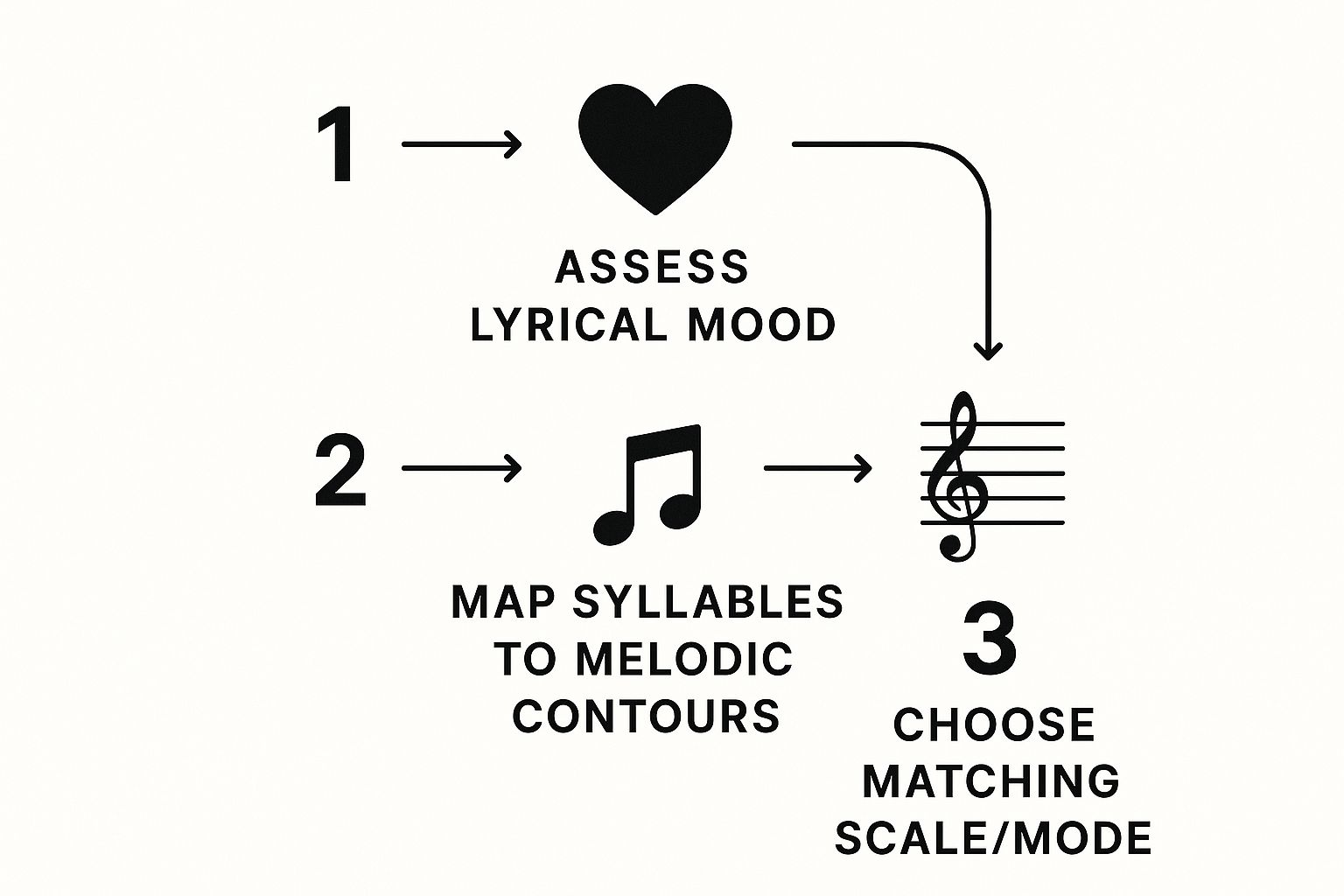
As you can see, everything starts with the emotion. That feeling then shapes the melody, which in turn informs the harmony holding it all together.
To make this even clearer, let's look at how specific emotions can translate into musical choices.
Mapping Lyrical Emotion to Musical Elements
This table shows how different lyrical emotions can be translated into core musical components to create a cohesive song.
Lyrical Emotion | Suggested Tempo | Common Key/Modality | Rhythmic Feel |
|---|---|---|---|
Joyful/Upbeat | 120-140 BPM | Major Key | Driving, on-the-beat |
Sad/Reflective | 60-80 BPM | Minor Key, Mixolydian | Sparse, flowing, legato |
Angry/Aggressive | 140-180 BPM | Minor, Phrygian | Syncopated, aggressive |
Hopeful | 90-115 BPM | Major Key (Lydian) | Steady, building |
Of course, these are just starting points. The real magic happens when you start bending the rules to fit your unique story.
Let the Lyrics Lead the Melody
The single biggest mistake songwriters make is trying to cram lyrics into a melody they wrote first. This almost always leads to awkward phrasing where words are stretched or squeezed in unnatural ways. The solution is simple: flip the process. Let the cadence of your words tell you where the melody should go.
Industry analysis actually backs this up. Successful songwriters often spend upwards of 60% of their composition time just tweaking melodies to perfectly align with the natural flow of the lyrics. It's that important. Furthermore, studies of hit songs show that melodies tend to emphasize the first and third beats in a 4/4 time signature, which perfectly mirrors common English speech patterns. For more on this, you can check out some fascinating music production trends.
A great melody doesn't compete with the lyrics; it elevates them. When your melody follows the natural rise and fall of your words, the listener doesn't just hear the song—they feel it.
If you're stuck staring at a blank page, a creative assistant like Lyric Studio can be a game-changer. Its “Magic Draft” feature can instantly generate a verse-and-chorus to give you a solid lyrical foundation to build your music on. With AI-driven suggestions that adapt to your theme, you can find the right words for your musical ideas without losing creative momentum.
Ready to turn your own words into a song? Download Lyric Studio free on iOS. (Note: in-app purchases may apply.)
Crafting Your Core Melody and Chords
Once you've got a handle on the natural rhythm of your lyrics, it’s time to give them a voice. This is where the real heart of the song comes to life—the melody and the chords that hold it all together. Think of the melody as your story's main character and the chords as the world they live in, setting the scene and the mood for every line.
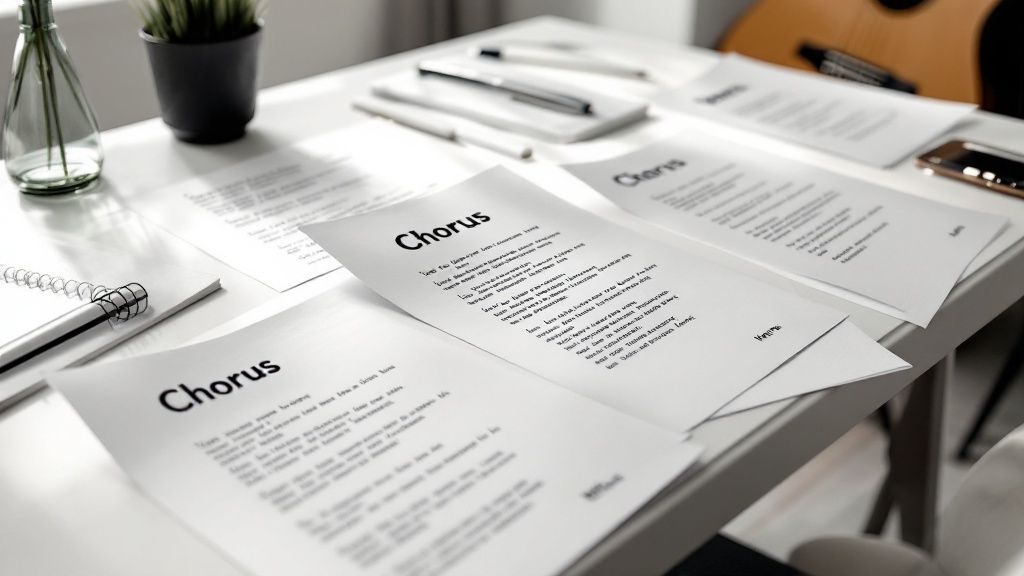
The best melodies usually spring from a simple, catchy musical phrase called a motif. It could be just a few notes you hum that perfectly match the feeling of your chorus hook. Don't try to force it. Just play around. Hum ideas into your phone, noodle on a keyboard, or sing your lyrics a dozen different ways until something just feels right. You're hunting for a short, memorable idea that feels like it was born from the words themselves.
Developing Your Melodic Idea
When you land on a motif you love, you can start building it out. How can you tweak it for the verses without losing its essence? Maybe your verse melody is a bit lower and more conversational, saving the big, soaring notes for the chorus to create that powerful emotional lift.
Pay attention to the melodic contour, which is just a fancy word for its shape:
Ascending melodies that climb higher tend to build tension, excitement, or a sense of hope.
Descending melodies that fall in pitch can create a feeling of resolution, sadness, or finality.
Try to make these shapes follow the emotional arc of your lyrics. If a line is about reaching for a goal, let the melody climb with it. If it’s about giving up, let it fall.
Choosing Chords That Amplify Emotion
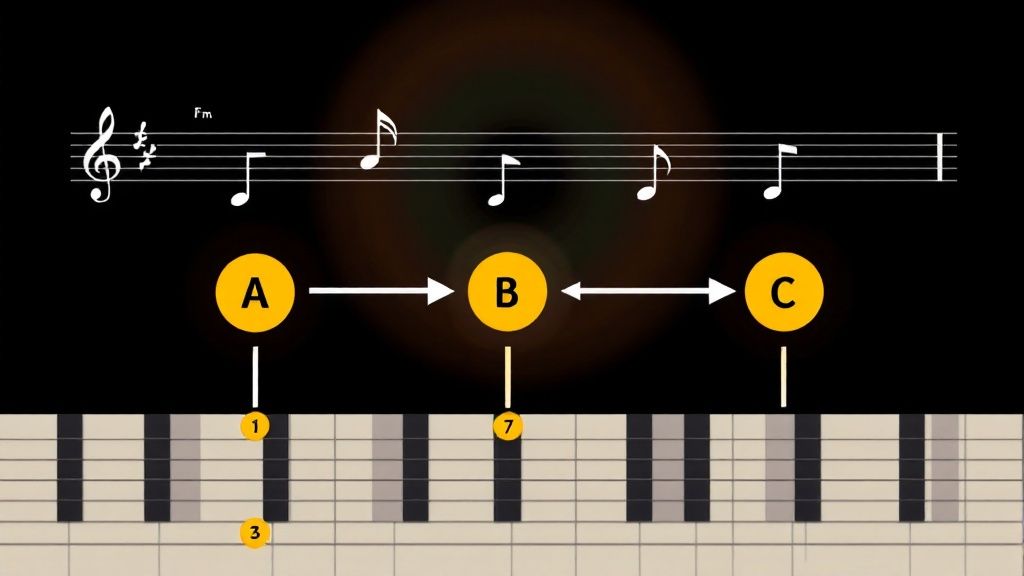
Chords are the harmonic bedrock of your song; they’re what give your melody its emotional punch. Sure, you can stick with a classic I-V-vi-IV progression—it works for a reason! But the real magic happens when your chord choices actually deepen the story.
For example, a sudden shift from a major to a minor chord can completely change the vibe from upbeat to somber, landing perfectly on a key word in your lyric.
This whole process is a bit of a dance. You'll find a chord progression you love, and it might inspire you to change a note or two in the melody. Or, you'll nail a killer melodic phrase that makes you realize you need a different chord underneath to really make it pop.
Let your melody and chords have a conversation. One should react to the other. This back-and-forth is how you move from a simple tune to a truly compelling song.
This constant tweaking of words, melody, and harmony is where a creative partner can really help. The AI-driven, context-aware lyric suggestions and integrated thesaurus in Lyric Studio let you experiment on the fly, finding the perfect words to fit the musical direction you're heading. It helps ensure your words and music grow together, making the final song that much stronger.
Ready to write melodies that people can't get out of their heads? Download Lyric Studio free on iOS and start building the heart of your next song. (Note: in-app purchases may apply.)
Building a Strong Rhythmic Foundation
Rhythm is your song’s engine. It's the pulse that gets heads nodding and feet tapping. It’s also what gives a slow ballad its emotional weight. A solid rhythmic foundation doesn't just hold your melody and lyrics up; it lifts them, making the whole song feel like it has a purpose.
It all starts with the right time signature and feel for your song's mood. Most of what you hear on the radio is in a straightforward 4/4 time signature—that classic one-two-three-four count. But the feel is where you inject personality. A driving, straight-ahead rock beat feels worlds away from a laid-back, behind-the-beat hip-hop groove, even though both are in 4/4.
Locking In Your Groove
Once you’ve got a vibe in mind, you can start sketching out a pattern. You don't need to be a drum virtuoso or a pro producer for this part. A simple guitar strum, a basic piano part, or even a simple programmed drum pattern is all it takes to lay down the core rhythm. The real trick is making it lock in with the natural rhythm of your vocal melody.
Here are a few ways to find a groove that works:
Just tap it out. Seriously. Tap a rhythm on your desk while you sing your chorus. What feels right? Is it steady and simple, or does it have a more complex, syncopated feel?
Try a loop. Grab a basic drum loop in a style that feels close to your song. Sing over it and listen for how your words land against the kick and snare.
Use your instrument. If you’re a guitarist, mess around with strumming patterns that hit the same accents your voice naturally does.
You're aiming for a conversation between the instruments and the vocals. They shouldn't be competing, but working together to create one unified feeling.
Using Rhythm to Build Excitement
A great rhythm track never just sits there; it grows and changes with the song's emotional arc. Shifting the dynamics of the rhythm is one of the most effective ways to build excitement and keep a listener hooked.
For example, you could pull the beat back during the verses, leaving more space for the story in the lyrics. Then, when the chorus hits, you can bring in more active elements like busy hi-hats or a more intricate kick pattern to make it explode.
Rhythm isn’t just about keeping time; it’s about creating energy. A sparse verse makes a powerful chorus feel even more explosive. This contrast is what makes a song dynamic and memorable.
Of course, genre plays a massive role. The rhythmic feel of a pop song is completely different from an R&B track. This is where a creative assistant can really help. Lyric Studio's genre & mood customization helps you align your musical ideas with specific styles for hip-hop, pop, R&B, and more, ensuring your rhythmic choices sound authentic and polished.
Ready to find the perfect beat for your words? Download Lyric Studio free on iOS to explore different grooves and build a solid rhythmic foundation for your next song. (Note: in-app purchases may apply.)
Arranging Your Song with Instrumental Layers

A great song is so much more than just a vocal line and some words. It’s a whole sonic world. That’s what arrangement is all about—the art of deciding which instruments play what parts, and when they come in and out. A truly thoughtful arrangement can elevate a simple idea into a rich, immersive track that pulls the listener right into your story.
Think of yourself as a painter. Your melody and lyrics are the main subject, but the arrangement provides the background, the shadows, and all the little highlights that bring the picture to life. You don't have to go big all at once. Start small, maybe with just a piano or an acoustic guitar to back up your vocal. From there, you can start to weave in other layers, each with its own job to do.
Building Your Arrangement One Piece at a Time
The easiest way to end up with a muddy, cluttered mix is to throw everything at the wall at once. Instead, try building your arrangement one layer at a time. Start with the absolute essentials and then add supporting parts that enhance—not compete with—the core idea.
Here’s a typical way you might stack your layers:
The Foundation: Get your lead vocal down first, along with the main rhythmic pulse. This could be a simple drum loop or just the strumming pattern of your guitar.
The Harmony: Next, bring in the instruments that will define the chords. Think keyboards, synth pads, or a solid rhythm guitar part.
The Texture: Finally, sprinkle in the details that add depth and character. This is where you can get creative with things like a subtle counter-melody from a synth or some ambient guitar swells.
This methodical approach keeps your track clean and ensures every instrument has a clear purpose. As you add each new element, keep asking yourself: does this part actually support the vocal and the emotion of the song?
Modern production tools have completely changed this game. Today, about 65% of music makers rely on Digital Audio Workstations (DAWs), and many of these programs are getting smarter about connecting lyrics to music. In fact, some analysts predict a 25.8% annual growth in AI music tools through 2033, as these systems learn to analyze lyrics and suggest musical ideas to match. If you're curious about where things are headed, you can discover more insights about the future of music production.
Using Dynamics to Tell a Story
Dynamics—the shifts in volume and intensity—are your secret weapon for making a song feel alive. A track that plows ahead at the same energy level from start to finish will put your listeners to sleep. Your arrangement should breathe with the lyrics, creating a sense of push and pull between sections.
Think of your arrangement as a spotlight. You can use it to shine a light on key lyrical moments by stripping back the instruments, or you can build to a huge crescendo for a powerful chorus.
For instance, you might keep the verse really sparse—just a vocal and a pulsing synth bass. As you move into the pre-chorus, you could bring in a simple drum pattern and some keyboard chords to build a little tension. Then, when the chorus hits, you let it all out: full drums, layered vocal harmonies, and a driving bassline. That kind of release is what makes a hook feel massive and unforgettable.
Of course, all of this starts with a solid lyrical foundation. Using a creative assistant like Lyric Studio can help you lock in your words with AI-driven suggestions that understand context and genre, freeing you up to focus on making these crucial arrangement decisions.
Ready to build your song's sonic world? Download Lyric Studio free on iOS and get the lyrical foundation you need to start arranging. (Note: in-app purchases may apply.)
Refining and Polishing Your Finished Song
You’ve got the core elements in place—the melody, the rhythm, the basic instrumentation. It feels like a song, but now the real work begins. This is the stage where you transform a solid draft into a polished track, stepping back to listen with a critical ear and tweaking every detail until it clicks.
Before you start messing with anything, just listen. Put on your headphones, play the demo from start to finish, and resist the urge to stop and fix things. Your only job right now is to feel the overall flow. Does the energy drop off a cliff somewhere? Does a certain line sound awkward or forced against the melody? Jot down anything that pulls you out of the moment.
Fine-Tuning Transitions and Arrangement
Smooth transitions are what make a song feel cohesive. The jump from a quiet, intimate verse into a massive chorus needs to feel earned, not just tacked on. If a section change sounds jarring, you might need to build a little bridge. Something as simple as a quick drum fill, a rising synth pad, or a cymbal swell can signal to the listener that a change is coming, making the whole thing feel much more natural.
This is also the perfect time to get ruthless with your arrangement. Be honest: is every single instrument truly serving the song? Sometimes, the most powerful move you can make is to subtract. Muting the bass and drums for the first half of a verse can make the chorus hit with so much more impact when they come crashing back in.
"The final 10% of the work—the polishing—is what separates a good song from a great one. It’s the small tweaks to a single word or a subtle harmony that can completely elevate the listener's emotional connection."
Getting Constructive Feedback
Fresh ears are priceless, but you have to guide them. Instead of playing your track for a friend and asking a vague "So, what do you think?", get specific.
Try asking questions like:
"Was there any point where your attention started to drift?"
"Did the story in the chorus come across clearly?"
"How did the bridge make you feel?"
This kind of targeted feedback gives you actionable insights you can actually use, without making you second-guess your entire vision. As you refine your lyrics based on these new musical realities, a smart creative partner can be a huge help. Lyric Studio, with its integrated rhyme and thesaurus tools, lets you quickly find better words to fit the final melody and groove perfectly.
Taking the time to polish isn't just about art; it’s also good business. Industry analysis shows that songs with a tight, seamless connection between melody and lyrics achieve 15-20% higher replay rates on streaming services. Cohesion keeps people listening, and as you can learn more from the RIAA's revenue report, that directly impacts a song's success. For more hands-on advice, check out these essential songwriting tips for beginners.
Ready to add that final layer of polish? Download Lyric Studio free on iOS and start refining every line with the precision it deserves. (Note: in-app purchases may apply.)
Common Songwriting Questions Answered
Even with a good process, some questions always seem to pop up, especially when you're figuring out how to put music to words. Let's dig into a few of the big ones and find some real-world answers to get you past those creative roadblocks.
What If I Don't Play an Instrument?
This is a huge one, but not playing an instrument is not a dealbreaker. Far from it. Some of the best songwriters started with the one instrument we all have—our voice. The only thing that matters, in the beginning, is getting that melodic idea down before it vanishes.
Just grab your phone and use a voice memo app. Sing your ideas over the lyrics. It doesn't have to be pretty or perfect. The goal is to just capture a tune that feels catchy and connects with the emotion of the words. Once you have that, you can either jump into a DAW with virtual instruments to sketch out a backing track or, even better, team up with a musician who can help bring the chords and arrangement to life.
Don't let a lack of instrumental skill stop you. Capture your melody with whatever you have. The rest can always be figured out later.
How Do I Find Chords for My Melody?
Figuring out chords can feel like trying to solve a puzzle, but there’s a simple way to start. First, listen to your melody and find the most important notes—usually the ones that land on the strongest beats. Think of these as your anchor points.
From there, just play around with the most common chords in your song's key. For a song in C major, for example, your go-to chords are typically C, G, Am, and F. Try playing each of those under your anchor notes and just listen. Does it sound right? Usually, if the chord contains the melody note, you're on the right track. Don't overthink it; your ears will tell you what works. You're looking for a progression that lifts the melody and supports the story you're telling.
How Can I Make My Song Structure More Interesting?
Getting stuck in a verse-chorus-verse-chorus rut is easy to do. To break out of it, think about your song as a journey. Adding new sections is a great way to build dynamics and keep your listener hooked.
Here are a few classic additions that can make a world of difference:
Pre-Chorus: This is all about building tension right before the chorus hits. It’s that little ramp-up that makes the hook feel even bigger and more satisfying.
Bridge: A bridge is your chance to step outside the main loop of the song. It can offer a new perspective lyrically or introduce a completely different musical feel before you bring it all home with the final chorus.
Instrumental Break: Sometimes, the music needs a moment to breathe on its own. A guitar solo or a stripped-back instrumental section gives the listener a chance to really soak in the emotion you’ve built.
You can also create more interest by changing the dynamics within the sections you already have. Maybe the first verse is just a quiet vocal and piano, but the second verse brings in bass and a simple drum beat. It's all about creating movement. If you're looking for ideas on what to write for these new sections, our guide on how to write song lyrics has some great starting points.
Creative assistants can give you a massive head start here. For instance, the "Magic Draft" feature in Lyric Studio generates a quick verse-and-chorus structure to jump-start your song, while AI-driven lyric suggestions can help you break through writer's block and get right to the fun part—making music.
Ready to take these ideas and run with them? With Lyric Studio, you get a creative partner that helps you find the perfect words and explore new song structures, letting you focus on bringing your musical vision to life.
Download Lyric Studio free on iOS. (Note: in-app purchases may apply.)

SCAN TO GET