Back to articles
How to Write Lyrics for Beginners
That blank page can feel like a songwriter's worst enemy. It’s intimidating, right? But here’s the thing: every song you’ve ever loved started right there, with just a single idea. The secret isn't some magic formula; it's about finding your core message, giving it a simple shape, and then playing with the words.
Let's walk through how to turn those quiet thoughts into lyrics you can be proud of, one line at a time.
Your First Steps in Lyric Writing
Here's something every new songwriter needs to hear: powerful lyrics come from honest feelings, not from being a poetic genius. Seriously. Forget trying to write a masterpiece from the very first word. That’s a trap that even seasoned writers fall into. The real goal is just to get your ideas out of your head and onto the page.
Think of it like you're telling a story to your best friend. You wouldn't agonize over every syllable. You’d just… talk. You'd focus on the feeling, the main point you want to get across. That’s the real heart of songwriting.
Starting Your First Song
To keep things from feeling overwhelming, let’s break the process down into a few simple, manageable pieces. Each one naturally leads to the next, giving you a clear path from a fleeting thought to a finished lyric.
For a quick overview, here's a simple roadmap to get you started.
Quick Guide to Starting Your First Song
Phase | Actionable Step | Beginner's Goal |
|---|---|---|
Brainstorm | Jot down feelings, stories, or simple observations. | Pick one central theme or feeling for the song. |
Structure | Outline a simple verse and chorus. | Create a basic skeleton to guide your writing. |
Free-write | Write a rough draft without worrying about rhymes yet. | Get your core ideas down on paper. |
Refine | Go back and polish your word choices and phrasing. | Make the lyrics flow and sound more musical. |
This table is just a quick reference. Let's dive a little deeper into making it happen.
The whole point of this approach is to take the pressure off. Sometimes, just starting is the hardest part. If you’re really feeling stuck, we have a whole guide with practical tips on how to overcome writer's block that can help.
To make that first step even easier, Lyric Studio has a feature called “Magic Draft.” It’s designed to instantly generate a first verse-and-chorus based on your topic. It’s a fantastic way to jump-start your process and smash through that initial hesitation.
Key Takeaway: The secret to getting started is to focus on one small thing at a time. Write down one feeling. Outline one simple structure. Draft one verse. It's all about progress, not perfection.
Ready to stop staring at that blank page and start writing? Download Lyric Studio free on iOS. The app has everything you need to begin, though please note that in-app purchases may apply.
Finding Your Core Song Idea

Every great song you love is built around a single, powerful feeling or a "big idea." This is the emotional anchor, the one thing that connects your song to a listener. Too many beginners get hung up waiting for a lightning bolt of inspiration to strike. But the truth is, song ideas are hiding everywhere in your daily life.
The real skill is learning how to spot them. It could be a conversation you overheard at a coffee shop, a memory that keeps replaying in your mind, or a strong emotion you’re wrestling with. Your job isn't to invent a feeling out of thin air; it's to capture one that's already there and make it your own.
Brainstorming Your Central Theme
Instead of passively waiting for an idea to find you, you can actively go looking for it. Think of it less like magic and more like a muscle you can train. All you need are a few simple techniques to give your creativity a little nudge.
Here are a few practical methods I've used to uncover compelling ideas:
Freewriting: This one's a classic for a reason. Just set a timer for 10 minutes and write nonstop about a single feeling, like "loneliness" or "excitement." Don’t edit, don’t judge, and don’t stop—just keep the pen moving. The goal is to get raw, unfiltered thoughts onto the page that you can mine for lyrical gold later.
Mind Mapping: Start with a central word in the middle of a page, something simple like "home." From there, just branch out with any related words, memories, and images that pop into your head. This visual approach is great for seeing connections you might have missed otherwise.
Observational Journaling: Carry a small notebook or use a notes app on your phone to jot down interesting phrases, sights, and feelings you encounter throughout your day. Think of yourself as a collector of puzzle pieces for a future song.
Sometimes, the biggest challenge is just getting started. If you feel that initial resistance, it can be really helpful to explore different creative problem-solving techniques to get the gears turning.
Pro Tip: Don’t dismiss the simple ideas. A song about waiting for the bus can be just as powerful as a song about heartbreak if it’s honest and detailed. Specificity is what makes a universal theme feel personal and real.
When You Feel Stuck
So, what happens when your brainstorming well runs dry? We've all been there, staring at a blank page. This is where a creative assistant can be a game-changer.
Lyric Studio is designed to give you that spark when you need it most. Its AI provides context-aware lyric suggestions that adapt to your chosen theme, emotion, and genre.
For example, if you’re writing a pop song about missing a friend, the app will suggest lines and words that actually fit that specific mood. It’s not about replacing your originality—it's a creative assistant that gives you new angles to explore when you’re facing a creative roadblock.
Feeling ready to find your next big song idea? Download Lyric Studio free on iOS and turn your feelings into lyrics. The app is free to download, with in-app purchases available.
How to Structure Your Song
Every great song has a skeleton. You might not see it, but it’s the framework that holds the whole thing together, guiding the listener from the first line to the last hook. Without that solid structure, even the most poetic lyrics can feel scattered and just don't land right.
Think about it like building a house. You need a blueprint. In songwriting, the most common and effective blueprint, especially in modern music, is the Verse-Chorus structure. It’s a classic for a reason—listeners get it, and it works.
The Building Blocks of a Hit Song
Let’s break down the essential parts of this go-to structure. Each piece has a specific job to do in telling your story and keeping your audience hooked.
The Verse: This is your storytelling space. Verses are where you set the scene, introduce characters, and build out the narrative, piece by piece. The key is to make sure each verse reveals something new.
The Chorus: Here it is—your song's "big idea." The chorus is the emotional core, the main message, the part that everyone will be singing in their car. It typically repeats with the same lyrics and melody, which is exactly what makes it so memorable.
The Bridge: The bridge is your secret weapon for adding contrast. It usually shows up just once, offering a fresh perspective or a change of pace. It’s a great spot to shift the song’s energy, introduce a new thought, or build tension right before you slam back into that final chorus.
This infographic lays out a simple way to think about crafting the rhyme and meter that give your song its musical flow.
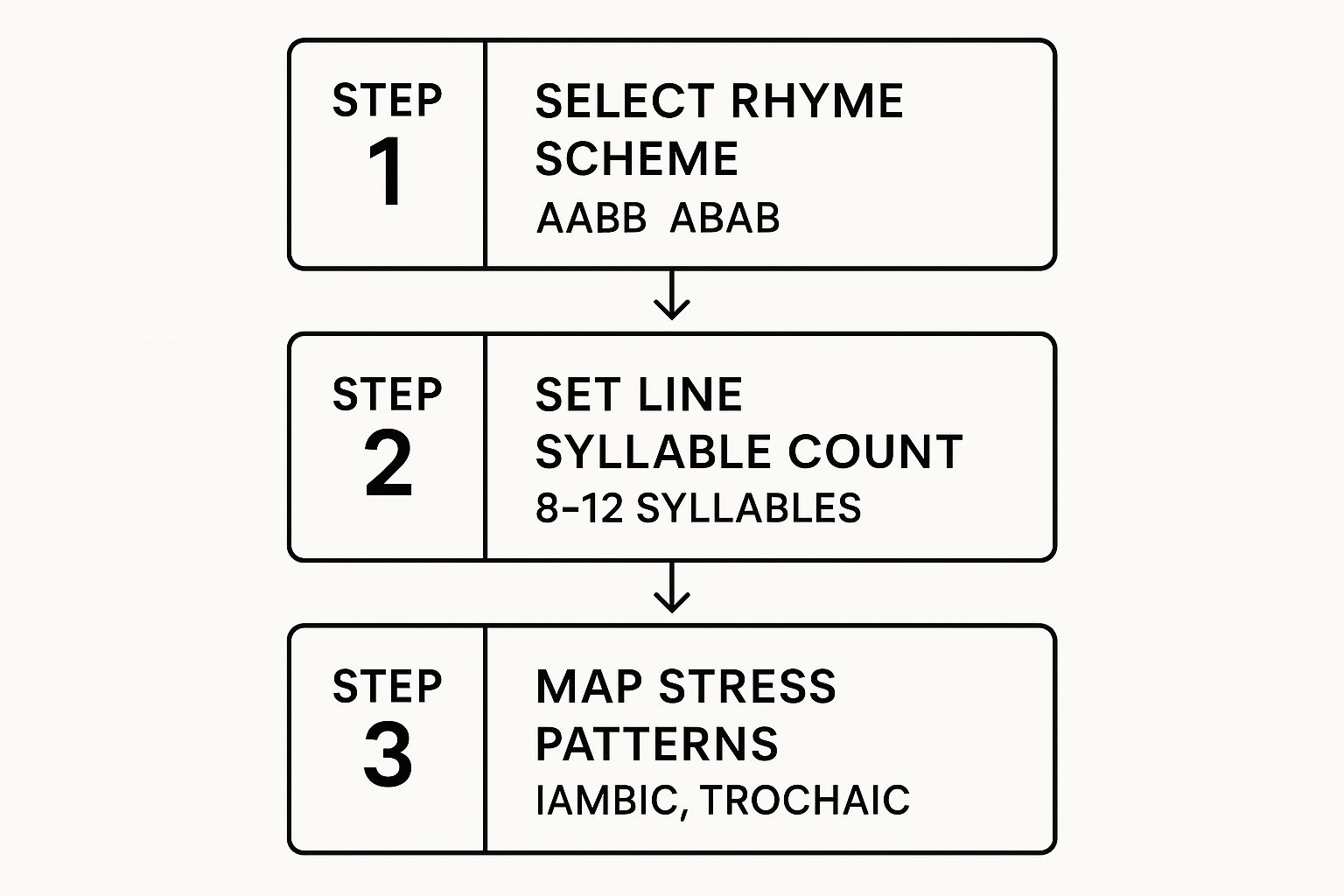
As you can see, things like picking a rhyme scheme and mapping out your syllables are what create that cohesive rhythm within your song’s structure.
Putting It All Together
For anyone just starting out, here’s a classic, can't-miss structure: Verse 1 - Chorus - Verse 2 - Chorus - Bridge - Chorus.
This pattern is so popular because it creates a really satisfying journey for the listener. The verses build the story, the choruses deliver the emotional punch, and the bridge gives everyone a little detour before you bring it home with that final, powerful hook.
If you really want to dig into making that chorus unforgettable, check out our guide on how to write a chorus.
A quick tip from my own experience: Don't think of structure as a creative prison. It's a tool. By using a familiar framework like Verse-Chorus-Bridge, you’re actually making it easier for people to follow along and connect with your lyrics. It gives your creativity a clear path.
Mastering Rhyme and Word Choice
Rhyme can be a songwriter's best friend, but it's also one of the easiest ways to trip up. We’ve all heard songs where a forced rhyme makes you cringe—it sounds cheesy, unnatural, and pulls you right out of the moment. The real trick isn't about making every line rhyme perfectly; it's about making the rhyme serve the emotion of the song.
So many new writers get stuck trying to find that one perfect word to complete a couplet, like matching "fire" with "desire." They end up twisting the whole sentence into a pretzel just to make it fit, often losing the original point entirely. A better way to think about it is to figure out what you really want to say first, and then let the rhyme follow.
Moving Beyond Perfect Rhymes
If you listen closely to your favorite songs, you'll notice they don't always use perfect, textbook rhymes. They often use what are called near rhymes, or slant rhymes. These are words that sound similar but don't match exactly. Think "home" and "alone," or "shape" and "late."
They give you that same satisfying feeling of connection but sound way more conversational and modern. It just feels less predictable.
Let's look at a quick example:
Perfect Rhyme: "I saw your face / Lost in this place." (This works, but it can feel a little too neat.)
Near Rhyme: "I saw your face / Trying to escape." (See how this feels a bit more interesting and less rigid?)
Using near rhymes opens up your vocabulary and gives you so much more creative freedom. You're no longer stuck hunting for one specific word and can instead choose the one that best tells your story.
A great lyric feels both inevitable and surprising. Near rhymes are a huge part of achieving that. You're giving the listener the sonic payoff they expect without handing them the most obvious word choice on a silver platter.
Sharpening Your Word Choice
Rhyming is only half the battle. The actual words you choose are what paint the picture for your listener. Your job is to swap out vague, generic language for words that are packed with sensory detail and emotion.
Don't just say a character is "sad." Show us. Are their "shoulders slumped"? Are they watching the "rain on the glass"? Specifics make a song feel real. It's the difference between telling someone a story and letting them experience it for themselves. A fun exercise is to take a boring line and just try to swap out the verbs and nouns for stronger ones.
This is where having a great creative assistant comes in handy. Lyric Studio has an integrated rhyme and thesaurus tool that understands the context of what you're writing. It doesn't just throw a list of random synonyms at you; it suggests words that actually make sense for the vibe of your song. It’s an amazing way to break out of your usual vocabulary and find the perfect word you didn't even know you were looking for.
Ready to find the perfect words and rhymes for your next song? Download Lyric Studio free on iOS and see what you come up with. The app is free to download, but some features might require in-app purchases.
How to Edit and Polish Your Lyrics

Getting that first draft down on paper is a huge win, but don't pop the champagne just yet. The real work—and the real magic—happens when you start to rewrite. This is your chance to take those raw, unfiltered ideas and shape them into something that truly connects with a listener.
Don't get too attached to that first version. I always think of it as the block of marble; the editing process is where you chip away to find the sculpture inside. It’s not about criticizing your work, but about uncovering its true potential. Every line can be sharper, and every word can carry more weight.
A Practical Checklist for Refining Your Lyrics
Once you’ve finished a draft, step away. Seriously. Go for a walk, grab a coffee, and come back to it with fresh eyes. The single best piece of advice I can give you is to read your lyrics out loud. Your ears will immediately catch what your eyes might miss—a clunky rhythm, an awkward phrase, or a line that just doesn't land right.
As you go through it, keep these things in mind:
Trim the Fat: Are there any extra words bogging things down? Be merciless. If a word isn't adding meaning or emotion, it’s got to go. Leaner lyrics almost always hit harder.
Strengthen Your Verbs: Hunt down weak, passive verbs and swap them for active ones. Instead of "the light was seen by me," write "I saw the light." It's more direct and pulls the listener in.
Check for Consistency: Does every line serve the song's main idea? If something feels like it came out of left field, it probably did. Make sure you’re telling one clear, cohesive story from start to finish.
This is also a good moment to think about the bigger picture. As you’re learning how to write lyrics, it pays to understand the business side of things. Recent songwriter reports have shown that roughly 61% of songwriters aren't part of any mechanical rights organization, which can make earning a traditional income tricky. It just goes to show how important it is for new artists to be proactive about their careers from day one. You can find more info on these songwriter industry shifts and what they mean for you.
Key Insight: Editing is an act of listening. Listen to how the words sound together, how the story flows, and how the song feels. Your gut will tell you what needs to change long before your brain figures it out.
Using AI to Polish Your Work
We've all been there—staring at a line that you know isn't quite right, but you have no idea how to fix it. This is where a tool like Lyric Studio can feel like a lifesaver. It’s not about letting AI write for you; it's about having a creative partner to bounce ideas off of.
The AI-driven suggestions can help you find a more powerful verb or rephrase an awkward line without losing your original meaning. It’s like having a co-writer on call who never gets tired or runs out of fresh perspectives.
Ready to take your rough draft and make it shine? Download Lyric Studio free on iOS and see how its tools can help you refine your songs today. Keep in mind the app is free to download but may have in-app purchases.
Building Your Songwriting Career
Writing powerful lyrics is the heart of what you do, but turning your art into a career means you have to start thinking a bit like an entrepreneur. It’s not just about the music anymore; building a personal brand is just as crucial as nailing that perfect hook.
These days, an online presence on platforms like Instagram and TikTok isn't just a nice-to-have. It’s often where a song first finds its audience and where a songwriter’s career can really start to take flight.
The Modern Songwriter Wears Many Hats
The job description for a songwriter has changed a lot. It's no longer just about writing songs and collecting royalties. A global survey by MIDiA Research found that songwriters are getting creative with how they make a living, branching out to build more stable careers.
What does that look like? They’re teaching, writing jingles for commercials, scoring indie films, and even offering their skills on creative marketplaces. The big takeaway from the study is that building a social media brand to connect directly with fans has become a top priority. You can dig deeper into these transformative shifts in the music business to see just how much things are changing.
Diversifying Your Songwriting Skills
To make it in today's music world, you’ve got to be versatile. Building a sustainable career means keeping your eyes open for opportunities everywhere and having the right tools ready when they pop up.
Here are a few paths to consider:
Writing for Media: This is a whole different ballgame. Crafting lyrics for a commercial or a TV show means you’re working to meet a client's specific needs, often on a tight deadline. It’s a great way to sharpen your skills under pressure.
Teaching and Coaching: Ever thought about sharing what you know? Running workshops or offering one-on-one coaching is a fantastic way to generate income and, honestly, it forces you to get even better at your own craft.
Building a Brand: Don't underestimate the power of community. Consistently sharing your work, your process, and a bit of your personality online builds a genuine connection with people who love your music. That's priceless.
Once your lyrics are polished and ready, the next step is getting them heard. It always helps to learn from artists who are already making it happen. You might want to explore some strategies for building a successful music career to see what's working for others.
As you develop all these different skills, having a solid creative toolkit makes a world of difference. To get started, you can check out our guide on the top 5 song writing tools we recommend.
A modern career requires modern tools. Download Lyric Studio free on iOS to write, refine, and get your lyrics ready for any opportunity that comes your way. (Note: The app is free, but in-app purchases may apply.)
Answering Your Biggest Lyric Writing Questions
When you're just starting out, a million questions can pop into your head. It's totally normal. Let's tackle a few of the most common ones I hear from new songwriters.
Do My Lyrics Have to Rhyme Perfectly?
Not at all. In fact, forcing perfect rhymes can make your lyrics sound clunky and a little bit childish.
Many of the most powerful songs use what we call "near rhymes" or "slant rhymes." Think about words like home and stone, or bridge and grudge. They don't match perfectly, but they have a similar sound that feels natural and conversational. Your main goal is to tell a story and create a mood—let the rhymes serve that purpose, not dictate it.
What's the Most Important Part of a Song?
Every part of a song has its job, but if you have to pick one, the chorus is where the magic really happens.
This is your song's central message, the part that gets stuck in everyone's head. It’s the musical and lyrical hook that listeners will come back to again and again. Pour your energy into making the chorus emotionally resonant and catchy. It’s your song’s heart.
How Can I Tell If My Lyrics Are Any Good?
This is the big one, isn't it? Good lyrics feel honest and connect with people. They also need to sound good when they're sung.
A great first step is to simply read your lyrics out loud. Do they flow? Is there a natural rhythm? Do they sound like something a person would actually say? If the words successfully capture the feeling you were aiming for, you've done your job. And don't underestimate the power of a second opinion—sharing your work with a trusted friend can give you the perspective you need.
The music industry is bigger than ever. The RIAA recently reported a record $5.6 billion in revenue, with over 105 million paid subscriptions globally. For new artists, that means writing lyrics that truly stand out is crucial. You can dive deeper into these music industry revenue trends to get a sense of the landscape.
Key Insight: Writer's block is just part of the process. Don't let it intimidate you. The trick is to sidestep it. Try freewriting for ten minutes without judgment, grab a random prompt, or just get up and write in a different room. Or, better yet, fire up the "Magic Draft" feature in Lyric Studio to instantly spark an idea and get words on the page.
Ready to stop wondering and start writing? With AI-driven suggestions and a whole suite of writing tools, Lyric Studio is designed to help you find the perfect words every time.
Download Lyric Studio free on iOS.

SCAN TO GET