Back to articles
How to Write Great Lyrics People Remember
Every songwriter knows the feeling. You've got a killer melody in your head or a powerful emotion you need to get out, but when you sit down to write... nothing. Just a blinking cursor on a blank screen. That initial stare-down with the empty page is often the biggest hurdle, stopping great songs before they even have a chance to breathe.
From Blank Page to First Verse in Seconds

The secret to writing great lyrics isn't about waiting for that perfect, lightning-bolt first line to magically appear. It’s about building momentum. The most effective way to beat writer's block is to sidestep it entirely. Jump straight into a rough draft—something you can react to, tear apart, and rebuild into something that’s truly yours.
Get an Instant Creative Assist
This is where having a creative assistant in your corner changes the game. Instead of wrestling with that intimidating void, you can get an immediate starting point. With Lyric Studio, you can beat the blank page with a single click.
The “Magic Draft” feature was built for this exact moment of paralysis. It instantly generates a complete first verse and chorus from just a few prompts to jump-start your songwriting.
Pick Your Genre: Are you writing pop, hip-hop, R&B, or something else? Customizing the genre sets the vibe.
Set the Mood: Is the song energetic, reflective, or romantic?
Give It a Topic: A simple theme is all you need. Think "chasing a dream in the city" or "a long-distance relationship."
From there, Magic Draft delivers a structured, relevant draft. It's not designed to be the final song; it’s a launchpad.
My Two Cents: Treat this draft like a co-writer tossing out the first idea in a session. It gives you a theme, a possible rhyme scheme, and a structure to work with, moving you from zero to a working draft in seconds. Your job is to take that raw clay and shape it with your unique voice.
Turning the AI Draft into Your Song
Once you have this foundation, the real fun begins. You're not starting from scratch anymore; you have something to play with. Read through the generated lines. What sticks out? Which phrases spark a better idea or a more honest way to say something?
Maybe an AI-driven suggestion for a rhyme feels a bit generic. Perfect—use the integrated thesaurus tool to refine your word choice and find a more clever or surprising alternative. Or perhaps a line in the verse nails a feeling perfectly, giving you a jumping-off point to weave in your own personal stories and details. It’s an interactive process that keeps the creative momentum going.
This approach turns songwriting from a lonely struggle into a dynamic collaboration. For anyone still getting a handle on the basics, our guide on the 5 steps to easily write song lyrics is a great resource that pairs perfectly with this method. By using a creative assistant as your catalyst, you’ll never get stuck on "go" again.
Finding Your Song's Core Message
Before a single lyric hits the page, every great song starts with a simple question: "What am I really trying to say?" The songs that stick with us have a clear, powerful core. It’s the emotional truth that holds the whole thing together, from the first verse to the final fade-out.
But let's be honest, finding that one big idea can feel impossible sometimes. The good news? You don't have to wait for some dramatic, life-altering event to strike. Inspiration is usually hiding in plain sight—in your daily grind, in overheard conversations, in the thoughts you have when you're alone. Learning to write powerful lyrics is really about learning to pay attention to your own life.
Uncover Your Authentic Story
The most memorable songs feel true because they are true. Forget trying to write about a topic just because it sounds cool or trendy. Dig into what feels real to you. Big, generic themes like "love" or "heartbreak" are fine as a starting point, but the magic, the stuff that makes people lean in, is always in the details.
So, how do you find those specifics? It's less about divine inspiration and more about good habits.
Journal for Raw Material: Spend a few minutes each day just writing. No filter, no judgment. Jot down what happened in your day, a weird dream you had, or a random memory that surfaced. You're not writing lyrics yet—you're just mining for emotional gold.
Mind-Map Your Feelings: Take one emotion, like "anxious," and put it in the middle of a page. Now, branch out from it with anything and everything that word brings to mind. "Anxious" could lead to "late-night phone calls," "the low hum of the fridge," or "checking the clock again and again." Those are the details that build a world.
Be an Active Observer: Next time you're on a walk or grabbing coffee, put your phone away. Really look around. Listen to how people talk. A whole story can be hiding in the way an old couple holds hands or the fresh graffiti on a brick wall.
A song about "heartbreak" is easy to forget. But a song about seeing your ex’s car parked outside a new apartment, with a box of their favorite takeout on the passenger seat? That’s a story. That’s a message that hits you right in the chest.
Set the Scene with Genre and Mood
Once you've got that spark of an idea, it's time to give it some shape. This is where thinking about your genre and mood becomes a secret weapon. It’s like a creative filter that helps you match your words to the sound you hear in your head.
Think about it: a message about overcoming a struggle will feel completely different as an upbeat pop anthem versus a gritty, reflective hip-hop track. Is it a hands-in-the-air, "we made it" moment, or a raw, honest story about the fight to get there?
This is where a tool like Lyric Studio can be a game-changer. Before you even write a line, you can set the stage.
Genre: Choose from pop, R&B, hip-hop, and more to get the right musical vibe.
Mood: Select a feeling like 'Reflective,' 'Uplifting,' or 'Melancholy' to guide the emotional tone of your words.
Setting this up from the start focuses your entire process. The AI-driven suggestions you get will be custom-fit for a 'Reflective' hip-hop track or an 'Uplifting' pop song. It ensures your lyrics and the musical feel are working together from the get-go, creating a song that’s cohesive and truly impactful.
Ready to find your song's core message and start writing with a clear focus? Download Lyric Studio free on iOS and see for yourself how defining your genre and mood can shape your next great idea. Please note that while the app is free to download, in-app purchases may apply.
Mastering Rhyme Without Sounding Cliché
Let's be honest, rhyme is the engine of most songs. When it’s working well, it drives the rhythm forward and makes your lyrics unforgettable. But when it’s bad, it sounds forced—like a cheesy, grade-school poem.
The biggest giveaway of an amateur lyric is when the story is clearly twisted just to make a rhyme work. Are you contorting your sentences into awkward shapes just to land a perfect rhyme? If so, you’re breaking the spell and losing the listener's trust. A great rhyme should feel both surprising and inevitable, clicking into place without a hint of effort.
To get there, you have to move beyond the basic AABB couplets (cat/hat, moon/spoon) we all started with. While simple rhymes have their place, leaning on them too heavily makes a song feel flat and predictable.
Beyond Basic End Rhymes
To give your lyrics some real texture and sophistication, you need to expand your rhyming toolkit. The best songwriters mix and match different rhyme types. It creates a natural, almost conversational flow that keeps you hanging on every word. Think of it like having more colors on your lyrical palette.
Here are a few techniques to use:
Internal Rhymes: This is when you place a rhyming word inside a line, not just at the end. For example: "The pain of the rain kept washing my thoughts away." It creates this subtle musicality within the verse itself.
Near Rhymes (or Slant Rhymes): This is a powerful trick. You use words that have similar, but not identical, sounds. Think home and alone, or shape and late. This technique feels much more modern and less rigid, giving you the freedom to choose words that actually fit what you're trying to say.
Assonance & Consonance: These are the building blocks of near rhymes. Assonance is repeating a vowel sound (like the 'i' in "will lift this spirit"), while consonance is repeating a consonant sound (like the 'k' in "the dark, sticky lock").
The goal is to make your lyrics sound like someone is actually speaking, not like you're reading from a greeting card. When you use a mix of perfect, near, and internal rhymes, your song flows better and the emotional core of your message hits so much harder.
Finding the Right Words Without Sacrificing Meaning
We've all been there—you have the perfect idea, but the right words just won't come. It's one of the most frustrating parts of being a writer. The solution isn't just finding a long list of words that rhyme with "fire"; it's about finding the one word that also fits the unique emotion and story of your song.
This is where having a smart assistant can be a game-changer. For this, turn to Lyric Studio. Its integrated rhyme and thesaurus tools are context-aware, meaning they adapt to your song's specific theme and mood. If you're writing a moody R&B track, it won’t just spit out generic rhymes; it will suggest words that match that specific vibe. It’s an incredible way to discover creative word choices you might not have found on your own.
This balance between a rich vocabulary and catchy repetition is a real hallmark of hit songwriting. Interestingly, an analysis of Billboard Top 100 hits found that in the 1980s, hit songs used an average of 261 unique words—nearly 50 more than in the 1970s. This shows that while repetition is crucial for hooks, lyrical depth in the verses is what can make a song truly great.
Instead of watering down your message to fit a rhyme, a tool like this helps you find rhymes that actually amplify your message. For more tips on speeding up this part of your process, check out our guide on how to make rhymes faster without losing quality.
Ultimately, great rhyming isn't a rigid science. It’s a creative art. Experiment, bend the rules, and find what feels right for your song.
Building a Structure That Tells a Story
A song's structure is its emotional roadmap. It’s what guides your listener from the opening line to the final hook, making sure your message doesn't just meander. Without a solid framework, even the most beautiful lyrics can fall flat, feeling disorganized and unsatisfying.
Think of it like this: every great story has a beginning, a middle, and an end. Your song is no different. The structures we see over and over again—like the classic Verse-Chorus-Verse-Chorus-Bridge-Chorus—exist for a reason. They just work. They create a pattern of tension and release that our brains are naturally wired to enjoy.
The Anatomy of a Great Song
To build a song that feels both familiar and fresh, you need to understand the job of each section. This isn't about following rigid rules; it's about making intentional choices that serve your story.
Here's how to think about the core components:
The Verse: This is where you do the heavy lifting of storytelling. Your verses should introduce characters, paint a picture of the scene, and push the narrative forward with specific details and imagery. Each new verse should reveal a little more of the story.
The Chorus: This is your song's heart. It’s the big, memorable idea that listeners will be singing in their heads later. A great chorus is both powerful and concise, crystallizing the central theme of your song.
The Bridge: This is your chance to change things up. The bridge can introduce a new perspective, raise the emotional stakes, or simply offer a moment of quiet reflection before you slam back into that final, powerful chorus.
As you build out your song's narrative, playing with different storytelling techniques can be a game-changer for keeping your audience hooked from start to finish.
Key Takeaway: Your song's structure isn't a cage—it's a framework. Use it to guide your listener. Let the verse tell the story, the chorus drive home the feeling, and the bridge offer a new angle.
Making Every Part Count
The best songs feel like a journey. A verse might build tension and ask a question, and the chorus provides the emotional release or the answer. For instance, if your verse quietly describes the loneliness of a rainy city street, your chorus could explode with the raw feeling of missing someone.
Nailing that perfect, impactful chorus is often the hardest part. It needs to be catchy without sacrificing the authenticity of your song’s message. If you want to dig deeper, our guide on how to write a great chorus is packed with specific strategies to make your hooks unforgettable.
Once you have a draft, the real work of polishing begins. It's an iterative process.
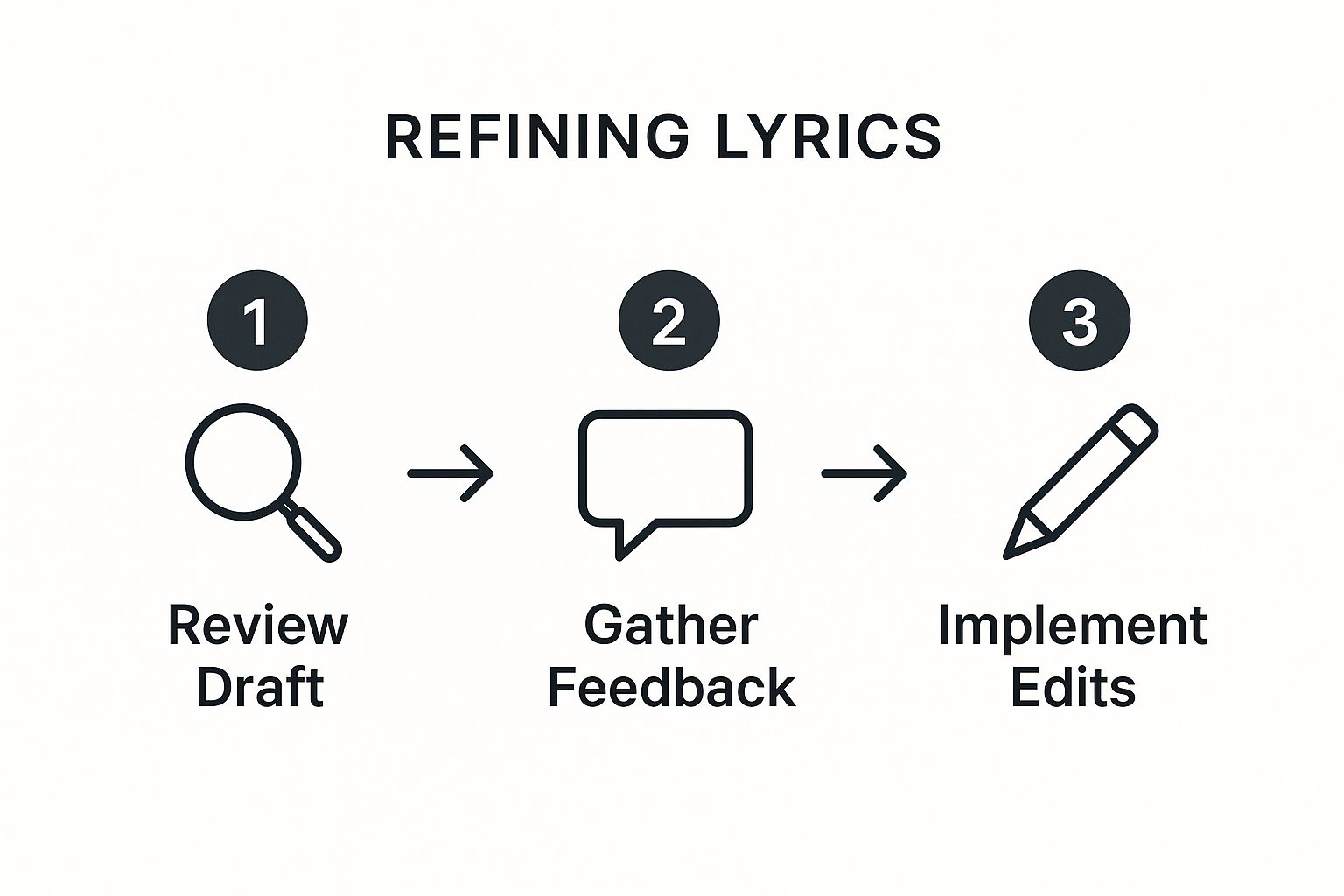
This simple flow—drafting, getting feedback, and refining—is the secret to turning a good idea into a great song. It’s a cycle, not a straight line.
Interestingly, you don't always need a complex structure to make an impact. Sometimes, simplicity is what connects most. Simpler, more repetitive lyrics tend to stick in our heads, which is a huge advantage in today's music world.
When you're ready to play with different structures, Lyric Studio can be a massive help. The “Magic Draft” feature can instantly generate a verse and chorus, giving you a solid starting point. From there, you can focus your creative energy on shaping the story and adding your unique voice, instead of getting stuck on where to begin.
Making Your Lyrics Hit Hard With Real Emotion
The best lyrics don't just state an emotion—they make you feel it. This is the whole idea behind the classic advice, "show, don't tell," and it's the secret to pulling a listener right into the world you're building with your song.
Think about it. "I was sad" is flat and forgettable. But describing the "cold coffee on the nightstand" or the "sound of rain against the windowpane"? That paints a picture. It conjures a feeling of loneliness that everyone understands, without you ever having to say the word "lonely." By homing in on those specific, personal details, you tap into experiences we all share and create a much stronger connection.
Turning Vague Feelings Into Vivid Pictures
So, how do you find these powerful details? Start with the core emotion of your song and ask yourself what it physically feels like. What does it look, sound, smell, or taste like?
Instead of writing about "feeling lost," you could describe "walking under streetlights that all buzz the same broken tune." Rather than saying you're "in love," you could show it by writing about "the way you trace the constellations on their back." These aren't just descriptions; they’re emotional anchors that ground the song in reality.
Sight: Don't just see "a messy room." See the "dirty clothes piled high on the chair where you used to sit."
Sound: It's not just "quiet." It's "the low hum of the fridge that suddenly feels deafening."
Touch: What's the physical sensation? Think "the sharp chill of the wind through a threadbare jacket."
Smell/Taste: These senses are incredible memory triggers. Consider "the stale smell of last night’s party" or "the bitter taste of coffee gone cold."
When you start thinking in these sensory terms, your lyrics suddenly have a real-world weight to them. They become authentic and tangible.
Pro Tip: Keep a note on your phone or in a small notebook for sensory details you notice in your daily life. The specific color of a sunset, a weird snippet of a conversation you overhear, the feeling of a cold steering wheel on a winter morning. This little habit builds an amazing library of raw, real-world material for your songs.
We can transform abstract feelings into concrete, relatable imagery by using a few key techniques. This table breaks down how to make that happen, turning your internal world into something your audience can see and feel for themselves.
Crafting Emotional Impact With Your Lyrics
Technique | Description | Example |
|---|---|---|
Sensory Detail | Engaging the five senses (sight, sound, smell, taste, touch) to ground the emotion in a physical experience. | Instead of "I miss you," try "I still smell your perfume on my pillow." |
Specific Actions | Showing the emotion through a character's specific, observable behavior. | Instead of "He was angry," try "He clenched his fists so tight his knuckles turned white." |
Metaphor/Simile | Comparing the abstract feeling to a concrete object or experience to make it more understandable. | Instead of "I felt free," try "A weight lifted, light as a feather on the breeze." |
Concrete Nouns | Using specific, tangible objects that carry emotional weight or symbolism. | Instead of "I remember our past," try "I found that faded photograph in a shoebox." |
By weaving these kinds of details into your lyrics, you don't just tell a story—you invite the listener to live inside it for a few minutes.
How Personal Details Become Universal Truths
Here’s one of the great paradoxes of songwriting: the more specific and personal you are, the more universally your song will connect. When you write with raw honesty about your own unique experience, you'll inevitably hit on feelings that everyone, everywhere, understands. That shared emotional truth is what gives a song its staying power.
Just look at a song like Radiohead's 1992 hit 'Creep'. Its power comes from its brutally honest and resonant lyrics about feeling like an outsider in the face of obsessive love. It’s a theme that strikes a chord with millions. As you can see from other insights about popular lyrics, while technical skill is important, the ability to trigger a deep emotional response is what makes a song timeless.
This is where a creative assistant can be a game-changer. Sometimes you know exactly what you want to say, but the perfect words are just out of reach. Tools like Lyric Studio are built to help you bridge that exact gap. Its AI-driven suggestions are context-aware, meaning they adapt to your song’s unique theme and emotion.
If you’re writing about nostalgia, for instance, it might offer phrases that bring up childhood memories or the feeling of time passing. It's not about writing the song for you; Lyric Studio is a creative assistant that helps you discover more descriptive and emotionally-charged language. It can give you that perfect, unexpected detail that makes your story not just heard, but truly felt.
Ready to turn your feelings into unforgettable lyrics? You can download Lyric Studio free on iOS and start painting vivid emotional pictures with your words. (Note: While the app is free to download, in-app purchases may apply.)
Common Lyric Writing Questions Answered
Even after you've been at it for a while, certain questions seem to pop up again and again. Hitting these roadblocks is just part of the process. Here are some answers to common questions from fellow songwriters, along with practical advice to keep you moving forward.
How Do I Know When a Song Is Finished?
Ah, the million-dollar question. The honest answer? A song is never really "finished"—it's just "ready." You could tweak a word here or polish a rhyme there forever. The real goal is to get it to a point where it nails its core message and just feels emotionally complete.
So, when is it ready?
The story feels whole. Does the listener follow the journey from the first line to the last? Your narrative needs a clear arc, even if it's an abstract one.
The emotion lands. When you play it back, does it hit you in the gut? If you don’t feel it, odds are nobody else will either.
Every part has a purpose. Can you justify every single line? If a word or phrase isn't serving the story, the rhythm, or the feeling, it’s probably time to let it go.
Ultimately, you have to decide to step away. Chasing perfection is a trap that can keep your best work hidden forever. Get it out there, play it for someone, and start on the next idea.
How Do I Write Lyrics to an Existing Melody?
This happens all the time, especially when you're collaborating or working with a producer. The music already has its own emotional DNA; your job is to find the words that belong there. The secret is to let the music itself dictate your phrasing.
Listen to the melody on a loop. I mean, really listen. Notice the natural rhythm, where the stressed syllables fall. Hum along with nonsense "scat" syllables—your "da-da-das" and "ooh-ahhs"—to map out the flow. You'd be surprised how often those placeholder sounds hint at the vowel sounds your final lyrics should have.
From there, soak in the mood. Is the track melancholic? Uplifting? Tense? That's your starting point for a theme. Let the feeling of the music point you toward a topic. If you’re drawing a blank, a tool like Lyric Studio can be a lifesaver here. You can plug in the genre and mood to match the track, and it will give you context-aware suggestions that fit the vibe you're working with.
What If I Get Writer's Block Anyway?
Writer's block is going to happen. It's not a sign you've lost your creativity; it’s a sign you need to change your angle of attack. The absolute worst thing you can do is stare at a blinking cursor.
My Advice: The best way to beat the block is to trick your brain. Step away from the song completely. Go for a walk, put on an album by an artist you love, or doodle in a notebook. The solution usually shows up the moment you stop hunting for it.
Another great strategy is to generate new ideas without any pressure. This is where a feature like Lyric Studio’s “Magic Draft” really shines. Instead of agonizing over the song you're stuck on, feed it a totally new prompt and let it generate a fresh verse-and-chorus. This isn’t about starting over—it’s about jump-starting the creative engine. Seeing a new idea take shape often sparks the very solution you needed for the original problem.
The key is to keep creating, even if it’s not for your main project. Momentum is the enemy of writer's block.
Ready to break through creative blocks and finally finish that song? Lyric Studio is built to be your creative assistant every step of the way. Download Lyric Studio free on iOS and start turning your ideas into songs people will remember. Please note that while the app is free to download, in-app purchases may apply.

SCAN TO GET