Back to articles
How to Write Good Songs That Actually Connect

Every great song starts with a single, powerful idea. Before you even think about a melody or a rhyme scheme, you need to lock onto an authentic emotion or a story that needs to be told. This is your foundation—the north star that gives your entire track a sense of purpose.
The Art of Finding Your Song's Spark
Many songwriters try to force a song into existence without a clear concept, and it almost never works. Think of your core idea as your song's mission statement. Is it about the bittersweet feeling of nostalgia? The anger of being betrayed? The simple joy of a perfect summer day?
Writing without this guiding principle is like trying to build a house without a blueprint. You might end up with some nice-looking walls and a solid floor, but they won't fit together into a cohesive, meaningful structure.
This early stage is all about being an observer and a collector of moments. Inspiration doesn't punch a clock; it shows up unannounced. It might be a line you overhear at a coffee shop, a sudden memory that hits you, or a gut reaction to something in the news. Your job is to be ready when it arrives.
How to Catch Those Fleeting Ideas
Your phone is your best friend here. Get comfortable with a notes app or voice memos to capture anything that sparks your interest, no matter how small or strange. The key is not to judge the idea in the moment—just get it down. A random phrase you record today could easily become the hook for your next big song.
Here’s what to listen for:
Specific Emotions: Don't just settle for "sad." Dig deeper. What about "the hollow feeling of walking through your empty apartment after a breakup"?
Vivid Imagery: "A rainy Tuesday morning" paints a much clearer picture than just "a bad day."
Unique Phrases: Keep an ear out for interesting words or lines that carry a double meaning. These are lyrical gold.
Turning a Spark into a Song Concept
Once you’ve collected a few ideas, pick the one that won't leave you alone. Before you jump into writing lines, take a minute to define its core elements. What’s the central theme? Who is telling this story? What’s the mood—is it reflective, angry, hopeful?
To help organize your thoughts, it's useful to nail down a few key building blocks before you go any further.
Core Elements of a Strong Song Concept
This quick reference table outlines the essential things to define before you start writing.
Element | Description | Why It Matters |
|---|---|---|
Main Theme | The central idea or message of the song. | Gives the song a clear purpose and emotional focus. |
Narrator (POV) | Who is telling the story? (e.g., first-person, third-person) | Shapes the listener's connection and perspective. |
Emotional Arc | How does the feeling change from start to finish? | Creates a dynamic journey and keeps the listener engaged. |
Core Imagery | Key visual symbols or metaphors you plan to use. | Makes your lyrics memorable and impactful. |
Nailing these down provides a clear roadmap, making every decision—from chord choices to lyric specifics—so much easier.
"The truth is, there is no set rule that says one has to come before the other. Every songwriter is different, and so are their songwriting methods."
But what happens when you’re just staring at a blank page, and the spark just isn't there? This is where modern help can make a huge difference.
If you have a theme but no words, an app like Lyric Studio can be a massive help. Its “Magic Draft” feature can instantly generate a first verse and chorus to get the ball rolling. It’s not about replacing your originality; it's about giving you a launchpad. You get a tangible starting point to react to, edit, and build upon, turning that vague feeling into concrete lyrics.
Ready to find your spark and break through writer's block? To cultivate your creative mindset, explore strategies that help unlock creativity and creative thinking.
Writing Lyrics That Tell a Story

Great lyrics are what turn a nice melody into a song that gets stuck in someone’s head for days. It’s not about finding the cleverest rhymes—it's about telling a story. Your words need to paint a picture and make the listener feel something real.
The best lyricists are storytellers first. The goal is to get someone to see the world through your eyes for a few minutes. That’s how you write a song that truly connects.
So, how do you do that? You get specific. Instead of just saying a relationship was "difficult," you show it. Describe the chipped coffee mug they left on the counter or the heavy silence during a long car ride. Those are the details that make a story feel true.
From Vague Ideas to Vivid Scenes
Specificity is your secret weapon. It’s what makes a line hit hard instead of just floating by. A listener might not have lived your exact experience, but they’ll recognize the emotion in your imagery.
Here’s a little exercise to get the ball rolling:
Start with a feeling: Let’s go with nostalgia.
Tie it to a sense: What does nostalgia smell like? Maybe it’s rain on hot pavement.
Drill down on the detail: "Summer rain on the asphalt" is good. But what about "the smell of rain on asphalt after the Fourth of July parade"? Now you’ve got a whole scene in one line.
This is exactly where an app like Lyric Studio can be a massive help. When you’re stuck on a phrase, its AI-driven, context-aware suggestions give you fresh angles. You can set the mood, and it feeds you ideas that fit your song's vibe, nudging you toward that perfect, vivid detail.
Finding the Perfect Words
Once you have your core images, it’s time to fine-tune your word choice. Every single syllable matters. Does "walked" feel as heavy as "trudged"? Does "whispered" have the same intimacy as "murmured"? This is the polishing stage.
"In the process of eliminating things that don’t help you write a better song, you also eliminate things that don’t help you live a better life." - Jason Isbell
For more ideas on building a narrative, it’s worth checking out some visual storytelling techniques. Even though they’re for visuals, the principles of creating an emotional arc are the same. You're guiding your listener on a journey.
The right tools make this so much easier. Lyric Studio’s integrated rhyme and thesaurus tools are a godsend here. Instead of killing your creative flow by opening a new tab to find a synonym, you get smart suggestions right in the editor. It helps you dodge clichés and find words with the exact emotional weight you’re looking for.
If you want to go even deeper on this, our guide on the 5 steps to easily write song lyrics breaks it down even more.
At the end of the day, writing lyrics that tell a story is about paying attention—to your own feelings and the tiny details around you. When you pair that human insight with smart tools, you're well on your way to writing songs that stick.
Download Lyric Studio free on iOS and start telling your story. Note that in-app purchases may apply.
Structuring Your Song for Impact
You’ve got some powerful lyrics down. Now what? You need a solid framework to hang them on. Think of song structure as the invisible blueprint that guides your listener from the first line to the last, making the emotional journey feel natural and satisfying. Without it, even the best lyrics can feel like a jumble of disconnected ideas.
This isn't about boxing yourself into a formula. It’s about using proven patterns to build and release tension, arranging your musical ideas into a story that keeps your audience hooked.
This visual guide breaks down a pretty standard songwriting workflow, showing how all the different pieces fit together.
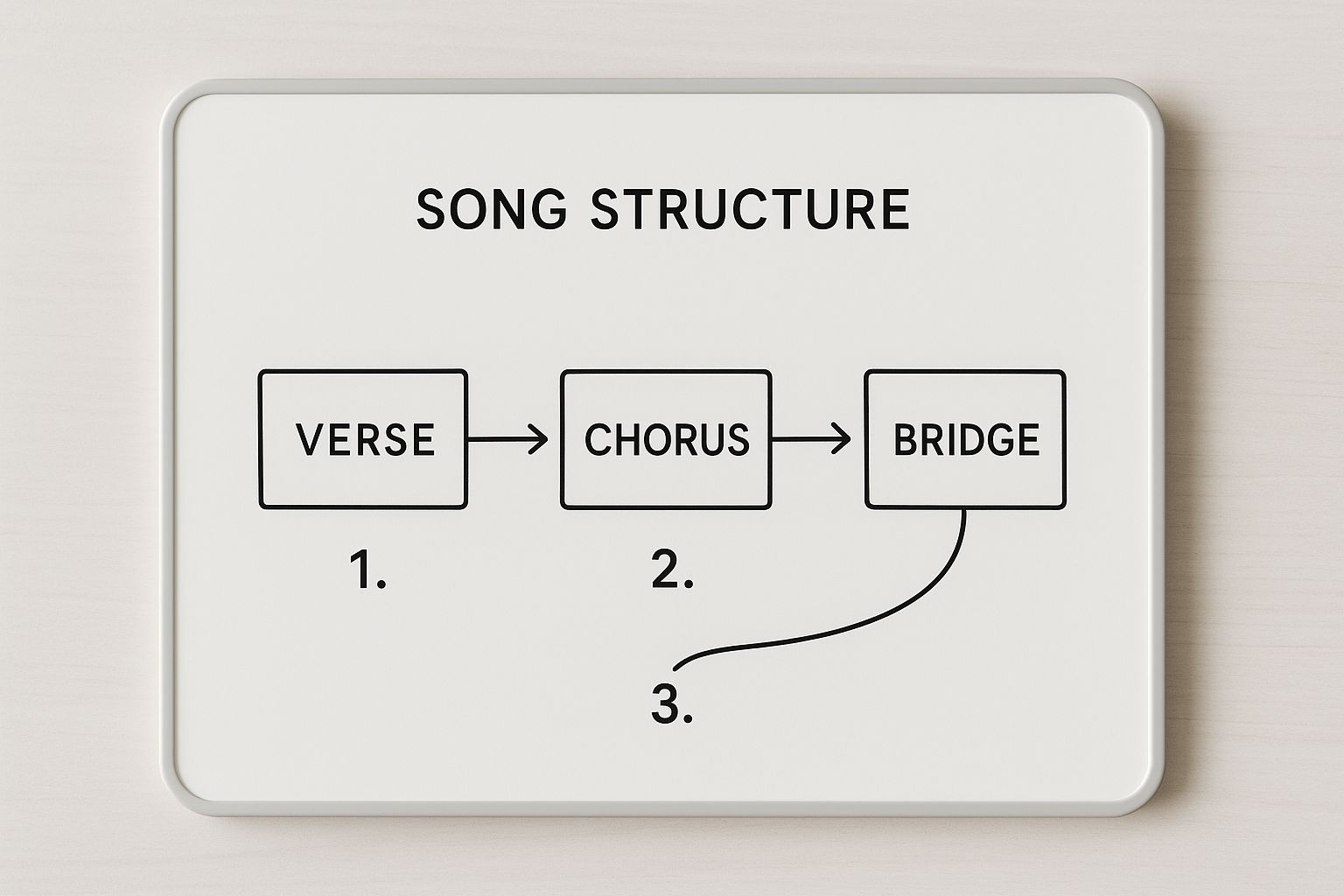
As you can see, the verses build the story, the chorus hits home with the main message, and the bridge throws in a new perspective—all leading to a powerful finish.
The Power of Verse and Chorus
The most common and reliable structure you’ll find in pop, hip-hop, R&B, and rock is the classic Verse-Chorus format. It’s popular for a simple reason: it just works.
The Verse: This is where you tell your story. Each verse should reveal new details, move the narrative forward, and build a little anticipation for what’s coming next.
The Chorus: This is your big moment—the hook, the song's central idea. The chorus usually repeats the same lyrics and melody, making it the one thing people will be humming all day.
The real magic is in the contrast between them. A quiet, detailed verse makes a loud, anthemic chorus feel massive. This dynamic shift is what keeps a song from feeling boring or repetitive. Mastering this push-and-pull is a game-changer when you're learning how to write good songs.
Adding Dynamic Sections
While the Verse-Chorus combo is the backbone, other sections add depth and keep things interesting. The bridge, for example, is your chance to introduce a new musical or lyrical idea. It provides a fresh perspective right before you circle back to that final, powerful chorus. It's the perfect spot for a moment of reflection or a twist in the story.
If you want to dive deeper into this crucial section, check out our guide on how to write a bridge for some practical tips.
A song structure is like a roadmap. You can take detours and explore side roads, but you always know where you're headed, ensuring the listener enjoys the ride without getting lost.
Building a structure from scratch can feel intimidating, but you don’t have to do it alone. Lyric Studio can help you organize your ideas with genre and mood customization, guiding you toward an arrangement that fits what you're trying to say. Instead of getting stuck on the "how," you can focus on telling your story. Ready to build your next hit? Download Lyric Studio free on iOS. Note that in-app purchases may apply.
Crafting Unforgettable Melodies and Hooks
Alright, you've got your lyrics. They tell the story, but it's the melody that truly makes it sing. A killer melody is that magnetic force that grabs a listener and doesn't let go, echoing in their head long after the track ends.
You don't need a music theory degree to write a great one. The secret is connecting the sound to the emotion of your words.
Think about how you talk. Your voice naturally rises and falls, speeds up and slows down. The most powerful melodies do the same thing. They follow the emotional contours of your lyrics, creating a vocal line that feels completely natural to both sing and hear.
The Heartbeat of Your Song: The Hook
Let's talk about the hook. This is the single most memorable part of your song, almost always planted in the chorus. It's that one little musical-lyrical phrase that jumps out of the speakers and sticks in your brain.
So, what’s the secret sauce for an unforgettable hook? It’s usually a clever mix of repetition and a subtle twist. You're aiming for something that feels instantly familiar yet surprisingly fresh. We actually go deep on this topic, so if you want to learn more, check out our guide on what makes a good hook.
This one element is often the deciding factor in whether a song becomes a smash hit. The music business has changed, but the power of a hook hasn't. Back in 1909, the U.S. introduced mechanical royalties, giving songwriters a steady, fixed rate for physical sales of vinyl and CDs. Today, streaming has flipped the script entirely, tying payments to individual streams and making income far less predictable for creators. It’s a whole new ballgame.
Building Melodies From the Ground Up
Feeling stuck on where to even start with a melody? Just grab a guitar or sit at a piano and hum along to a simple chord progression. Seriously, you don't need anything fancy. Many of the biggest hits in history were built on just three or four basic chords.
Here are a few things to do when you're searching for a melody:
Play with Rhythm. Sing your lyrics over a simple drum loop, trying out different timings. You’d be amazed how changing the rhythm can completely alter the energy of a line.
Follow the Vowels. This sounds a bit weird, but listen to the vowel sounds in your words. Sometimes, the natural shape of an "oh" or an "ee" can suggest a melodic rise or fall.
Record Everything. And I mean everything. Your phone's voice memo app is your best friend. Capture every little scrap of a melodic idea that pops into your head. You can always stitch the good parts together later.
The process is messy, but that's where the good stuff is found. This is another spot where an app like Lyric Studio can really help. Its genre and mood customization for hip-hop, pop, R&B, and more can give you a musical vibe that matches your lyrics, providing a solid starting point to build from.
A simple, honest melody that serves the emotion of the lyric will always hit harder than a complex one that just gets in the way.
Ultimately, you're searching for a vocal line that elevates your story. It should feel so intertwined with the words that you can't imagine one without the other. That perfect marriage of lyric and melody is what turns a good song into a great one.
Navigating the Modern Music Landscape
Not too long ago, writing a great song felt like crossing the finish line. These days, it's just the starting line. The job of a songwriter has spilled out of the writing room and into the public square. To really succeed, you often have to be a creative entrepreneur, building your own brand and connecting directly with the people who love your music.
This isn't just about marketing; it's about survival. It's about finding new opportunities in a changing industry. A recent eye-opening study from MIDiA Research showed that in the streaming age, a songwriter's income is more spread out than ever. The report found that about 20% of songwriters are now putting real effort into their social media to build that direct line to fans—and it's paying off with more music and more releases.
The Songwriter as an Entrepreneur
This new reality means you have to start thinking like a business owner. Your songs are your product, and your brand is the story you tell around them. When you build a following, you're creating a community of people who will be the first to stream your new track, buy a t-shirt, or grab tickets to a show.
This approach gives you a shot at creating new income streams that go way beyond the unpredictable trickle of streaming royalties. It puts you in the driver's seat of your career, letting you carve out a sustainable path on your own terms.
Building a personal brand isn't about being an influencer; it's about giving your music a voice and a face, creating a deeper connection that turns casual listeners into dedicated fans.
Once your songs are ready, getting them out there is everything. To really connect with your audience and start building that brand, you'll need some fresh ideas. You can explore these creative social media content ideas to get started.
Streamlining Your Creative Workflow
With all these new hats to wear, your actual creative time is more precious than ever. You can't afford to waste it. What you need is an efficient workflow that keeps you focused on the most important thing: writing incredible music. This is where a dedicated creative assistant can change the game.
Songwriting apps can help you get from a spark of an idea to a finished lyric much faster, which frees up your headspace for all the other stuff like promotion and connecting with listeners. An app like Lyric Studio can become that essential partner. Its AI-driven, context-aware suggestions and integrated rhyme tools are perfect for busting through writer's block, while its genre and mood features help keep your original vision sharp and clear.
Don't let the business side of music kill your creative spark. Download Lyric Studio free on iOS and see how much faster you can bring your songs to life. Note that in-app purchases may apply.
Your Top Songwriting Questions, Answered
Even with a solid grasp of the basics, you're bound to hit a few snags in the creative process. It happens to everyone. Let's tackle some of the most common questions that pop up for songwriters, so you can push past those hurdles and keep the music flowing.
Every artist's path is different, but a lot of the challenges we face are surprisingly similar.
How Long Should It Take to Write a Song?
Honestly, there's no single answer. You hear stories about massive hits being scribbled on a napkin in 20 minutes, while other iconic songs took years to get just right. The real goal isn't speed—it's about capturing a feeling and telling a story effectively.
Instead of watching the clock, focus on making each part of the song—your verse, your chorus, your bridge—as strong as it can possibly be. If you rush to the finish line, you'll almost certainly leave better ideas on the table. Let the song evolve at its own pace.
What Should I Do If I Get Writer's Block?
First off, don't panic. Writer's block isn't a sign that you've lost your touch; it's just a normal part of being a creative person. The best way to break through it is usually to just change something up.
Step away from your instrument for a day. Go for a walk. Call up another musician and see if they can lend a fresh ear to your idea. This is also where a creative assistant can be a huge help. For instance, the “Magic Draft” feature in Lyric Studio is built for this exact moment. It can instantly generate a verse and chorus from your initial concept, giving you something concrete to react to and edit. Sometimes, just having that first draft to tear apart is all it takes to get the gears turning again.
Do I Need to Know Music Theory to Write Songs?
Absolutely not. While knowing some theory about chord progressions or song structure can be useful, tons of legendary songwriters wrote timeless music purely by ear. Your intuition and your unique voice are far more important tools.
The main thing is to chase what sounds and feels right to you. That raw emotion is what connects with listeners, not how well you follow the rules.
A powerful idea and an honest feeling will always trump technical perfection. Don't ever let a lack of formal training hold you back.
How Do I Know When My Song Is Finished?
A song is "finished" when you feel like it successfully says what you wanted it to say, and any more tinkering might actually make it worse. It’s a fine line to walk between polishing a song and overworking it into the ground.
One of the best tricks is to simply put it away for a few days. When you come back to it, you'll have fresh ears. Does the story still land? Does the melody still move you? Another great move is to play it for a trusted friend or mentor. Getting that outside perspective can tell you everything you need to know. At some point, you have to let go. Perfectionism is often just a fancy word for fear, so learn to recognize when your work is ready to be shared.
Ready to tackle these challenges and make your songwriting process a little smoother? Lyric Studio is the creative partner you need.
Download Lyric Studio free on iOS. Note that in-app purchases may apply.

SCAN TO GET