Back to articles
How to Write a Good Song: Tips to Create Music That Connects

Before you can figure out how to write a good song, you need to find its heart. This is the central idea, the core message, the one thing you're trying to say. Everything else—the lyrics, the melody, the chords—will be built on this foundation. The best, most unforgettable songs almost always come from a real place: a personal story, a powerful emotion, or just a weird observation you can't get out of your head.
Finding Your Song's Core Message

Every great song starts small. It doesn't begin as a fully-formed masterpiece but as a single, nagging thought. Think of this idea as your song's North Star—it’s the point you'll keep coming back to, the thing that guides every decision you make along the way. Getting started isn't about waiting for some mythical bolt of lightning; it's about getting into the habit of noticing and capturing ideas as they float by.
The real secret? Pay attention to your own life. Some of the most powerful songs ever written are just honest stories. The rush of a new love, the gut-punch of a breakup, the quiet desperation of a job you hate—these are the things people connect with. Your authentic experiences are a goldmine for relatable music.
From Vague Feeling to Concrete Idea
Once you have that spark, the next move is to give it some shape. What does this song feel like? Is it a fist-pumping pop anthem, a quiet R&B ballad for a rainy day, or an in-your-face hip-hop track? Nailing down the genre and mood early gives you a creative sandbox to play in.
This one decision immediately helps you clarify things like:
Lyrical Tone: Are you going to be direct and conversational, or more poetic and abstract?
Musical Style: Are we talking major key and uplifting, or minor key and contemplative?
Overall Vibe: Do you want people dancing, or do you want them thinking?
If you’re feeling a little lost, a creative assistant like Lyric Studio can really help you find your footing. Right at the start, you can select the genre and mood you're aiming for. This simple step helps focus your creative energy, making sure every line you write serves your original vision.
Key Takeaway: Choosing a mood and genre isn't about limiting yourself; it's about giving yourself direction. It provides a clear identity for your song and stops you from getting overwhelmed by a million different possibilities.
Getting Past the Blank Page
Let's be real: sometimes the hardest part is just starting. You might have a feeling swirling around in your head but can't quite wrestle it into words or a melody. That's completely normal. If you're stuck staring at a blank page, learning how to overcome creative block is a skill that will pay off for your entire songwriting journey.
Make capturing ideas a habit. Keep a notebook, or use the voice memos app on your phone. Whenever an interesting phrase, a cool melody fragment, or a strong feeling hits you, record it. No judgment, just collect. This little library of raw material will become an invaluable resource when you actually sit down to write.
Ultimately, finding your song's core is about turning something you feel on the inside into a concept people can grasp on the outside. It’s the non-negotiable first step in learning how to write a good song.
Ready to turn those thoughts into music? Download Lyric Studio free on iOS and start shaping your vision with tools designed to help at every stage. In-app purchases may apply.
Writing Lyrics That Tell a Compelling Story
You've got your core idea. Now it's time for the fun part: turning that idea into lyrics that grab a listener and don't let go. Your words are the most direct line to your audience's heart. It's how you paint pictures, spark feelings, and tell a story that sticks. Honestly, learning how to write a good song is really about learning how to tell a good story with your words.
The best lyrics create a whole world for the listener to step into. They aren't just a collection of clever rhymes; they set a scene, introduce characters (even if that character is just you), and build an emotional journey from start to finish. The key is to get specific. Instead of just saying you're sad, you could describe the way the rain streaks down the window or the empty, cold space on the other side of the bed.
That's how a song becomes more than just words—it becomes an experience.
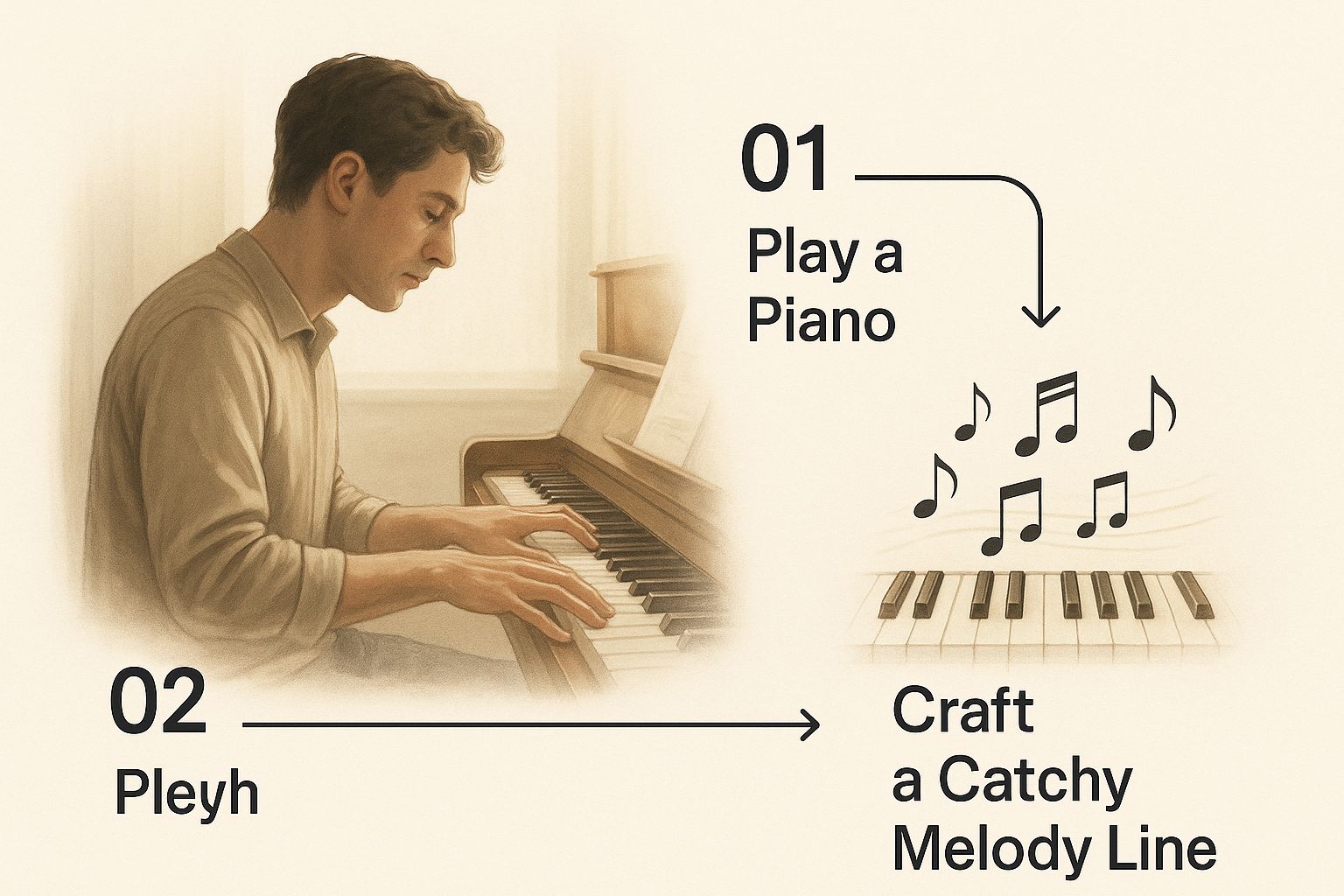
As you can see, a great song is built piece by piece, blending the craft of writing with the spark of musical inspiration.
Use Imagery and Sensory Details
The most powerful lyrics are the ones we can see, hear, and feel. They don't just tell you what’s happening; they show you. Think about it: a line like "the smell of coffee and your perfume" hits so much harder than a generic "I miss you in the morning." It grounds the emotion in a real, sensory moment that people can instantly connect with.
Try your best to steer clear of clichés. We all reach for them sometimes because they're easy, but they rarely have the impact to make someone stop and really listen. If you catch yourself using a common phrase, challenge yourself to say it in a completely new way.
Pro Tip: Specificity is your secret weapon. Don't write about a car; write about the "dented blue Honda." Instead of a party, describe the "red plastic cups and music too loud to talk." It's these tiny, authentic details that make your story feel real and unforgettable.
Of course, finding that perfect, original phrase isn't always easy. When you're feeling stuck, Lyric Studio can be a huge help. It provides AI-driven, context-aware lyric suggestions that adapt to your song's theme and emotion. It feels less like a robot and more like a creative partner giving you a nudge in the right direction.
Structure Your Lyrical Story
Every good story needs a roadmap, and a song is no different. A solid structure guides your listener through the narrative, making sure the story unfolds in a way that makes sense and drives your main point home.
To get started, it's helpful to understand the basic building blocks of a song. While you can always play with the formula, most popular songs use these common elements to create a satisfying journey for the listener.
Common Song Structure Elements
Song Section | Purpose and Function |
|---|---|
Verse | This is your storytelling section. Each verse pushes the narrative forward, adding new information, details, and context. |
Chorus | The heart of your song. It contains the main theme and emotional hook, and its repetition makes it the most memorable part. |
Bridge | The bridge offers a shift. It can introduce a new perspective, a plot twist, or an emotional peak before you return to the final chorus. |
Understanding what each part is designed to do helps you build a song that flows naturally and keeps your audience engaged from the first line to the last.
Want to go a little deeper? We've got a great guide that breaks down the 5 steps to easily write song lyrics, which gets into more detail on how to craft each of these sections.
The blank page can be intimidating. If you're struggling to get started, Lyric Studio has a powerful feature called “Magic Draft” that can instantly generate a first verse and chorus based on your topic. It’s not about replacing your originality, but it gives you a starting point to react to, edit, and make your own. Sometimes, that’s all you need to get the ball rolling.
Ultimately, your lyrics should sound like they came from you. Write conversationally, honestly, and from the heart. The best songs often feel like one person speaking directly to another. By focusing on vivid details and a solid structure, you can write lyrics that don't just sound good—they leave a mark.
Composing Melodies That Stick

You’ve poured your heart into the lyrics, and now it’s time to make them sing—literally. The melody is what carries your words, burrowing them deep into a listener's mind. It’s the soul of your song. Crafting a great melody is a non-negotiable part of learning how to write a good song, but don't worry, you don’t need a degree in music theory to pull it off.
A truly great melody doesn't just sit on top of the lyrics; it feels like it was born from them. It should echo the emotion, rhythm, and arc of your story. Think of it as a partnership where the words and music are constantly lifting each other up, creating an experience that’s more than the sum of its parts.
Match the Melody to Your Lyrical Rhythm
The best starting point is hiding in plain sight: the natural rhythm of your lyrics. Just read them out loud. Notice the cadence—where your voice rises and falls, which syllables get more emphasis. That’s your raw material right there.
Try speaking a line from your chorus, then sing it on a single note, focusing only on that rhythm. Now you can start shaping it. Does the tune climb on a word full of hope? Does it dip for a moment of reflection? When you let the lyrics lead, the melody feels organic and conversational, not forced.
This connection is what turns poetry into a song. It’s the secret to making your melody feel so natural that people can't help but sing along.
Key Takeaway: The catchiest melodies almost always follow the natural speech patterns of the lyrics. Let the emotion and rhythm of your words shape the tune for a song that feels authentic and hits hard.
Build Melodic Hooks That Are Hard to Forget
A melodic hook is that short, infectious musical phrase that gets stuck in your head for days. It's the "earworm." While it's most common in a chorus, a good hook can pop up anywhere. The best ones are usually simple, easy to remember, and repeated just enough.
As you're crafting your hooks, think about these things:
Contour: What's the shape of your melody? Does it leap up dramatically or step down gently? A melody with a dynamic shape—a mix of small steps and bigger jumps—tends to be far more interesting.
Repetition: Repeating a melodic idea makes it stick. The art is in doing it without being boring. You can repeat it exactly or tweak it slightly each time to keep things fresh.
Singability: Can a normal person sing this in the shower? If your melody is too complex or jumps all over the place, you might lose your audience. A tune that just feels good to sing is way more likely to catch on.
A strong melody often strikes a perfect balance between being predictable and surprising. The repetition makes it feel familiar, while a few unexpected twists keep the listener hooked.
Create Harmony That Supports the Story
Harmony is what gives your melody its emotional context. It's the chords you play underneath the tune on a guitar or piano, and it's what tells the listener how they should feel. A simple change from a major chord (which often sounds bright or "happy") to a minor chord (which can feel more somber or "sad") can flip the entire mood of a section.
You don't need to be a harmony wizard. Start with a few basic chords and just play them under your melody. How do they feel? Experiment with different chord progressions (sequences of chords) and see which ones best support the story you're telling.
A classic pop progression like C-G-Am-F feels resolved and uplifting. On the other hand, starting a progression on a minor chord can instantly create a more serious or introspective vibe. When you pair your melody with the right harmonic foundation, your song becomes a unified piece of music that connects on every level.
Arranging Your Song for Maximum Impact
So, you've got powerful lyrics and a melody that just won't quit. Fantastic. But now comes the real magic: arranging those pieces into an emotional journey. Think of arrangement as the art of storytelling with sound—it’s how you build energy, create tension, and deliver a knockout emotional punch.
Honestly, this is what separates a collection of good ideas from a truly great song.
You're the director here, but your film is a song. You get to decide when to bring in new instruments, when to pull back for a quiet, intimate moment, and when to build to that massive, soaring climax. A smart arrangement controls the listener's experience from the first note to the last, making every second count.
Your goal is to make sure every part of the song has a clear purpose. A great arrangement makes them all work together, keeping the track dynamic and making each section feel fresh and intentional.
Mapping Your Song's Journey
If a song's structure is its skeleton, the arrangement is the muscle that brings it to life. Each section—from the intro to the very last fade-out—needs to flow naturally into the next, building momentum and feeling along the way. When you get the arrangement right, the story in your lyrics and the emotion in your melody hit so much harder.
Let’s look at the job of each section:
Intro: This is your handshake. It sets the mood and grabs the listener's attention right away, giving them a taste of what's to come without spoiling the surprise.
Verse: This is where you tell your story. Good arrangements often keep the verses a bit sparse, maybe adding a new instrumental layer with each one to slowly build interest.
Pre-Chorus: Think of this as a ramp. It’s all about building tension and anticipation for the chorus. You can literally feel the energy lift here, usually with a rising melody or the introduction of drums and harmonies.
Chorus: The emotional core of your song. Your arrangement should make the chorus feel like the biggest, most memorable moment, with fuller instrumentation and a hook that’s impossible to ignore.
Bridge: The bridge offers a welcome change of pace. It’s a chance to shift perspective, both sonically and lyrically, before you bring back that final, powerful chorus.
Outro: This is how you say goodbye. You can either fade out gently, leaving the listener thinking, or end with a big, final statement that sticks the landing.
The chorus is the heart of it all, and a killer arrangement makes sure it lands with incredible force. To really nail this, check out our deep dive on how to write a chorus that stands out and hooks your listeners.
Using Dynamics and Texture
Once you have your song mapped out, you can start painting with sound. The two most important tools in your toolkit are dynamics (how loud or soft the music is) and texture (how many instruments are playing). Using these creates contrast and keeps your listener glued to their speakers.
Key Takeaway: An arrangement without dynamics is like a movie with no close-ups or wide shots—it's flat and monotonous. Use contrast to create peaks and valleys that make the journey unforgettable.
This is where you make those crucial creative choices. Maybe the first verse is just a raw vocal and a single acoustic guitar. Then, as you move into the pre-chorus, you sneak in a simple bassline and a soft shaker. By the time that chorus hits, you can unleash the full band and layered harmonies, making it feel absolutely huge in comparison.
Then, when you drop down to a quiet bridge, pulling almost everything out makes that final chorus feel even more explosive when it crashes back in. Fine-tuning these moments can be tough, but finding the perfect word for a specific feeling helps. Lyric Studio has integrated rhyme and thesaurus tools that are perfect for tweaking a line to match the emotional energy of your arrangement.
Ready to build a song that takes listeners on a ride they'll never forget? Download Lyric Studio free on iOS and use its features to arrange your music with feel and precision. In-app purchases may apply.
Refining and Polishing Your Final Track
Alright, you’ve got a song. The lyrics are down, you have a melody, and the basic structure is there. Now comes the part that separates a good idea from a song that truly connects with people: the final polish.
This is where you step back and listen with fresh ears. Seriously, put the song away for a day or two. When you come back to it, you'll hear it differently. You’ll suddenly notice that one clunky lyric, a melody that meanders, or an arrangement that just loses its punch halfway through. The goal here is to be your own toughest critic, but also to know when to trust your gut.
The Art of Seeking (and Hearing) Feedback
Getting an outside opinion is a game-changer. Play your song for a few trusted people—fellow musicians are great, but even a friend with good taste will do. The key is to pick someone who will give you an honest, constructive take, not just tell you what you want to hear.
Don't just ask, "So, what do you think?" Be specific. Try questions like, "Where does the energy dip for you?" or "Is the story in the lyrics making sense?"
Getting feedback can sting a little, but it’s how we get better.
Listen more than you talk. Your first instinct might be to defend your choices. Resist it. Just absorb what they're saying.
Look for patterns. One person thinking the bridge is weird is just an opinion. If three people say it, you’ve probably got something to fix.
You're the final judge. Thank them for their input, but remember, it’s your song. You decide which notes to take and which to leave.
This whole process helps you hear your song through your audience's ears, shining a light on blind spots you'd never see on your own. If you want to get a better handle on the building blocks of your song, our guide on music theory for songwriters is a great place to start.
Making the Final Edits
Armed with some fresh perspective, it's time to get back in there and tighten the screws. This isn't about starting over; it's about making small, smart improvements.
Go through your lyrics. Do they flow well when you sing them? Do the rhymes feel natural or a bit forced? This is where Lyric Studio's integrated thesaurus can be a lifesaver, helping you hunt down that perfect word that fits both the meaning and the rhythm.
Then, listen to your melody and arrangement again. Does every part serve the song? Sometimes the best edit is subtraction—cutting that one distracting guitar lick or a wordy line to let the stronger parts really shine. To get your arrangement just right, you might want to explore some free music production software to get the job done without breaking the bank.
Key Insight: Polishing isn't just about adding more stuff. It's about refining what you already have. The goal is to make every single element feel intentional, so your song hits as hard as it possibly can.
Polishing for Today's Music World
The songwriter's job has changed. These days, writing a great song also means thinking about how it will live and breathe online. A recent study really brought this home, showing how songwriters are becoming more entrepreneurial.
It found that 61% of songwriters aren't part of a Mechanical Rights Organization, which directly impacts their streaming income. Since streaming royalties are notoriously small and depend on huge play counts, writing a song that people want to listen to over and over is more vital than ever. The study also showed that songwriters who build a social media presence tend to release more music and connect with more fans. You can read the full research about the songwriter's shifting role to dig deeper.
This final polish is your chance to make your song undeniable. It’s where you turn a good song into a great one.
Ready to add that final shine? Download Lyric Studio free on iOS. Its tools are built to help you refine your lyrics and melodies with real precision. In-app purchases may apply.
Your Top Songwriting Questions, Answered
Every songwriter, whether it's their first tune or their hundredth, runs into the same nagging questions. It’s just part of the creative journey. Let's tackle some of the most common ones I hear from artists so you can keep your momentum going.
How long does it take to write a song? Honestly, it takes as long as it takes. There's no magic number. Leonard Cohen famously spent years wrestling with a single song, while some of the biggest hits were written in a burst of inspiration over a single afternoon.
The real goal isn't speed. It's about serving the song. Don't compare your timeline to anyone else's—focus on making it great, not making it fast.
Breaking Through Creative Blocks
So, what happens when you hit the dreaded writer's block? First thing: walk away. Seriously. Give your brain a break. A change of scenery or just stepping outside for a few minutes can do wonders for clearing your head. You could also try calling up a friend or another musician to get a fresh set of ears on what you've got so far.
Sometimes, all you need is a little push to get the ball rolling. If you’re just staring at a blank page, a tool like Lyric Studio can be a lifesaver. Its “Magic Draft” feature can instantly generate a first verse and chorus based on your topic.
Think of it less as a ghostwriter and more as a creative assistant. It gives you something to react to, something to edit, and a foundation to build your own ideas on top of.
Making Co-Writing Work
What's the secret to a great co-writing session? It comes down to a few key things:
Set Clear Roles: Before you even start, figure out who’s handling what. Is one person the lyricist? Is the other focused on the melody or the chords? This avoids creative traffic jams.
Keep an Open Mind: You're collaborating to create something new, something neither of you would have made alone. Be ready to compromise and let the best idea win, even if it isn't yours.
Talk it Out: Honest, respectful communication is everything. If a line or a chord change doesn't feel right, speak up—but do it constructively.
How do you know when a song is actually done? A song is finished when it says what you need it to say. When you feel like any more tweaks would just be tinkering rather than improving, it's time to let it go. Trust your gut, and maybe play it for a trusted friend for a final reality check.
Ready to finally break through those blocks and get your next song finished? Lyric Studio is like having a co-writer on call, with smart suggestions and tools designed to help you bring your ideas to life.
Download Lyric Studio free on iOS.
In-app purchases may apply.

SCAN TO GET