Back to articles
How to Pitch Songs to Artists The Right Way

So, you've written a song you believe in. That's a huge first step. But how do you get it from your notebook or laptop into the hands of an artist who can turn it into a hit? It's about much more than just the music; it's about making a smart, professional business proposal.
The goal isn't just to show off a great tune. It's to show an artist and their team that your song is the perfect fit for their specific sound, brand, and career path.
Laying the Groundwork for a Winning Song Pitch

Before you even dream of writing a pitch email, you need to lay some serious groundwork. Honestly, this is where most songwriters go wrong. They fire off a fantastic song to the wrong artist, and all that hard work ends up in a digital black hole. It’s a missed opportunity that’s easy to avoid.
Think of it this way: you have to stop being just a fan and start being a student of the artist's career. Get to know their sound inside and out, pay attention to the stories they tell in their lyrics, and understand where they are headed musically.
A killer pitch is built on solid research, not blind luck. You have to prove you’ve done your homework and that your song genuinely aligns with the artist's vision.
What a Modern Pitch Actually Looks Like
Forget the old-school fantasy of mailing a CD to a record label. The game has changed. These days, music supervisors and A&R reps are inundated with submissions, so they almost never listen to unsolicited music from writers they don't know. They rely on trusted sources. Your job is to be so professional and prepared that you come across as one of those trusted sources.
You need to make it incredibly easy for them to listen, get all the info they need, and say "yes."
This means putting together a complete, professional package that includes:
A High-Quality Demo: The recording needs to be clean and well-produced. The focus should always be on showcasing the core melody and lyrics, not on flashy production that might box an artist in.
Polished Lyrics: Every single word counts. Your lyrics are the ultimate showcase of your craft. If you ever feel stuck, diving into some songwriting tips for beginners can be a great way to find a fresh angle or sharpen a line.
Spot-On Metadata: This is crucial. Make sure all your writer splits, contact info, and other details are embedded correctly in the audio file.
Getting your pitch right means treating your song like a product and the artist as your ideal client. To help you map this out, here's a quick rundown of the entire process.
Quick Guide to Pitching Your Song
This table breaks down the key stages of preparing and sending a professional song pitch. Think of it as your checklist for success.
Stage | Key Action | Why It Matters |
|---|---|---|
Research | Deep-dive into the artist’s catalog, interviews, and social media. | You can’t pitch effectively if you don’t understand their sound, themes, and audience. |
Demo | Record a clean, professional demo focusing on vocals and melody. | A&R teams need to hear the song's potential, not get lost in your production. |
Lyrics | Refine and polish every line. Ensure the story is compelling. | Strong lyrics are the heart of a memorable song and showcase your skill as a writer. |
Pitch | Craft a short, personalized email with a private streaming link. | A concise and respectful pitch shows you value their time and understand industry etiquette. |
Follow-Up | Send one polite follow-up email after a week if you haven't heard back. | It shows you’re serious but keeps you from being perceived as pushy. |
By following these steps, you present yourself not just as a songwriter, but as a professional partner who understands the business of music.
A powerful way to get your lyrics pitch-perfect is to refine them long before you even hit the record button. Lyric Studio can be a secret weapon here, offering AI-driven, context-aware suggestions to help you find stronger rhymes, explore new themes, and nail the emotional tone. It ensures your song is as compelling on the page as it is in the demo.
Ready to craft lyrics that an artist can't ignore? Download Lyric Studio free on iOS. The app is free to download and offers optional in-app purchases, including handy tools like an integrated thesaurus to help you find that perfect word.
Finding the Perfect Artist for Your Song
Sending a brilliant song to the wrong artist is one of the most common ways to get your work ignored. It’s a waste of your time and theirs. If you want to pitch songs effectively, you have to ditch the "spray and pray" method and get surgical with your approach.
This means you need to do your homework. Go beyond the artist's biggest hits on Spotify. Dig into their full albums, listen to the B-sides, and watch their interviews. What are the recurring themes in their music? What’s their brand all about, and what does it feel like they’re trying to do next?
The real magic happens when your song doesn't just match an artist's current sound, but instead fills a future need. Pitching your track as the missing piece for their next album is infinitely more powerful than just adding one more song to their "maybe" pile.
Look for the Gaps
Instead of trying to copy what an artist has already done, search for what's missing. Listen through their catalog and look for holes—either sonically or thematically.
For example, maybe you've got a pop artist who is famous for upbeat bangers but has mentioned in interviews that they’d love to record a more emotional, stripped-back ballad. That's your in. Your pitch suddenly becomes the answer to a creative problem they're already thinking about.
Find the Right Gatekeeper
Once you've got a shortlist of artists, you need to figure out who to actually contact. Firing off a demo to a superstar's public email address is a surefire way to get lost in the noise. You need to aim for their inner circle:
The Manager: This person handles the artist's career and business moves.
The A&R Rep: Their job is to find new songs and talent for the label.
The Publisher: They manage the artist's song catalog and are always looking for new material.
After pinpointing the artists who are a great match for your song, the next challenge is tracking down their contact details. You can learn more about the best ways to do this by checking out these tips on how to find someone's email. A professional, targeted outreach is key.
This chart lays out the flow for getting your track ready before you even think about hitting send.
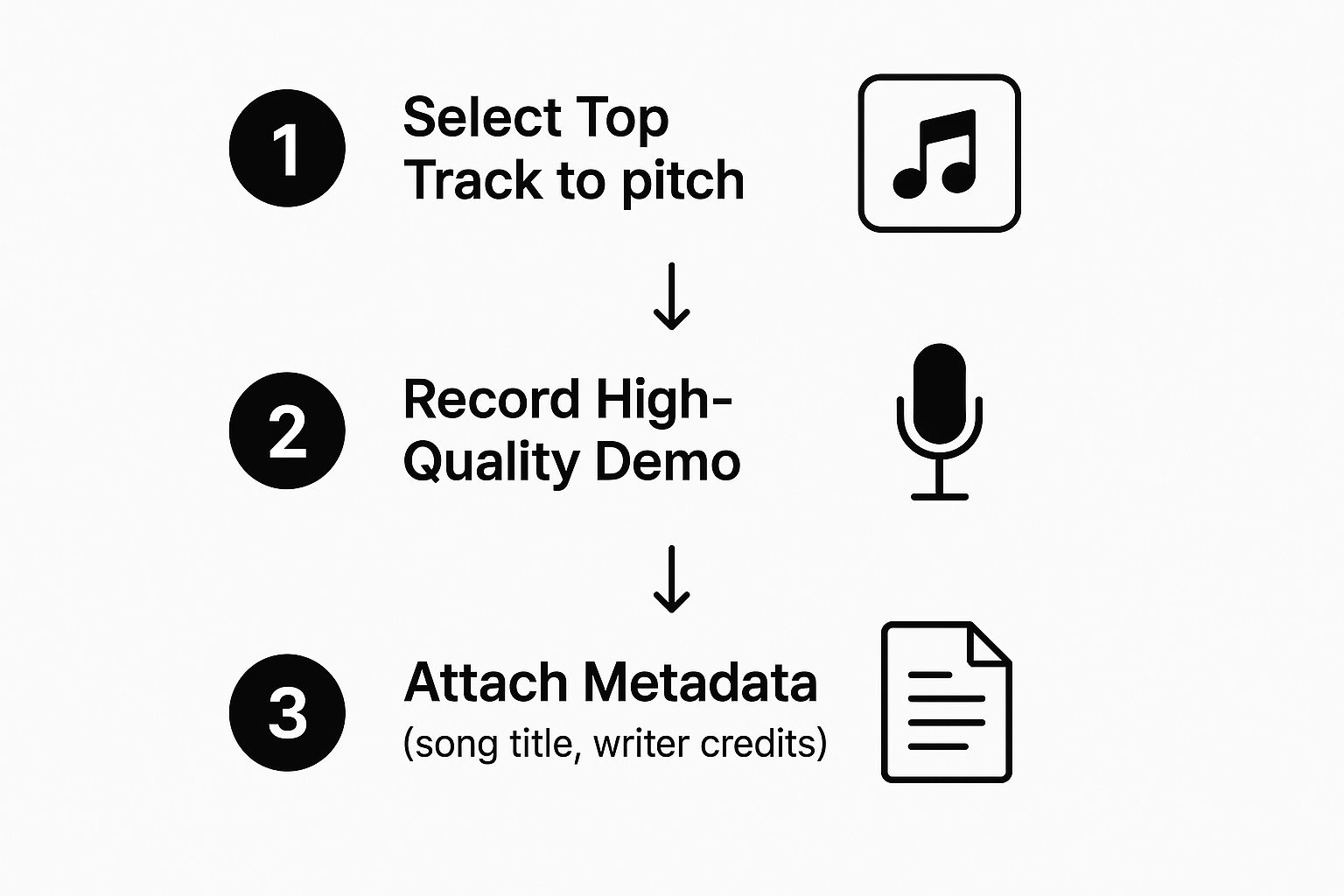
Remember, having a great song is just the first step. A clean, professional demo and accurate metadata aren't optional—they're the price of entry.
Creating a Demo That Demands Attention

Your demo is your song’s first—and often only—audition. Think about it: an artist’s team is sifting through hundreds of submissions, and yours needs to cut through that noise immediately. The goal isn’t to produce a radio-ready hit. Not yet. It's to deliver a clean, professional recording that shows off the song's bones.
A great demo is like a blueprint. It lets an A&R rep or manager hear the core melody, understand the story, and feel the vibe without getting bogged down by complicated production. A simple, well-executed demo lets them instantly imagine how the song could fit their artist’s unique sound.
The Songwriting Comes First
Before you even think about hitting "record," your song has to be solid. I can't stress this enough: a mediocre song with incredible production is still just a mediocre song. This is your chance to get every line right and nail the emotional journey of the track.
Strengthening your lyrics is probably the single most impactful thing you can do. To take your writing to the next level, it's worth checking out some of the top 5 song writing tools that can help you find fresh ideas and polish your craft.
A great demo doesn't sell an arrangement; it sells the song itself. The lyrics and melody are the stars of the show. Everything else is just supporting cast.
If you’re staring at a blank page or feel stuck on a particular section, the "Magic Draft" feature in Lyric Studio can be a real lifesaver. It can instantly generate a first verse and chorus based on your topic, giving you a solid foundation to build from. It’s a great way to blast past writer's block and get back to what you do best—creating.
What Makes a Demo Sound Professional
Once your song is written, it’s all about the recording. Professionalism here doesn't mean dropping thousands on studio time. It means clarity. It means quality. An industry pro can spot an amateur demo from a mile away, and it usually comes down to a few basic things.
Your Demo Must-Haves:
Clean Vocals: The lead vocal has to be clear, in tune, and full of emotion. It’s the single most important part of your demo.
Simple Arrangement: Stick to the basics. An acoustic guitar or piano and a simple beat are often all you need. Don't add a bunch of layers that a producer will just want to strip away anyway.
Solid Mix: Your vocal needs to sit clearly on top of the instruments, not be buried underneath them. Learning how to enhance audio quality is a crucial skill that can turn a good recording into a truly professional presentation.
Lyric Studio Features for a Polished Demo
A tool like Lyric Studio can help you sharpen your song long before you ever get to the demo stage. Think of it as a creative assistant that helps you find the perfect words to tell your story.
The table below breaks down how specific tools within Lyric Studio can help you refine your song before you even think about recording.
Feature | How It Helps Your Pitch | Best For |
|---|---|---|
Magic Draft | Instantly generates a verse-and-chorus, providing a strong starting point. | Overcoming writer’s block and quickly structuring new ideas. |
AI Suggestions | Offers context-aware lyric ideas to sharpen lines and improve flow. | Refining existing lyrics and exploring new creative angles. |
Rhyme & Thesaurus | Provides integrated tools to find perfect rhymes and alternative word choices. | Improving lyrical vocabulary and avoiding cliché rhymes. |
By perfecting the core of your song before you record, you create a demo that doesn’t just get heard—it gets remembered. You’re handing them a polished, professional idea that an artist can easily imagine as their next single.
Ready to write lyrics that demand attention? Download Lyric Studio free on iOS and transform your ideas into pitch-ready songs. (The app is free to download; in-app purchases may apply).
Crafting a Pitch Email That Gets Opened

Think of your email as the first handshake. In a sea of unread messages, yours has to be professional, direct, and interesting enough to warrant a click. You're not trying to tell your life story here; the goal is simply to present a killer creative opportunity with clarity and respect.
The best pitches I've seen are built on two things: being brief and being personal. Show them you've actually listened to their music by mentioning something specific about the artist's recent sound. A generic, copy-and-pasted email is painfully obvious and gets deleted in a heartbeat.
The Anatomy of an Effective Pitch
A winning email has a few key parts that work together, making it incredibly easy for a busy A&R or manager to listen and reply. It’s all about delivering what they need, with zero fluff.
Your subject line is everything. It's the very first thing they see. It has to be professional and, most importantly, helpful.
Subject Lines That Actually Work:
Song Pitch for [Artist Name]: "Uptempo Pop Anthem (125 BPM)"
For [Artist Name] - Ballad: "R&B Ballad - Sounds Like [Comparable Artist]"
Song Submission: "[Your Song Title]" (For [Artist Name])
See what these do? They immediately provide context. A manager can see the genre, tempo, and intended artist at a glance, helping them decide if it fits what they're looking for right now.
Of course, none of this matters if your email lands in the junk folder. It's worth taking a moment to understand how to prevent emails from going to spam.
What To Include and What To Leave Out
Once they open the email, get straight to the point. Introduce yourself, state why you're writing, and provide one single, private streaming link (SoundCloud or Disco are standard). Never attach audio files like MP3s or WAVs. They’re inbox-cloggers and a huge red flag for security filters.
Your pitch email is a business proposal, not a fan letter. Keep it professional, concise, and focused on how your song can benefit the artist.
Today, there’s another layer to consider: social media. It's smart to think about a song's potential for platforms like TikTok. You might even briefly mention how the song's hook or structure is perfect for short-form video.
A polished song feels professional and complete, especially when the lyrics and beat are perfectly in sync. If you feel your writing could be sharper, our guide on how to write lyrics to a beat has some great practical tips.
Ultimately, polishing your song before it ever reaches an inbox is the real secret. Think of Lyric Studio's AI-driven suggestions and integrated rhyme tools as your personal creative assistant, helping you make every single line count. Download Lyric Studio free on iOS to start writing lyrics that get noticed.
Let the Numbers Do the Talking
Look, a great song is always the main event. But in today's music business, a little bit of data can take your pitch from "Hey, listen to this" to a serious business proposal. Numbers speak a language that A&Rs, managers, and publishers understand loud and clear. Instead of just claiming your song is a potential hit, you can actually show them why, making your email stand out in a crowded inbox.
This is where you put on your strategist hat. You don't need a PhD in data science, but knowing which numbers matter and how to talk about them can be a game-changer. It’s about building a compelling story around your song using simple analytics.
Know What Metrics Actually Matter
When you're getting ready to pitch, some stats are way more important than others. Artist teams are always hunting for proof that real people are connecting with a track. They want to see genuine engagement.
You should be looking for data that shows your song has legs, like:
Listener Retention: Are people sticking around for the whole song? A high retention rate is gold. It proves the track hooks them and keeps them listening.
Playlist Adds: This is a huge one. When someone adds your song to their personal playlist, it’s a powerful sign that they love it and plan to listen again.
Social Media Buzz: If a song is starting to bubble up on a platform like TikTok, measured by how many people are using it in their videos, that’s a massive signal of viral potential.
Think about it. Which pitch is more powerful? "I wrote a song I think you'll like," or "This demo is already hitting a 75% retention rate and got added to over 200 user playlists in its first week." The second one makes your song feel like an opportunity, not just another submission.
Pitching effectively means you need to get comfortable with music analytics. Key metrics from Spotify for Artists, like total streams, monthly listeners, and playlist adds, tell a clear story of a song's performance. TikTok has also become a critical launchpad; the number of video creations using your sound is a huge indicator of cultural relevance. If you want to dive deeper, you can learn more about how music analytics can guide your strategy and really sharpen your approach.
Weave Your Data into the Story
Once you've got a few solid data points, you just need to drop them into your pitch email. Don’t overwhelm them with a spreadsheet. Just a couple of key highlights are all it takes to make your point.
Here’s how you could phrase it in an email: "I'm reaching out with my new song 'Summer Haze,' which I feel would be a perfect fit for [Artist Name]'s sound. The demo is already showing some really strong early signs on SoundCloud, with a 78% listener retention rate and a lot of shares from listeners in the 18-25 demographic."
A single sentence like that immediately shows you're not just a songwriter; you're a professional who understands the market and their own music's potential.
Of course, before you even get to tracking data, you need lyrics that grab a listener and don't let go. That's what drives retention in the first place. This is where a tool like Lyric Studio can really help you polish your work. It gives you context-aware suggestions to sharpen your themes and find that perfect word, ensuring your lyrics have the punch needed to create real engagement.
Give your songs the lyrical depth they need to get noticed and drive the numbers you want. Download Lyric Studio free on iOS and start writing tracks that are ready for the pitch. (The app is free to download with optional in-app purchases).
Your Top Song Pitching Questions, Answered
Stepping into the world of song pitching can feel like learning a whole new language with a lot of unwritten rules. It's completely normal to have questions. Let's clear up some of the most common ones so you can send every pitch with total confidence.
How Many Songs Should I Pitch at Once?
This is a classic rookie mistake: sending way too many songs. The golden rule here is quality over quantity.
Stick to pitching just one to three songs at a time. This tells the person on the other end that you've actually done your homework and you’re convinced these specific tracks are a fantastic match for their artist. Bombarding them with your entire catalog just creates work for them and signals that you're just spraying and praying.
An A&R rep is much more likely to listen to one perfectly targeted song than to dig through a folder of ten. Your goal is to make their job easier, not to give them an assignment.
Do I Really Need a Music Publisher to Get Started?
While having a great publisher in your corner can absolutely open doors, it’s not a deal-breaker when you're starting out. Plenty of independent songwriters have landed major cuts all on their own.
What's more important is focusing on what you can control. That means writing undeniable songs and building professional, thoughtful pitches. A fantastic song, pitched the right way, can cut through the noise with or without a publisher's stamp of approval.
What's the Right Way to Follow Up on a Pitch?
Following up is a delicate dance. You need to be persistent enough to show you're serious, but not so pushy that you burn a bridge.
If you haven’t gotten a response after about a week, it's perfectly fine to send one polite follow-up email. A simple, friendly nudge is all you need.
Here’s a quick example:
"Hi [Name], just wanted to quickly follow up on the song 'Sunset Drive' I sent over last week for [Artist Name]. Hope you have a chance to listen when you're free. Thanks again!"
It's short, respectful, and bumps your original message back to the top of their inbox. If you still don't hear anything after that one follow-up, it’s time to let it go and move on. Pestering a contact is the fastest way to end a relationship before it even begins.
How Do I Legally Protect My Music?
This is non-negotiable. Before you send your music anywhere, you have to protect your work. The best and most official way to do this is to register your song with the U.S. Copyright Office.
This registration creates a public, legal record that you are the author, which is the strongest protection you can have in any dispute. You might have heard of the "poor man's copyright"—mailing a sealed copy of your work to yourself—but frankly, it doesn't offer real legal standing. A formal copyright registration is the only method that truly holds up.
Of course, before you worry about pitching or publishing, the song itself has to be undeniable. It all starts with lyrics that grab an artist and make them feel something. Using a tool like Lyric Studio can be your secret weapon for polishing every line until it shines. Its smart suggestions and integrated rhyme tools help you turn good ideas into powerful, pitch-worthy lyrics.
Ready to write songs that artists can't wait to record? Get started with Lyric Studio and bring your best ideas to life. Download Lyric Studio free on iOS. The app is free to download and offers optional in-app purchases.

SCAN TO GET