Back to articles
How to Get Started Rapping: 5 Easy Steps to Begin
So, you want to learn how to rap? It all really comes down to three things: listening to a ton of different artists, studying the basics of rhythm and flow, and then practicing like crazy. The path forward isn't about dropping a perfect verse right out of the gate. It's about soaking up the culture and building your skills, one day at a time.
3 First Steps to Start Rapping
Getting into rap can feel like a huge mountain to climb, but the process is more straightforward than you might think. It’s a world built on sharp lyrics, a killer delivery, and telling your own story.
The secret? Don't worry about writing a hit song on your first try. Instead, focus on listening, learning, and starting to find your own unique voice.
Learn from the Greats
First things first, you need to become a student of the game. That means putting in the time to really listen—not just to the legends who built this genre, but also to the new artists pushing the envelope today.
Pay close attention to what they're doing. What are their styles like? How do they ride the beat? What kind of rhyme schemes are they using? Asking these questions as you listen is how you build your own musical vocabulary and figure out where you want to go with your own sound.
Build Your Core Skills
As you absorb all that music, you can start working on the two pillars of rapping: lyricism and flow.
Writing lyrics is an art form. It’s way more than just finding words that rhyme; it’s about painting a picture, getting an emotion across, and making a real connection with whoever is listening. If you want to go deeper on this, our guide on how to write a rap song is packed with practical advice for turning your ideas into solid verses.
Flow, on the other hand, is your delivery—the rhythm and cadence you use to say those lyrics over a beat.
This process is a cycle. You listen, you learn, you practice, and you get better. It’s a simple loop.
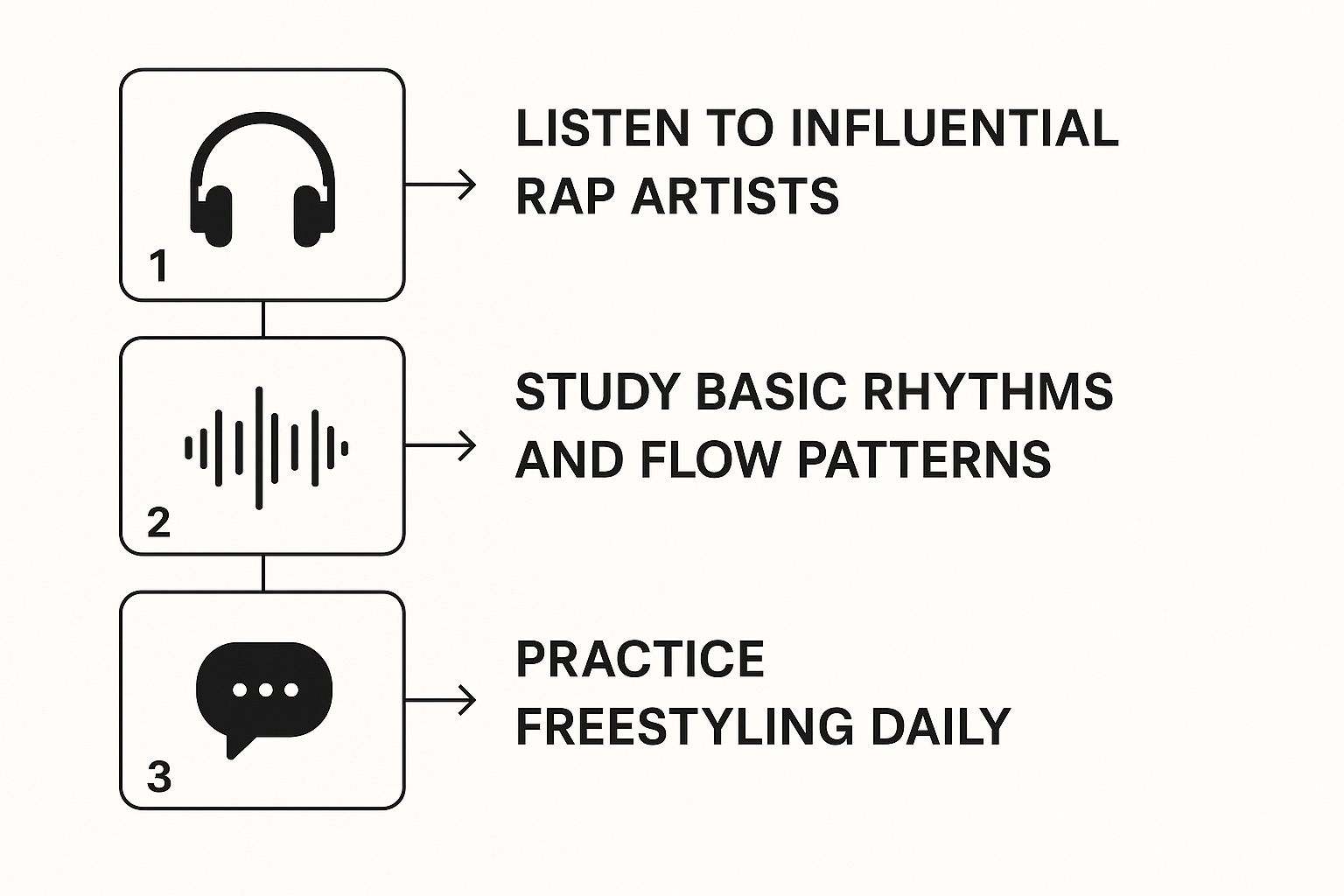
Looking at it this way makes the whole thing feel less intimidating. It’s not about one giant leap; it’s about small, manageable steps you take every day.
To help you stay focused, here’s a quick rundown of the essential elements to get you started on your journey.
Your Rapping Starter Kit
Core Element | Why It's Important | First Action Step |
|---|---|---|
Active Listening | Builds your "musical vocabulary" and exposes you to different styles and techniques. | Pick 3 influential rap albums (one old, one new, one sub-genre) and listen to them all week. Take notes. |
Lyric Writing | This is the foundation of your message and storytelling. | Spend 15 minutes a day writing down interesting words, phrases, or ideas in a notebook. Don't judge, just write. |
Flow Practice | Your delivery is what makes your lyrics come alive over a beat. | Find a simple instrumental beat on YouTube and try rapping your favorite artist's lyrics over it. Focus on hitting the beat. |
This table isn't just a checklist; it's your roadmap for the first few weeks. Mastering these basics is what separates the dabblers from the dedicated artists. Once you feel comfortable, you can embark on your content creation journey and start sharing your work.
Find Your Creative Assistant
Every writer hits a wall eventually. It happens. But you don’t have to go it alone.
Modern tools can give you a serious boost when you're feeling stuck. For example, Lyric Studio can act like a creative partner, giving you AI-powered lyric suggestions that actually fit the theme and vibe you're going for.
The path from aspiring MC to confident rapper is paved with small, consistent wins. A little bit of practice every day—even just 15 minutes of freestyling—beats waiting around for a lightning bolt of inspiration.
This isn’t about letting a tool write for you. It’s about having a powerful assistant to help you break through those tough spots and polish your own ideas. Ready to see how it works? Download Lyric Studio free on iOS.
Finding Your Flow and Cadence
So, you've started writing some bars. That's huge. But the words on the page are only half the battle. Now it’s time to work on your flow—the rhythm, the bounce, the unique way you deliver those lyrics over a beat. Think of it as the soul of your performance. It’s what makes your words stick, and it’s what separates a rapper from someone just reading rhymes.
A great flow sounds completely natural, almost effortless. But don't be fooled. That "effortless" sound comes from a deep understanding of rhythm and a ton of practice. You're not just reciting words; you're becoming another instrument in the track, weaving your voice right into the music. Developing this skill is all about finding a cadence that feels like you.
Laying Down Your Rhythmic Foundation
Before you even try to spit a single line, you need to become one with the beat. Seriously. Put on an instrumental, close your eyes if you have to, and just listen. Nod your head. Tap your foot. Feel where the kick drum hits and where the snare snaps. Those are your anchors. Your job is to dance around them with your words, not be locked in a cage by them.
Once you’ve got the feel for the beat’s pulse, try speaking your lyrics over it. Don't worry about sounding perfect or even rapping yet. Just talk through the lines in time with the music. The goal here is pure comfort and timing. You’re building muscle memory, getting your mouth and brain to sync up with the track.
Discovering Your Unique Pocket
Every beat has a "pocket"—that sweet spot where a flow just sits perfectly. There’s no map to find it; you get there through pure experimentation.
Try playing with your delivery. Rap a little ahead of the beat to push the energy forward, or lay back and drag your words just behind it for a more relaxed, confident vibe.
Here are a few things to try:
Play with emphasis. Take one line and rap it five different times. Each time, stress a different word. You’ll be amazed at how this simple trick can completely change the line's impact and meaning.
Switch up your speed. Practice spitting your bars at different tempos. Go slow and focus on hitting every syllable clearly, then ramp it up. This builds incredible control.
Use silence. Don't be afraid of pauses. A moment of dead air before a punchline hits can make it ten times more powerful. It gives the listener a second to breathe and absorb what you just said.
The best rappers make it look easy because they’ve put in thousands of hours. Your signature flow won’t just appear overnight. It's something you uncover through relentless practice and the willingness to sound a little awkward at first.
A big hurdle for beginners is making their lyrics actually fit the rhythm naturally. It's a common struggle. For a deeper dive, check out our guide on how to write lyrics to a beat—it’s packed with specific techniques to tackle this exact problem.
Finding Your Delivery and Developing Timing
Think of your written lyrics as a blueprint. The words on the page are just the beginning. Your delivery is what actually builds the house—it's the energy, the personality, and the rhythm you inject into those words that makes someone feel something. This is what truly separates the legends from the crowd. It’s not just what you say, but precisely how you say it.
Delivery is so much more than just staying on beat. It's about discovering your own voice, that signature style that could only come from you. Getting there is all about practice and experimentation, building the muscle memory and instincts that make your timing feel second nature.
From Page to Performance
The first real test is getting your lyrics off the page and into the air. Before you even think about a beat, just read your verses out loud. You’ll immediately catch clunky phrases or tongue-twisters that looked fine on paper but are a nightmare to say.
Once you’ve done that, pull up a simple instrumental. Don't even try to rap. Just talk the lyrics over the beat. The whole point is to feel how your words naturally fall into the pockets of the rhythm. This simple exercise is the foundation for connecting what you wrote to the music itself.
Crafting Your Unique Vocal Style
As a rapper, your voice is your instrument. Learning to play it with intention is what makes a delivery compelling. You don't have to be a world-class singer, but you absolutely need to control your vocal presence.
Here are a few things that can help:
Play with Pitch: Say a line in your normal speaking voice. Now try it again, but a little higher. Then go lower. See how just a small shift in pitch can completely change the emotion of the bar?
Master Your Volume: Practice whispering a line, then delivering that same line with force and projection. This dynamic range is what adds texture and keeps your verses from sounding flat.
Nail Your Articulation: Enunciate. Every. Syllable. If they can't understand you, the cleverest punchline in the world is wasted. Tongue twisters are genuinely great for improving your diction.
Sometimes the best ideas hit you when you're away from the keyboard. Capturing those moments is crucial. Using tools like dictation software for writers can be a game-changer for getting those fleeting ideas down before they disappear.
A killer delivery feels effortless, but it’s built on pure intention. Every pause, every change in tone, every burst of speed—it should all serve the story you're telling. You’re making conscious choices to create an unconscious emotional reaction in your listener.
One of the biggest hurdles is making your lyrics sound natural instead of forced. If you're finding your bars just aren't flowing right, our guide on the 5 steps to easily write song lyrics provides a solid framework that can help your verses feel more organic from the get-go.
Stuck on a line or can't find the right flow? Lyric Studio was built to be your creative partner. It has AI-powered lyric suggestions and integrated rhyme tools that can help you bust through writer's block and sharpen your bars. The "Magic Draft" feature is especially cool—it can instantly generate a first verse and chorus to give you a solid foundation to build on.
Ready to find your flow? Download Lyric Studio free on iOS and start turning your ideas into actual tracks. (Note: in-app purchases may apply.)
Building Your Rapping Skills
Nothing beats consistent practice. It's the fuel that takes you from scribbling rhymes in a notebook to grabbing a mic in front of a real audience. But just being good at rhyming isn't enough; you've got to be smart about your approach. It's way more important to build a rock-solid foundation of skill than to jump into the spotlight before you're ready.
Think of it as a marathon, not a sprint. The real win is developing a skill set you're genuinely proud of and actually enjoying the ride.
Carving Out Your Practice Space
Your "practice space" is simply wherever you can get in the zone and create. You don't need a pro studio. It could be your bedroom, a quiet corner of your apartment, or even your daily commute with a good pair of headphones. The key isn't the place—it's the consistency.
Try to set aside some dedicated time to work on your craft. Here are a few things that really work:
Freestyle Over Beats: Find some instrumentals on YouTube and just go for it for 15-20 minutes a day. This is like weight training for your brain, building your ability to think on your feet.
Recite Your Verses: Read your written lyrics out loud. Over and over. This is how you find the pocket, smooth out any clunky lines, and make the words feel like your own.
Study the Greats: Don't just listen to your favorite rappers—dissect what they do. Pay attention to their rhyme schemes, their flow, and how they use breath control to deliver their lines.
When you hit a wall and the words just aren't coming, tools can give you a much-needed nudge. The integrated rhyme and thesaurus features in Lyric Studio can help you find that perfect word, and its AI suggestions can adapt to your topic to keep you from losing that creative spark.
Here's something that clicks for a lot of new rappers: think about the competitive landscape. You don't have to go up against the biggest names on day one. Start at your own level where you can actually connect with listeners instead of getting drowned out.
Performing for the First Time
Your first performance probably won't be a stadium tour. It's more likely to be an open mic night, a local rap battle, or maybe just posting your first finished track online. The trick is to find an opportunity that fits where you are right now. Start small, get a feel for it, and treat every single experience as a chance to learn.
As you sharpen your skills and get ready for that first taste of recognition, knowing how to connect with people online is a game-changer. You can find some proven ways to boost social media engagement to make sure your debut makes an impact.
Staring at a blank page for that first song? Lyric Studio has a "Magic Draft" feature that can generate an entire first verse and chorus in seconds. It's an incredible way to get a head start and break through that initial writer's block.
Ready to build your skills with a creative partner in your corner? Download Lyric Studio free on iOS and start prepping for your first performance.
The Mental Game of Rapping

In the world of rap, you’ll quickly learn that a perfect rhyme and solid technique can only carry you so far. The real game-changer, what separates the good rappers from the great ones, is what happens between your ears. It's all about the mental game.
Let's break down how to stop just writing rhymes and start thinking like a true artist. This means learning to handle pressure, shake off a bad take, and hear the perfect verse in your mind before you ever hit record. Confidence isn't just a feeling; it's the foundation of consistency and your best tool for performing when it matters most.
Building Unshakeable Confidence
Where does real confidence in rapping come from? It’s not from arrogance or luck. It comes from one thing: preparation. It's the quiet trust you have in the countless hours you’ve put in. Every single verse you write and every freestyle you practice is like making a deposit in your confidence bank.
This is why you have to practice with purpose. Don't just go through the motions. Set a small, specific goal for every session. Maybe today is all about keeping your flow consistent through a whole verse. Or perhaps you're focusing on your breath control. These tiny, intentional wins stack up, building the kind of genuine self-assurance you can rely on when you hit the mic.
When you know you’ve done the work, you can finally let your muscle memory take the wheel. That frees up your mind to focus on nothing but the performance in front of you.
The mental part of rapping is just as critical as the physical skill. In fact, you'll hear many top professionals say that success is often 90% mental. Your ability to manage nerves, stay focused under pressure, and bounce back from a mistake is what ultimately puts you in the winner's circle. You have to develop mental toughness to push past those frustrating plateaus. If you want to dive deeper, you can discover more insights on the roping mindset from the pros.
Handling Pressure and Setbacks
Let's get one thing straight: every rapper flubs a line. It's going to happen. The only thing that separates artists is how they react. Do you let one bad take spiral into a bad day? Or do you take a second, figure out what happened, and move on to the next one with a clean slate?
A huge piece of the mental puzzle is learning to stay positive when things don't go your way. Don't stew over the mistake. Treat it like data. Did I rush my delivery? Did I run out of breath? A constructive approach turns every setback into a lesson, not a failure.
The next time you feel that pressure building, just take a deep breath. Bring your mind back to your fundamentals—the simple, solid mechanics you’ve practiced a thousand times. It’s the surest way to quiet the noise and ground yourself in what you can actually control.
Common Questions About Getting Started in Rapping
If you're just starting out, you probably have a lot of questions. That's totally normal. Let's walk through some of the most common things beginners ask so you can get on the right track from day one.
What’s the Best Gear for a Beginner?
When you're new to rapping, you don't need a professional studio. What you really want is a decent USB microphone and a pair of headphones. That’s it. Brands like Audio-Technica and Rode make some fantastic options that are perfect for learning and won't break the bank.
A simple setup is more forgiving. It’s easier to handle while you're figuring out the mechanics of recording and hearing yourself back. The best thing you can do is read a few reviews online and find a well-regarded mic in your budget.
Do I Need a Beat to Start Rapping?
Absolutely not. It’s actually better if you don't always start with a beat. The most important skills you need to build are all learned a cappella (without music).
Building a smooth, consistent flow, learning how to manage your breath, and delivering your lines right where you want them—that all starts with just your voice. Practicing your verses out loud is the best way to develop the muscle memory you'll need later on. Get that foundation solid before you even think about finding the perfect beat.
How Do I Find People to Practice With?
Rapping is a community, and finding your place in it will help you learn so much faster. A great first step is to search for local open mic nights or cyphers. Check out social media, especially Reddit threads or Facebook groups dedicated to hip-hop in your city or region. Don't underestimate asking around at local music shops, either—they're often the hub of the local scene.
Lots of venues host weekly events that are open to everyone. Show up. It's the best way to meet other rappers, find people who can give you pointers, and just get in some good practice time.
How Much Should I Practice Each Week?
Here’s the thing about practice: consistency beats cramming every single time. You'll make way more progress with short, frequent sessions than one marathon session that leaves you exhausted.
Aim for 3-4 practice sessions a week. Even if it's just for 20-30 minutes freestyling or writing in a notebook, that steady repetition is what builds real, lasting skill. It’s what creates a flow that’s smooth, effective, and won’t fall apart under pressure.
This approach keeps you from getting burned out and makes every minute you spend practicing count.
Feeling stuck or need a creative boost to get your first verse down? Lyric Studio is designed to be your writing partner. With AI-driven suggestions and a "Magic Draft" feature to kick-start your song, it helps you overcome writer's block and refine your ideas.
Download Lyric Studio free on iOS. (Note: The app is free to download; in-app purchases may apply.)

SCAN TO GET