Back to articles
How to Compose Rap Lyrics That Actually Impress
Before you even think about rhymes, you need an idea. But not just any idea—a killer concept. This is the foundation of your entire track, the thing that makes people lean in and listen. It's the story you want to tell or the message you need to get across.
From Your First Idea to a Killer Concept

Every legendary track starts with something real. Forget trying to invent a persona or chasing trends. The best material is already in your head, waiting to be unlocked. Staring at a blank page is intimidating, so don't. Instead, dig into your own life.
Think about a powerful memory, a strong opinion you hold, or something you've observed that nobody else seems to notice. Rap connects when it comes from a place of truth. Your unique experiences are your greatest asset.
Nail Down Your Core Message
So, what's the point? Before you get caught up in finding the perfect rhyme, you need to know what you're actually trying to say. Are you telling a story about overcoming the odds? Making a statement about your city? Just flexing about a recent win?
A clear purpose is your compass. It keeps your lyrics focused and prevents them from just becoming a jumble of cool-sounding words.
To get the ideas flowing, try a few of these moves:
Freewrite: Grab a notebook or open a doc, set a timer for five minutes, and just write. Don't stop, don't edit, don't judge. Just dump every thought related to your topic onto the page.
Mind Map: Put your main theme in the center of a page and circle it. Now, start branching out with any related words, feelings, images, or memories that pop into your head.
Ask the 5 Ws: Who? What? Where? When? Why? Answering these basic questions about your topic forces you to add the details that bring a story to life.
Once you have that raw material, you can start shaping it. Turning a simple idea into a memorable song often comes down to the principles of compelling storytelling. A story with a beginning, middle, and end will always hit harder.
Set the Vibe
What should this song feel like? The mood you choose will influence every word you write and how you deliver it. Is this an aggressive, in-your-face anthem or something more thoughtful and laid-back?
Decide on that emotional tone early. It ensures your track has a consistent vibe that listeners can get lost in.
A track about success, for example, will probably use confident, punchy language. A more introspective song might lean on metaphors and complex imagery. This is where you start to hear the song in your head, long before you ever touch a microphone.
Mastering Rhyme Schemes and Lyrical Wordplay
Once you’ve locked down your core idea, it's time to build the engine of your track: the lyrics. Good rhyming is what makes a rap song work, but great rhyming is what makes people hit the rewind button. This isn't just about finding words that sound the same; it's a craft.
We're moving past the simple end-of-the-line stuff. This is where you learn to weave intricate patterns that give your track layers, turning your words into their own percussive instrument.
Moving Beyond Basic Rhymes
Most of us start with simple couplets, where the last word of one line rhymes with the last of the next (an AABB scheme). It gets the job done, but lean on it too heavily and your verses will start to sound predictable, almost like a nursery rhyme. To really elevate your writing, you have to dig into more complex structures.
Here are a few foundational techniques that separate the legends from the newcomers:
Multisyllabic Rhymes: Instead of just rhyming one-syllable words like "cat" and "hat," you start rhyming entire phrases. Think of how "lyrical miracle" rolls off the tongue, or rhyming a phrase like "lyric genius" with "spirit is fearless." It creates a much smoother, more sophisticated sound.
Internal Rhymes: These are the hidden gems. Instead of only rhyming at the end of a bar, you drop rhymes inside the line itself. A classic example would be something like, "I make the crowd get loud on the stage." This technique packs your bars with a dense, rhythmic texture that rewards careful listeners.
Slant Rhymes (Near Rhymes): Perfect rhymes can be a creative trap. Slant rhymes are words that sound similar but aren't identical—think "shape" and "great." They open up a world of possibilities, letting you prioritize the meaning of your line without sacrificing the rhythm.
To really get a feel for how these patterns work together, you should dive into our guide on what is a rhyme scheme. It breaks it all down even further.
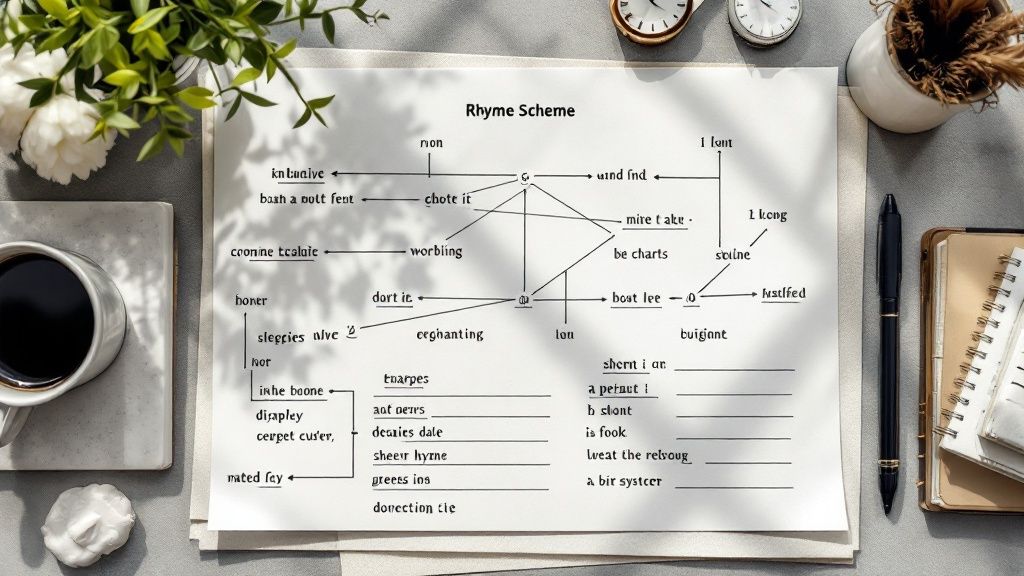
To help you get started, here's a look at some common rhyme schemes you'll hear all over rap music. Think of these as blueprints for structuring your verses.
Common Rhyme Schemes in Rap
Rhyme Scheme | Structure | Example | Best For |
|---|---|---|---|
Couplet | AABB | "The beat is slow, I'm ready to go" | Simple, direct storytelling; building momentum. |
Alternating | ABAB | "I walk the street (A) | Creating a steady, conversational rhythm. |
Enclosed | ABBA | "The rain outside is heavy (A) | Building tension and delivering a punchline. |
Complex | AABCCB | "I'm on a new level (A) | Showcasing advanced skill and intricate patterns. |
Experimenting with these will quickly add a new dimension to your writing.
The Power of Wordplay and Figurative Language
Rhymes give your lyrics a skeleton, but wordplay gives them a soul. This is your chance to paint vivid pictures in the listener's mind. Metaphors and similes are your absolute best friends here. They let you draw powerful comparisons that make complex ideas feel real and relatable.
Instead of a flat line like, "I'm very confident," try a simile: "My confidence is like a skyscraper, you can't see the top." Or make it even more direct with a metaphor: "My confidence is a skyscraper." See the difference? These little tweaks turn an average line into something memorable.
Key Takeaway: The goal isn't just to find words that rhyme; it's about finding the right words that rhyme. A perfect word should lock into your scheme, deepen your song's meaning, and ride the beat—all at the same time.
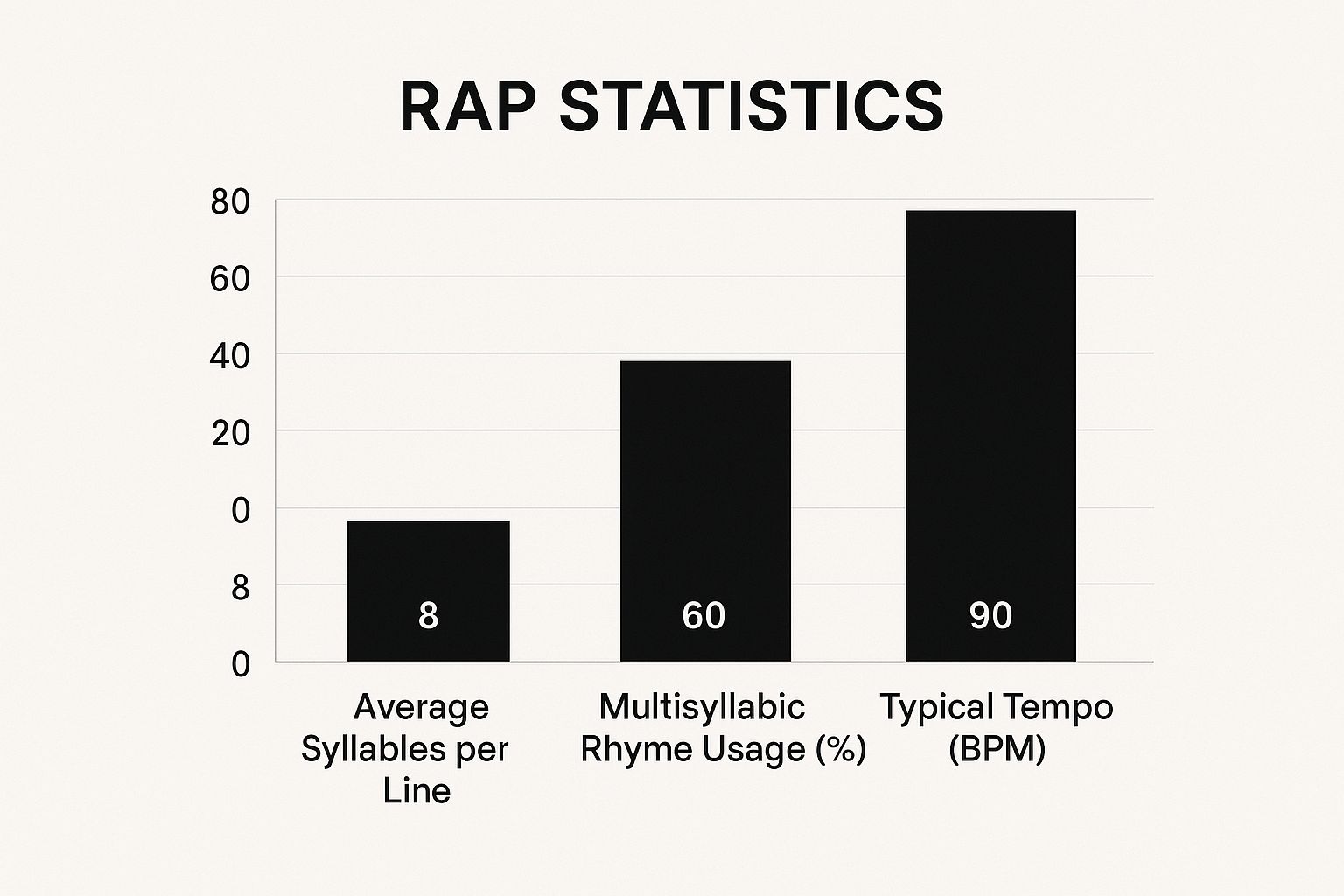
It's no secret that rap is a lexically demanding genre. Studies have shown that rap lyrics contain an average of 600 to 900 unique words per 1,000 words—way higher than most other popular genres. This is exactly why a rich vocabulary and clever wordplay are essential to stand out.
Finding the Perfect Word Every Time
We've all been there. Staring at a line, knowing it's almost perfect but you're missing that one key word. Hunting for the right rhyme can completely kill your creative momentum.
This is where having a dedicated writing assistant makes all the difference.
Instead of breaking your flow to open another tab and search a clunky online rhyming dictionary, imagine getting smart suggestions right as you type. That’s what Lyric Studio was built for. Its integrated rhyme and thesaurus tools are context-aware, which means they don't just find random rhymes—they find words that actually fit the theme and emotion of your song.
This turns a moment of writer's block into a moment of discovery, helping you find those multisyllabic rhymes and clever word choices you might not have thought of on your own. It keeps you in that creative zone where the best ideas happen. Download Lyric Studio free on iOS to see how it works.
Structuring Your Song for Maximum Impact
Killer bars are one thing, but a great song is a whole other beast. It's a journey. The way you arrange those bars is what guides your listener through a story, an emotion, or a hard-hitting statement. If you want to move beyond just rhyming and start making complete, professional-sounding tracks, you need to master song structure.
Think of it as the blueprint for your music. It gives listeners a familiar framework to latch onto, making your track easier to follow and feel. And while you can always break the rules, you have to know them first.
This isn't just theory; you can see how structure has evolved. Early hip-hop was often built on simpler, more repetitive styles. But by the late '80s and '90s, artists were using far more complex patterns and arrangements to tell their stories. The game changed. You can actually see the data on rap's lyrical evolution and track how composition has grown more sophisticated over the decades.
The Building Blocks of a Rap Song
Every section of your track has a job to do. Once you get a feel for the role each one plays, you can start piecing them together to build momentum, hit emotional peaks, and make a song that sticks with people long after it's over.
The Intro: This is your handshake. It sets the mood and grabs the listener in the first 5-10 seconds. It could be a simple instrumental, a spoken-word clip, or a sample that hints at what’s to come.
The Verse: Here’s where you do the heavy lifting. The verses are the narrative backbone of your song. This is where you lay out the details, build your world, and really flesh out your core message. A standard verse is typically 16 bars.
The Chorus (or Hook): This is the part everyone remembers. Your chorus needs to be catchy, simple, and hammer home the main idea of your song. It’s the part people will be humming later, so make it count.
The Bridge: This is your chance to switch things up. The bridge connects different sections—usually the second chorus and the final verse—by introducing a new perspective, a different rhythm, or a melodic change. It breaks up the pattern and keeps things interesting.
The Outro: This is how you say goodbye. You can let the beat fade out, drop one last powerful line, or switch up the instrumental. A solid outro provides a sense of closure and gives the listener one final thought to hang on to.
Crafting a Hook That Sticks
The chorus, or hook, is arguably the most vital piece of the puzzle. It’s the anchor for the entire song. A weak hook can make an otherwise great track fall completely flat, no matter how fire your verses are.
Your goal is to make it unforgettable. Use simple language, a strong rhythm, and a clear, powerful message. This is where you boil your whole track down into just a few lines. To really nail this, it’s worth diving deeper into what makes a good hook in our detailed guide.
Pro Tip: Try writing your chorus first. If you can lock in a powerful and memorable hook from the jump, it acts as a North Star for your verses, keeping the whole song focused and on-theme.
Putting It All Together
A tried-and-true song structure you'll hear everywhere looks like this:
Intro -> Verse 1 -> Chorus -> Verse 2 -> Chorus -> Bridge -> Chorus -> Outro
This formula just works. It creates a natural pattern of tension and release. The verses build the story and hype, and the chorus delivers that satisfying, memorable payoff. Then the bridge gives everyone a quick breather before you bring it all home with that final, powerful chorus.
Not sure where to start? Lyric Studio can give you a massive head start. Its "Magic Draft" feature can instantly generate a first verse and chorus, giving you a solid structural foundation to build on. It’s a great way to see how your song could flow right from the beginning.
How to Develop a Signature Flow
You can have the best lyrics in the world, but if your delivery is off, the track just won't hit. That's where your flow comes in.
Flow is all about the rhythm and cadence of your voice—how you ride the beat, catch the groove, and make your lyrics come alive. It’s what separates a rapper from someone who’s just reading words off a page.
Mastering your flow is how you inject your unique personality into the music. It's how you turn a simple rhyme into a pattern that gets stuck in people's heads. It’s not just about staying on time; it's about finding that sweet spot in the beat and making it your own.
Finding the Pocket of the Beat
Before you can build a unique flow, you have to really feel the pulse of the beat. A great flow feels like it was made for the instrumental, weaving perfectly between the drums and the melody. This means you need to listen actively, not just have the beat playing in the background.
Break down the core elements and listen for how they interact:
The Kick Drum: Think of this as the track's heartbeat. When you lock your bars into the kick pattern, you create a powerful, driving energy.
The Snare Drum: The snare gives you that classic backbeat, usually landing on the 2s and 4s. Hitting your punchlines or main rhymes on the snare gives them that satisfying snap.
The Hi-Hats: These give you the faster rhythm. If you want to develop quicker, more complex flows, try practicing your cadence along with the hi-hat pattern.
Here’s a simple exercise: take one line and rap it over and over again on a loop. But each time, change which word you emphasize. Try to land the rhyme directly on the snare. Then, try hitting it just a hair before the beat, or even a little late. This is how you start to feel all the rhythmic possibilities inside a single bar.
Exploring Different Styles of Flow
There's no single right way to flow. The best in the game switch their cadence constantly, sometimes multiple times in one verse, just to keep things interesting. You have to experiment to find what works for you.
You could go with a classic on-beat flow, where your delivery is super tight and locks right into the main groove. This is perfect for clear storytelling and making big, anthemic hooks that are easy for people to follow.
Or, you could mess around with a syncopated flow. This is where you intentionally rap around the beat instead of directly on it, creating a more complex and unpredictable rhythm. This style is great for showing off your technical skill and making your verses feel more like a conversation.
A Practical Tip: Don't be shy about imitation when you're starting out. Pick a verse from a rapper you admire and try to copy their flow exactly. The point isn't to steal their style forever; it's to take it apart and figure out the mechanics of how they're using rhythm and timing.
Improving Your Technical Skills
A killer flow is more than just having a good ear; it takes serious technical control. How you actually deliver the words—your breath, your articulation—is just as important as your timing.
Breath Control: Nothing kills the vibe faster than running out of air mid-verse. Practice rapping longer and longer sections in a single breath to build up your lung capacity. It also helps to go through your lyrics and mark out spots where you can sneak in a quick breath without breaking the rhythm.
Enunciation: If people can't understand what you're saying, your words don't matter. Mumbled verses get completely lost in the mix. Do some diction exercises, like tongue twisters, to make your delivery sharper. Every single word needs to land with purpose.
Pacing: Your flow shouldn't be a flat line. Play with your speed. Switching from a rapid-fire triplet flow to a slow, deliberate delivery can create a huge dramatic impact, putting a spotlight on a specific line or completely changing the mood.
To really get a feel for your unique flow, experimenting with how you hear your own words can be a game-changer. Practicing out loud is essential, but you can also use tools like advanced text-to-speech technology. Hearing a computer-generated voice read your lyrics back can instantly reveal awkward phrasing or rhythmic weak spots you might have missed.
Developing your signature flow is a journey. It’s where your words meet your voice, and it takes practice. Ready to hear how your own flow sounds over a beat? Download Lyric Studio free on iOS. The app’s built-in studio lets you record your vocals over custom beats, so you can start practicing and refining your delivery right away.
Bring in a Creative Partner to Refine Your Lyrics
Let's be real: your first draft is just a starting point. The real magic happens in the edit. This is where you roll up your sleeves and polish what you’ve written until every single word earns its spot on the track.
Refining your lyrics means stepping back and listening with a critical ear. You're hunting for the weak spots—the clunky lines, the overused clichés, the rhymes that feel a little too forced. This process is what separates a decent song from an unforgettable one.
How to Spot and Fix Weak Lines
A weak line can completely derail the momentum of a verse. Maybe it's a filler phrase you threw in just to make a rhyme work, or a bar that trips up the rhythm. The best way to find these is to read your lyrics out loud. Over and over again.
If you stumble over a line when you say it, your listeners will hear it. Those are the moments that need a rewrite.
Here’s what to look for when you're in editing mode:
Kill the Clutter: Are you saying the same thing in two different ways? Find those filler words and repetitive phrases and cut them. Be ruthless.
Power Up Your Verbs: Weak verbs create weak imagery. "I walk to the store" is okay, but "I stride to the store" or "I creep to the store" tells a story.
Show, Don't Tell: This is a classic for a reason. Instead of saying you're confident, show it. "My reflection's my only rival" hits way harder than "I feel very confident."
The Power of a Digital Sparring Partner
This is exactly where having a creative partner can be a game-changer. After staring at the same page for hours, your brain starts to glaze over. You need a fresh set of eyes—or in this case, a fresh algorithm—to help you break through those creative blocks.
Lyric Studio is your secret weapon here. Think of it as a creative assistant that gives you a new perspective right when you feel stuck. The AI-driven suggestions are context-aware, meaning they actually adapt to the theme, emotion, and genre you're writing in.
You can customize the genre and mood for hip-hop, pop, R&B, and more to get suggestions that actually fit the vibe of your track. It’s not about replacing your voice; it's about adding new possibilities you might not have thought of on your own.
Stuck on a line that just isn't landing? Instead of getting frustrated, you can instantly get a list of alternate phrasings and rhyme suggestions. This keeps you in the creative zone, turning writer's block into a moment of discovery. If you're curious about the mechanics, we've broken down how AI can help songwriters in another article.
Using AI to Level Up Your Lyrical Complexity
The idea of using tech to break down rap isn't even new. Back in 2016, a study used machine learning to analyze the deep-level structures of rap verses. It confirmed what we all know: lyrical complexity and creative rhyme patterns are hallmarks of great writing. The model they built could actually predict the next line in a verse with an accuracy 50 times better than random chance. You can read about the findings on AI and lyricism yourself.
This just proves that there are tangible patterns in what makes a lyric effective. The AI in Lyric Studio works on a similar principle. It uses its deep understanding of language and structure to offer up more creative ways to say what you mean, helping you find that perfect multi-syllabic rhyme or a stronger metaphor.
This isn't a crutch; it's a tool. It's designed to push you to think differently and elevate your craft by providing a fresh perspective exactly when you need it. By bringing it into your refining process, you can transform your lyrics from good to undeniable.
Ready to see what a creative partner can do for your writing? Download Lyric Studio free on iOS and start polishing your work until it shines. (Note: in-app purchases may apply).
Still Got Questions About Writing Rap Lyrics?
Even with a solid process, a few questions always seem to come up. Learning to write rap is a journey, not a destination, so hitting a few bumps in the road is totally normal. Let's clear up some of the most common hurdles so you can get back to creating.
How Long Should a Rap Song Be?
There’s no magic number here. Most of the rap songs you hear on the radio or on your favorite playlist usually clock in between 2 minutes and 30 seconds and 4 minutes. That's typically enough room for an intro, two or three 16-bar verses, a catchy chorus that repeats, and maybe a bridge or an outro to tie it all together.
But honestly, don't get obsessed with the stopwatch. The real goal is to keep your listener hooked and to tell your story from start to finish. Focus on making the track feel complete, not just on hitting a specific time.
What Do I Do When I Get Writer's Block?
First off, relax. Every single artist hits a wall. It’s just part of the game. When it happens, the best thing you can do is step away for a bit. Go for a walk, fire up a video game—anything that gets your mind off the blank page.
Another trick is to just flip your process on its head. If you usually start with lyrics, try finding a beat that gets you hyped and write to that instead. Sometimes a new rhythm is all it takes to spark an idea.
And when you're really stuck, a creative assistant can be a game-changer. For instance, Lyric Studio's "Magic Draft" feature can generate a whole first verse and chorus for you in an instant. It gives you context-aware rhymes and line suggestions right when you feel like you've got nothing left, turning a moment of frustration into a breakthrough.
How Do I Find My Own Rap Style?
Your style isn't something you just discover one day; it's something you build over time, brick by brick. A great way to start is by listening to everybody. I mean everybody—from old-school pioneers to the new wave of artists pushing the boundaries. See what sticks with you. Is it their flow? Their storytelling? Their clever wordplay?
The most important thing, though, is to write about what's real to you. Your life, your experiences, your point of view. That's where your unique voice is hiding.
Pro Tip: Record yourself rapping over all kinds of beats—fast, slow, hype, chill. You’ll quickly find out which tempos and moods feel the most natural for your voice. Your style will end up being a mix of your influences, your personality, and a whole lot of practice.
Is It Better to Write Lyrics Before or After Finding a Beat?
Ah, the classic debate. The truth is, there’s no right or wrong answer. It really just depends on what gets your creative gears turning.
Writing to a beat is great because it gives you an immediate blueprint. The rhythm can shape your flow and cadence, and you can build your rhymes to fit perfectly in the pocket of the instrumental.
Writing lyrics first offers total freedom. You can build your story however you want, with no rhythmic rules holding you back. Then, you can find or create a beat that perfectly matches the vibe of your words.
Plenty of pros do it both ways. My advice? Try both and see what clicks for you. You might find that one method works better for certain types of songs.
Ready to smash through writer's block and get that next track finished? With AI-driven, context-aware lyric suggestions and a built-in studio, Lyric Studio is the ultimate co-writer. Download Lyric Studio for free on iOS and start bringing your bars to life.

SCAN TO GET