Back to articles
How to Compose a Song from Scratch

Every song starts with three things: a great idea, lyrics that mean something, and a melody that sticks. The real work is catching that first spark of inspiration, shaping it into a story with verses and choruses, and then wrapping it all in music that makes you feel something.
Find Your Core Song Idea
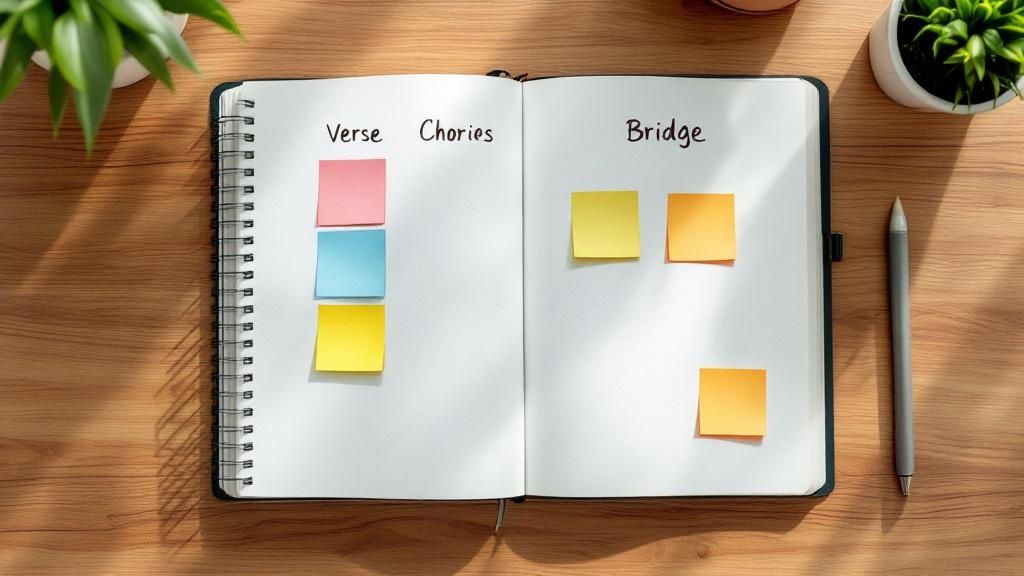
The best songs rarely arrive fully formed. They start small—with a single line you can’t shake, a feeling you just have to get out, or a simple melody you hummed into your phone. That’s your starting point. The trick is to grab that raw, unfiltered bit of inspiration before it vanishes.
Too many new songwriters get stuck waiting for that perfect lightning bolt of genius. But if you talk to the pros, they'll tell you inspiration is a muscle. It shows up when you do. Think about the legends from the Tin Pan Alley era. A guy like Irving Berlin wrote over 1,500 songs in his lifetime, cranking out 20-30 songs a year at his peak because he treated it like a craft. He showed up to work. You can find more on the history of this approach over at Beatportal.
From Feeling to Concept
Okay, so you have a feeling. Now what? The first real step is to turn that abstract emotion into a concrete idea. What do you want your listener to feel? Is it the quiet ache of a rainy Sunday morning? Or the pure, unadulterated joy of a Friday night with friends? That decision will shape every choice you make, from the words you pick to the tempo you set.
Once you’ve nailed down the feeling, give it a home. Figuring out your genre and mood early on gives you a creative roadmap.
Genre: Are you aiming for a soulful R&B ballad, an aggressive hip-hop track, or a bright, shiny pop anthem? Each one comes with its own set of rules and expectations.
Mood: Is your song reflective? Defiant? Joyful? Somber? The mood is the emotional color you'll be painting with.
This is where a creative assistant can make a huge difference. Before you even write a single word, you can set the stage with a tool like Lyric Studio. Its genre & mood customization for hip-hop, pop, R&B, and more lets you lock in the sonic and emotional vibe from the get-go, making sure your creative vision has a solid foundation to build on.
A song idea doesn't need to be some grand, complicated concept to be powerful. The most timeless songs are about universal human stuff: love, loss, hope, and struggle. It's your unique take on it that makes it special.
Capturing Fleeting Moments
Inspiration is a funny thing. It never shows up when you expect it to. It hits you on the bus, in the shower, or while you're just walking down the street. The most important thing you can do is be ready. Always. Keep a notebook handy, use the voice memos on your phone—whatever it takes to get the idea down before it's gone.
These little sparks are the seeds of your next song. They might be:
A cool phrase you overheard or a weird observation.
A simple chord progression you found just messing around on your guitar.
A rhythm you started tapping out on a table.
Don't filter yourself. Just collect everything. Not every idea will be a masterpiece, but building a library of concepts means you’ll never have to stare at a blank page again. When you're ready to turn those ideas into lyrics, a creative assistant like Lyric Studio can help you get there faster. Download Lyric Studio free on iOS to start building your song right now. Please note that the app is free to download but may offer in-app purchases.
Write Lyrics That Connect
Alright, you’ve got your big idea. Now it's time to find the words. Lyrics are what turn that spark into a story someone else can step into and feel. This is where we move from the abstract concept to the nuts and bolts of crafting a narrative that actually resonates with people.
A song's structure is its skeleton—it holds everything together. There's a reason most hits you hear in pop, hip-hop, and R&B follow a similar pattern: it just works. This framework guides the listener, builds tension, and helps your core message hit with real impact. You don't need to reinvent the wheel, but understanding how each part works is crucial.
Building Your Song's Narrative
The classic verse-chorus structure is popular because it’s a killer way to tell a story. Think of your verses as the chapters. Each one peels back another layer of the narrative, setting the scene or pushing the plot forward. They're all about the details.
Your chorus, though? That's the main event. It’s the emotional heart of your song, the central theme boiled down to its most potent form. This is the part people will scream back at you from the crowd, so it needs to be powerful, memorable, and straight to the point. A good bridge then provides a change of scenery—a new perspective or a shift in the music—before dropping you back into that final, explosive chorus.
If you want to go deeper on this, we've got a whole guide on the five steps to easily write song lyrics.
This workflow shows how you can take those scattered thoughts and build them into a fully-fledged song.
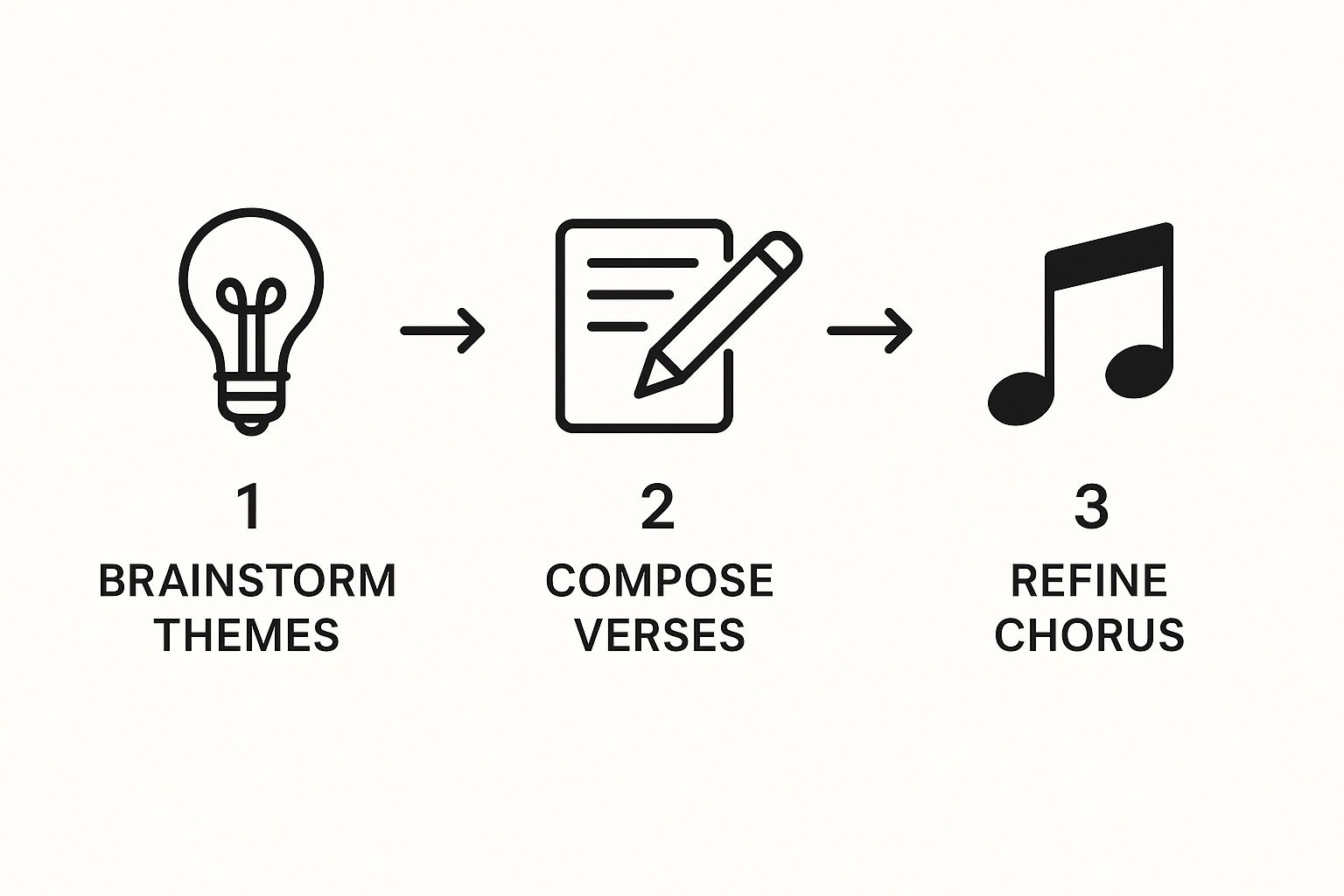
As you can see, songwriting isn't just one magic moment of inspiration. It’s a process of building, refining, and polishing an idea until it shines.
To help you map this out, think about the role each part of your song plays.
Essential Song Structure Components
Here’s a quick breakdown of what each common section in a song is built to do, which can help guide what you're trying to say in each part.
Song Section | Primary Purpose | Lyric Writing Focus |
|---|---|---|
Verse | Tell the story, provide details, set the scene. | Use descriptive language, introduce characters, move the plot. |
Chorus | State the main idea, deliver the hook. | Be memorable, concise, and emotionally direct. |
Bridge | Offer a change in perspective or emotional shift. | Introduce a new thought, ask a question, raise the stakes. |
Pre-Chorus | Build anticipation for the chorus. | Create tension and a clear transition into the main hook. |
Outro | Conclude the song, provide a final thought. | Fade out, repeat a key phrase, or offer a final emotional punch. |
Having this blueprint in mind gives your lyrics a sense of direction and makes the final song feel cohesive and intentional.
Choosing Words That Work
Word choice is everything. It's the difference between a cliché and a line that stops someone in their tracks. My best advice? Get specific. Use sensory details—words that help the listener see, hear, and feel what you’re describing. Instead of just saying you’re sad, show it with "the ghost of your perfume on my jacket" or "the static from a dead-end call."
This is where rhythm and rhyme become your secret weapons. The natural rhythm of your words should feel good to say and sing, complementing the melody you have in mind. A solid rhyme scheme can make your lyrics click into place, but don't ever force it. Nothing pulls a listener out of the moment faster than a clunky rhyme that’s only there for the sake of rhyming.
It's so easy to get hung up on finding that one perfect word, and that hunt can bring your whole session to a screeching halt.
Songwriter’s Tip: Don't let the search for the perfect rhyme kill your momentum. Just drop in a placeholder word that gets the meaning across and circle back to it later. The most important thing is to keep the ideas flowing.
This is exactly where having a creative assistant comes in handy. Lyric Studio has integrated rhyme and thesaurus tools that are way more than just a dictionary. They give you context-aware suggestions that actually fit the vibe of your song, helping you nail that word choice without breaking your creative flow.
Overcoming the Inevitable Writer's Block
Look, every single songwriter—from absolute beginners to Grammy winners—hits a wall. The blank page starts to feel like a personal attack, and the pressure to write something great can be completely paralyzing. When that happens, you need a way to jump-start the engine.
Think of it as hitting a creative reset button. Sometimes, just changing your approach is enough to shake an idea loose. For example:
Change your POV: Try telling the story from someone else's perspective.
Work backward: What’s the last line of the chorus? Start there and build the song in reverse.
Set a timer: Give yourself 10 minutes to just write. No editing, no judgment. The only goal is to fill the page.
Sometimes, all you really need is a little push to get started. The “Magic Draft” feature in Lyric Studio was designed for these exact moments. Based on your topic, it can instantly generate a first verse-and-chorus to give you a solid foundation. It doesn't write the song for you; it gives you a launchpad you can then edit, rewrite, and mold into your own unique creation.
Laying Down Memorable Melodies and Chords

Alright, your story is coming together and you’ve got some killer lyrics on the page. Now it's time to make them sing. This is where you breathe life into your words with melody and harmony—the real emotional engine of your track.
Don't sweat it if you're not a music theory whiz. The goal here isn't to be technically perfect; it's to match the sound to the feeling. A great melody doesn't just ride on top of the lyrics; it fuses with them, making your message impossible to forget.
Crafting a Melody That Sticks
Think of your melody as the path your listener’s ear follows. Out of everything you write, the chorus melody is the most critical piece of the puzzle. It has to be catchy, powerful, and something people can hum after hearing it just once.
So, how do you do that? Choruses often reach for higher notes and feature bigger melodic jumps. This simple trick creates a burst of energy and signals to the listener, "Hey, this is the main event!" Verses, on the other hand, usually sit in a more conversational, lower range, which is perfect for telling the story.
This contrast is your secret weapon. A steady, grounded verse makes that soaring chorus feel like an emotional release when it finally hits. My advice? Just start humming different ideas over your lyrics. Don't judge them, just play around and see what feels right for each section.
A killer chorus melody is often built on repetition with a slight twist. This makes it instantly familiar and easy for a crowd to sing along with—a surefire sign of a hit song.
Setting the Mood with Chords
If melody is the voice, chords are the heartbeat. A chord progression is just a series of chords that creates the harmonic vibe for your song, and the chords you pick will instantly define the mood.
It's simpler than you think:
Major Chords: These sound bright, happy, and optimistic. Think upbeat pop or a triumphant anthem.
Minor Chords: These feel more somber, introspective, or serious. They're perfect for emotional ballads or moody hip-hop tracks.
You really don't need complex jazz chords to write something powerful. Some of the biggest songs in history are built on just a few simple chords. If you want to dive a little deeper, we put together a handy guide on music theory for songwriters to get you started.
Common Chord Progressions to Get You Started
So many pop, R&B, and rock hits are built on a handful of the same tried-and-true chord progressions. They just work. Using one of these is a fantastic way to lay down a solid foundation for your song.
Here are a few classics to experiment with (we use Roman numerals to represent them):
Progression | Feeling | Common Genres |
|---|---|---|
I-V-vi-IV | Epic, emotional, versatile | Pop, Rock, Country |
vi-IV-I-V | Hopeful, slightly melancholic | Pop-Punk, Ballads |
I-vi-IV-V | Classic, nostalgic, '50s vibe | Doo-Wop, Pop |
i-VI-III-VII | Dramatic, moody, dark | R&B, Hip-Hop, Minor Pop |
Grab a guitar or sit down at a keyboard and just play through these. Which one feels like it fits the story you're trying to tell?
Remember, the goal is to make the words and music feel like they were born together. When you get that right, the song becomes so much more than the sum of its parts.
Arrange Your Song for Maximum Impact
This is where the magic really happens. You've got your lyrics and your melody—now it's time to put on your producer hat and build the world your song will live in. Arrangement is all about turning that core idea into a full-blown musical experience.
Think of it like telling a story with sound. You decide which instruments show up, when they make their entrance, and how they all work together to build energy and guide the listener. A lone acoustic guitar can pull someone in for an intimate verse, but when you add a deep bassline and a solid drum beat, you're suddenly pushing the story forward into the chorus.
This is the stage where your sketch becomes a finished painting.
Building Your Track Layer by Layer
A killer arrangement is built on contrast and movement. You don't want to hit the listener with everything you've got in the first five seconds. That leaves you nowhere to go. Instead, think about building your song in layers, introducing new elements over time to keep things fresh and exciting.
For example, your first verse might be super sparse—maybe just vocals and a simple piano part. This creates a ton of space and puts all the focus right on your lyrics. But when the second verse rolls around, maybe you sneak in a subtle bassline or a light shaker. It’s a small change, but it signals a shift in energy and keeps the listener leaning in.
Here are a couple of common approaches:
Additive Arrangement: Start small and add instruments as you go. This is a classic way to build excitement toward a huge, powerful chorus.
Subtractive Arrangement: Start with a fuller sound and then strategically pull instruments out for certain sections, like a quiet bridge. This creates a ton of tension right before you bring everything back for the final chorus.
The goal is to make every new sound feel intentional. Each layer should add something important to the emotional journey of your song.
Mapping Your Song's Energy
The best arrangements have a clear energy map—a deliberate plan for the song's emotional highs and lows. You want that chorus to hit like a tidal wave and leave a lasting impression. This is what makes a song feel dynamic and gives it that can't-stop-listening quality.
Find the loudest, most intense moment of your song. Chances are, it's your final chorus. Now, work backward. What can you do in the section right before it to make that moment feel even bigger? Maybe you strip everything away for a beat, leaving just a vocal hanging in the air. That pocket of silence makes the crash of the full band feel absolutely massive.
Great arrangement isn't about complexity; it's about impact. A song with just three perfectly arranged instruments can feel bigger and more powerful than a song with fifty messy layers. It’s all about creating tension and release.
Learning how to build that anticipation is a huge part of the craft. It's directly tied to what makes your hook so effective. If you want to dive deeper into that, we have a whole guide on what makes a good hook that can help.
Using Space and Silence
Sometimes, the most powerful tool you have is what you don't play. The space between the notes is just as important as the notes themselves. A well-placed pause can build suspense, add emotional weight to a lyric, or give the listener a moment to breathe before the next section slams in.
Don't be afraid to let your song have quiet moments. A stripped-back bridge makes that final chorus feel like a huge release. A song that’s cranked to 11 from start to finish just gets tiring. Variety is what keeps people hooked.
Feeling stuck on where to even begin with these layers? Sometimes you just need a creative nudge. The Magic Draft feature in Lyric Studio can instantly generate a first verse-and-chorus, giving you a solid lyrical and structural foundation to start building your arrangement on top of. Download Lyric Studio free on iOS and see how a creative assistant can get your producer brain firing. Please note that the app is free to download but may offer in-app purchases.
Refine and Polish Your Work

Getting that first draft down is a massive win, but the real magic happens in the rewrite. This is where you put on your editor hat and transform a good idea into a truly great track. It’s all about stepping back, listening with a fresh perspective, and making smart, intentional changes.
I've always believed that the best songwriters are ruthless editors. They know a song isn’t finished when you can’t think of anything else to add, but when there’s nothing left you can possibly take away. That means being brutally honest with yourself about what’s working and what isn’t.
Become Your Own Toughest Critic
The first rule of editing? Give it some space. Once you finish a draft, put it away for a day or two. This is so important—it lets you come back to the song not as its creator, but as a listener. That distance changes everything.
When you finally hit play, come at it with a plan. Don’t just ask, "Is it good?" Ask pointed questions that give you a clear path forward.
Lyrical Flow: Do any lines feel clunky or awkward to sing out loud? Are there any rhymes that feel predictable or, even worse, forced?
Melodic Impact: Does the chorus melody actually lift off from the verses? Is it still stuck in your head after you stop listening?
Chord Simplicity: Is the chord progression serving the emotion, or is it getting in its own way? Sometimes, cutting one chord can make a whole section breathe.
This is your diagnostic phase. You're not trying to tear your song down; you're just looking for the weak spots so you can build them back up, stronger than before.
Strengthen Your Lyrics and Melody
Once you've zeroed in on the areas that need some love, it's time to get your hands dirty. Maybe a verse has a killer concept, but the words just aren't hitting right. Or maybe the melody in your pre-chorus wanders a bit aimlessly. This is exactly where a creative assistant can make a huge difference.
If you’re stuck on a line, the AI-driven, context-aware lyric suggestions in Lyric Studio can be a godsend. Because the suggestions adapt to your theme, emotion, and genre, they’re not just pulling random rhymes from a dictionary. They’re offering up intelligent alternatives that can spark ideas you never would have thought of.
Polishing a song is like sculpting. You start with a rough block of stone—your first draft—and carefully chip away everything that isn't the final masterpiece. Each small edit brings the song's true form into sharper focus.
This whole process is a loop. You rewrite a line, which inspires a little tweak to the melody, which then makes you rethink the line right before it. Lean into that. That back-and-forth is the very heart of refinement.
Polish for the Modern Listener
Let's be real: the way people listen to music has completely changed, and we have to write for that reality. Today, music streaming makes up about 84% of the global music industry’s revenue. As detailed on Exploding Topics, this shift has pushed songwriters to create tracks that grab a listener immediately to survive in a playlist-driven world.
This doesn't mean you have to sell out your artistic vision, but you have to be smart. The average pop song is now around three minutes long, and you'll often hear the main hook within the first 30 seconds.
As you do your final polish, keep these things in mind:
Get to the Point: Is your intro dragging on? Can you get to the hook or the first verse faster?
Strengthen Your Hook: Does your chorus hit hard enough to make someone smash that "repeat" button?
Trim the Fat: Is every section absolutely essential? Is that instrumental break truly serving the song, or is it just filler?
This last pass ensures your song is not only creatively finished but also ready to find its audience. When you feel like you’ve taken it as far as you can on your own, it’s ready.
If you’re ready to really dig into the revision process and make your songs shine, a tool like Lyric Studio is the perfect creative assistant. Its powerful features, from the integrated rhyme tools to the Magic Draft that helps you reboot a section from scratch, are all designed to help you refine your work. Download Lyric Studio free on iOS and start polishing your next hit. Please note that the app is free to download and may offer in-app purchases.
Got Songwriting Questions? We've Got Answers.
Diving into songwriting is a blast, but it’s easy to get bogged down by a million questions. Where do I even begin? Is this idea any good? Every songwriter, from first-timers to seasoned pros, runs into these same walls. Let's tackle some of the most common ones head-on.
Music or Lyrics First?
Ah, the classic chicken-or-the-egg debate of songwriting. The honest truth? There's no single right way to do it. Some of the most iconic songs in history started as a few lines of poetry scribbled on a napkin, while others were born from a melody hummed into a voice memo.
Many songwriters, like the talented Hannah Trigwell, prefer to start with the music. A chord progression or a simple melody can instantly paint an emotional backdrop, giving you a clear vibe to write lyrics for. But sometimes, a powerful lyrical idea or a killer song title is all you need to give your music a built-in GPS, guiding every chord and note.
My advice is to not lock yourself into one method. Experiment! See what feels right for the song you're trying to write today. If you've got a melody you love but the words just aren't coming, a tool like Lyric Studio can be an amazing creative assistant. Its AI-driven suggestions can help you find lines that fit your theme, helping you bridge the gap between your music and your message.
What's the Ideal Song Length?
There are no hard-and-fast rules, but if you look at what's charting in pop, R&B, and hip-hop, you'll see a clear trend. The sweet spot right now is between two and a half to three and a half minutes. This is all about the streaming game—in a world of endless playlists, you need to grab the listener's attention and get to the hook fast. Shorter songs are simply more likely to be replayed and less likely to be skipped.
That said, don't let a stopwatch dictate your art. A song should be exactly as long as it needs to be to tell its story. Never force another verse just to add time, and don't chop out a powerful bridge just to hit a magic number.
How Can I Tell If My Song Is Actually Good?
This is the big one, the question that haunts every creative person. The single best way to find out is to get it out of your own echo chamber.
Once you think it’s done, step away for a day or two. Then, play it for someone you trust—a friend whose musical taste you respect and who will give you an honest opinion. Don't ask them "Is it good?" Just watch them. Do they start bobbing their head? Do their eyes glaze over? Their gut reaction will tell you more than their words ever could.
You can also benchmark your work. Put your song in a playlist with a few professional tracks in the same genre that you admire. How does it stack up? This isn't about feeling bad if yours isn't as polished; it's about training your ear to hear what works in a pro-level song.
At the end of the day, the real test is simple: Does it make you feel something? If your own song moves you, there's a very good chance it will connect with someone else, too.
If you're just staring at a blank page and can't even get started, the “Magic Draft” feature in Lyric Studio is a lifesaver. It can kick out a first verse-and-chorus in seconds, giving you something to react to, edit, and build from. It’s a great way to kill writer's block before it even starts.
Ready to stop questioning and start creating? Lyric Studio is packed with tools designed to help you push through these common hurdles and turn your ideas into finished songs. Download Lyric Studio free on iOS and get writing. Please note that the app is free to download and may offer in-app purchases.

SCAN TO GET