Back to articles
How to Come Up with a Song Lyrics: Tips for Songwriters

Every song starts with a spark. It could be a personal story you're burning to tell, a feeling you just can't shake, or even a single compelling phrase. Finding that one core idea is your first real step; from there, you can start building everything else—the themes, the imagery, the story—around it.
Finding Your Core Song Idea

We've all stared at a blank page, waiting for that lightning bolt of inspiration. But here's a secret from seasoned writers: inspiration isn't something you wait for. It's something you practice finding. The best, most unforgettable lyrics almost always spring from a place of authenticity. So, let's stop waiting and start looking.
Your own life is a goldmine. Think about a vivid memory, a dream that felt too real, or a conversation that’s been replaying in your mind. These are the moments packed with the kind of raw, honest emotion that listeners instantly connect with.
Tapping into Your Environment
Sometimes, the best ideas are right in front of you, hiding in plain sight. You just have to pay attention. Listen to the rhythm of conversations at a coffee shop, watch the stories unfolding on the evening news, or just notice the way the light hits the trees as the seasons change.
Great songwriters are observers. They capture the tiny, specific details of human experience that somehow manage to reveal universal truths. Even something as simple as a pop culture trend can ignite a song. A fascinating analysis of recent hit songs revealed how lyrics often reflect what's happening in society, mixing high-end luxury brands with everyday items to create a world that feels both aspirational and deeply relatable.
Turning Vague Feelings into Concrete Themes
Okay, so you have a spark. Now what? You need to give it shape and turn that abstract feeling into something listeners can grasp. Here are a couple of tried-and-true techniques I use to get my thoughts organized and find a song's true direction:
Freewriting: This is my go-to for breaking through the noise. Set a timer for 10 minutes and just write. Don't censor yourself, don't worry about rhymes, and definitely don't worry about making sense. The only rule is to keep your pen moving. You'll be surprised at what comes out when you turn off your inner critic.
Mind Mapping: If you're more of a visual thinker, this one's for you. Write your core idea in the middle of a page and circle it. Then, just start branching out with any related words, images, feelings, or memories that come to mind. It's a fantastic way to discover connections you never would have seen otherwise.
A song idea doesn't need to be some grand, complex concept to hit hard. The most powerful songs often take a simple, universal feeling—love, loss, hope—and explore it from a fresh, deeply personal perspective.
These exercises are all about helping you find the heart of your song. If you're just starting out, we've got a whole guide full of essential songwriting tips for beginners that goes even deeper.
When you're truly stuck, a creative assistant like Lyric Studio can help. Its "Magic Draft" feature instantly generates a first verse and chorus to jump-start your process. Plus, its integrated rhyme and thesaurus tools are perfect for refining your ideas and hunting for that perfect word.
Ready to get those ideas out of your head and onto the page? Download Lyric Studio free on iOS.
Structuring Your Lyrics for Emotional Impact
A great idea is just the start. To really make it hit home, you need a solid framework. Don't get lost in complex music theory—just think of song structure as the emotional roadmap you're creating for your listener. How you lay out your verses, choruses, and other parts will guide their journey from the very first note to the final fade-out.
Choosing the right structure is all about what serves the story. Are you building tension slowly, creating a sense of unease or anticipation? Or are you aiming for an explosive, in-your-face chorus right from the get-go? Your choice here will completely shape how the listener feels your message.
This infographic breaks down a few common song structures, showing how they build and release tension differently.
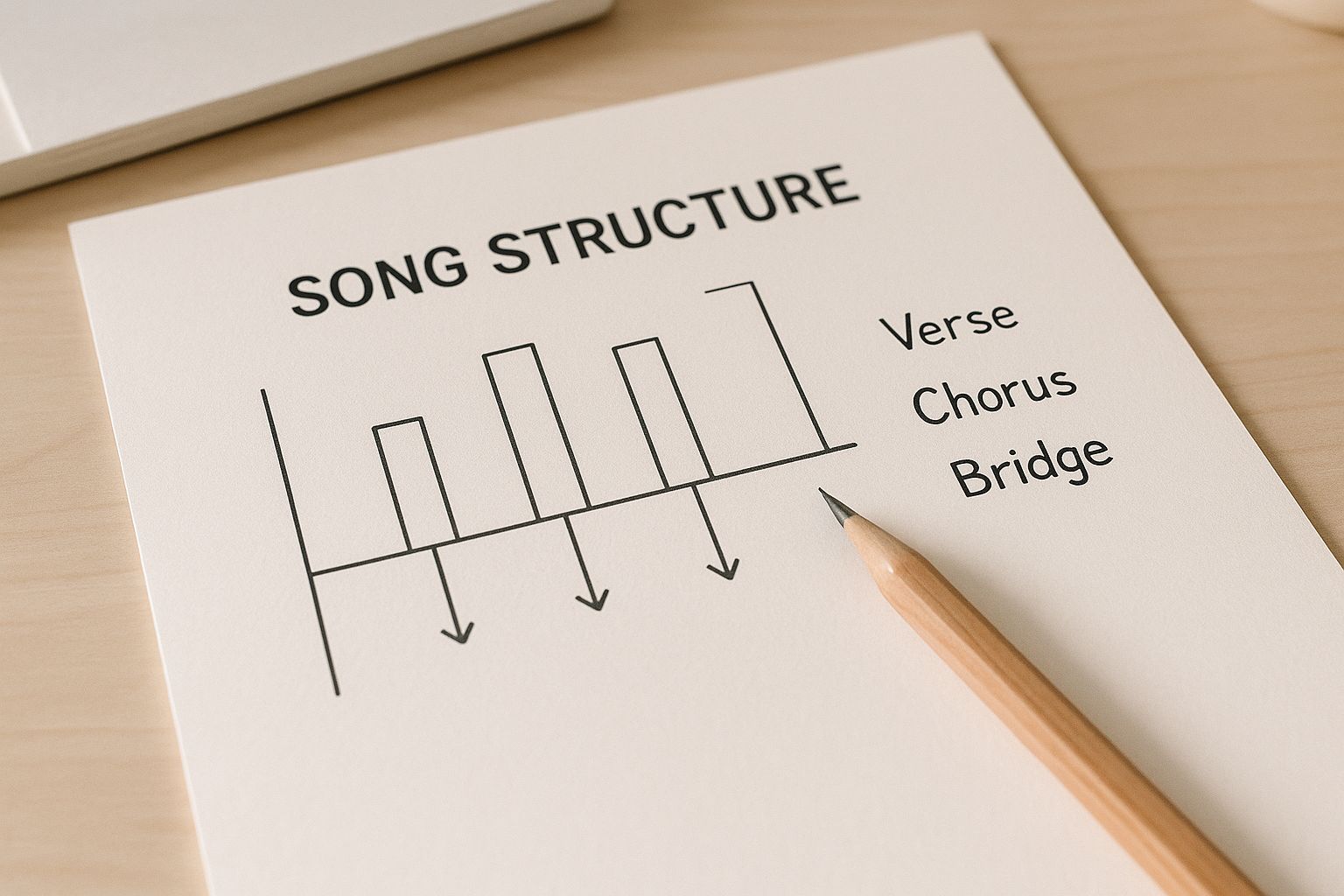
As you can see, each structure creates a totally different emotional arc. It's all about guiding your listener through a story with its own unique peaks and valleys.
Choosing Your Narrative Blueprint
You’ll find the classic verse-chorus format everywhere—in pop, rock, country, and hip-hop. There's a good reason it's so popular: it just works. The verses are your storytelling sections, painting a picture with specific details and moving the plot along. The chorus then smashes home the main theme, giving the listener a catchy, memorable hook to grab onto.
This structure is your best bet when you have a clear, powerful core message that you want stuck in people's heads long after the song is over.
Another great option is the AABA structure, which you'll hear a lot in older pop tunes and jazz standards. This one gives you two similar verses (the A sections), a contrasting bridge with a fresh perspective (the B section), and then a final return to the main verse theme (A). It's fantastic for creating a feeling of a journey and a satisfying return home.
The goal isn’t to cram your song into a rigid box. It's about finding a skeleton that helps your story stand up straight and makes its emotional core land with maximum impact. Think of it as the architecture holding up your brilliant ideas.
Building Lyrical Tension and Release
No matter which blueprint you pick, the real magic is in managing the song's energy. A track that's full-throttle from beginning to end is just tiring. But one that never really builds or goes anywhere feels flat and boring.
Here’s how the different parts typically work together:
Verse: This is where you set the scene. Introduce your characters, the setting, and the specific details that ground the story for the listener.
Pre-Chorus: Think of this as the ramp leading up to the big drop. It’s an optional but incredibly effective tool for building anticipation right before the chorus, making that hook feel even bigger when it finally hits.
Chorus: This is the heart of your song. It should be the most memorable and emotionally potent part, containing the single big idea you want everyone to walk away with.
Bridge: The bridge is your chance to take a detour. It can offer a new point of view, a sudden plot twist, or a quiet moment of reflection. It breaks the pattern and gives the listener a fresh perspective before you bring it all back home.
If you're staring at a page of ideas and can't figure out how they fit together, Lyric Studio can be a huge help. Its AI-driven, context-aware lyric suggestions can spark new ways to phrase a verse or add more punch to a chorus. Even better, the genre and mood customization ensures the ideas you get actually fit the emotional vibe you're going for, whether it’s a high-energy pop anthem or a moody R&B ballad.
Ready to build a structure for your next hit? Download Lyric Studio free on iOS and start arranging your ideas with real impact. Please note, in-app purchases may apply.
Crafting Lines That Stick
Alright, you've got your core idea and a rough structure. Now for the fun part—breathing life into your song line by line. This is where the real magic happens. Crafting unforgettable lyrics isn't just about finding clever rhymes; it’s about choosing words that hit with intention and make people feel something.
The best way to do that? Engage the senses. Instead of just telling us you were sad, show us. Describe the "cold weight in your chest" or the "gray blur of the city through rain-streaked glass." This kind of sensory detail paints a vivid picture, pulling the listener right into the world you're creating.
Making the Abstract Concrete
Feelings like love, loneliness, or regret are abstract concepts. Your job as a songwriter is to give them a physical form. You can do this with strong verbs, concrete details, and powerful metaphors that make these emotions feel real and tangible.
For instance, "you're not talking to me" is a statement. But a line like "your silence is a fortress" turns that silence into something solid and imposing. It hits much harder.
Think about the tiny details that tell a much bigger story. A cracked coffee mug on the counter, a faded photograph in a wallet, or the smell of gasoline on a summer afternoon—these specifics carry immense emotional weight and ground your song in reality, making it instantly relatable.
The Power of Simplicity and Repetition
It might seem counterintuitive, but your lyrics don’t always need to be complex to be powerful. Sometimes, the simplest, most direct lines are the ones that cut the deepest. They’re clear, honest, and leave no room for misunderstanding.
In fact, research analyzing over 350,000 songs from the last 50 years revealed a fascinating trend: popular music lyrics have become simpler and more repetitive. This isn't laziness; it's a strategic move. As the study points out, simpler lyrics are easier to remember and get their core message across more effectively, helping them connect with a huge audience. You can read more about these music trends and their impact.
Every single word in your song has to earn its place. If a line doesn't move the story forward, deepen the emotion, or strengthen the imagery, it's just filler. Be ruthless with your editing.
This is especially crucial when writing a chorus. A powerful, memorable chorus almost always leans on simple, intentional repetition. For a closer look at this, check out our guide on what makes a good hook.
When you find yourself stuck searching for that perfect, punchy phrase, Lyric Studio’s AI-driven suggestions can be a lifesaver. It gives you AI-driven, context-aware lyric suggestions that adapt to your theme and emotion, helping you discover powerful words that stick. The integrated rhyme and thesaurus tools are perfect for tightening up your lines and making sure every single one pulls its weight.
Ready to make every word count? Download Lyric Studio free on iOS at https://apps.apple.com/us/app/lyric-studio-rap-rhyme-maker/id1600316328. Note that in-app purchases may be available.
Using AI to Beat Writer's Block
Every songwriter has been there: staring at a blank page, waiting for an idea that just refuses to show up. It's a frustrating creative paralysis, but it’s definitely not a dead end. These days, technology gives us a powerful way to push through those moments, acting as a creative assistant that sparks new ideas without ever overshadowing your unique voice.
Think of an AI assistant less like a ghostwriter and more like a collaborator. It’s a tool built to give you a nudge right when you need it, helping you explore new directions and keep the creative momentum going. For songwriters looking to add technology to their process, the Clipbot AI tool offers some great solutions for sparking ideas and getting past those creative hurdles.
Jump-Starting Your Song with AI
Sometimes, the hardest part of writing a song is just getting started. That initial inertia can feel impossible to overcome. This is exactly where a feature like "Magic Draft" in Lyric Studio becomes so valuable. With one tap, it can instantly generate a first verse and chorus based on a few of your initial thoughts.
This isn't your final song, of course. But it's something real—a starting point you can react to, tear apart, and build upon. It completely shatters the blank page problem and gives you immediate material to shape and mold into your own.
Finding the Perfect Word
Once you have a draft going, the real craft of refining begins. You might know the exact feeling you want to capture but just can't find the right word. An AI-powered tool can offer AI-driven, context-aware lyric suggestions that adapt to your song's specific theme, emotion, and even its genre.
Genre & Mood Customization: Whether you're writing a hard-hitting hip-hop track or a heartfelt pop ballad, Lyric Studio provides suggestions that actually fit the style you're going for.
Integrated Rhyme & Thesaurus: Instead of bouncing between different websites and losing your focus, you get smart rhyme and word choice options right there in your workflow.
An AI assistant is your co-pilot. It handles the navigation so you can focus on flying. It gives you options, finds pathways you might have missed, and helps you land the song exactly where you want it to go.
The music industry is already seeing this shift happen. The global AI-generated song lyric market was valued at around $415 million and is growing, which tells us these tools are quickly becoming a standard part of a songwriter's toolkit.
This collaborative approach is changing how artists come up with song lyrics, making the entire process feel more fluid and a lot less intimidating. If you're curious about this, you can explore our in-depth article on how AI can help songwriters.
Ready to see how an AI partner can break your writer's block for good? Download Lyric Studio free on iOS. Please note that in-app purchases may apply.
How to Refine and Polish Your Lyrics
Your first draft isn't the finish line—it's just the clay on the wheel. The real magic, the stuff that turns a decent idea into a powerful song, happens in the edit. This is where you’ll trim the fat, sharpen your message, and make sure every single word pulls its weight.
It might sound too simple, but one of the most effective things you can do is read your lyrics out loud. Seriously. This isn't just about catching typos; it's about feeling the rhythm. Does a line get stuck in your mouth? Does the phrasing sound like something a real person would say? Your ears will pick up on clunky rhymes and awkward rhythms that your eyes completely miss.
Getting a Fresh Perspective
Staring at the same page for hours gives you tunnel vision. You know what you intended to say, but that doesn't mean it's what's actually coming across. It's time to bring in some fresh ears.
Find a few people you trust to give you honest feedback. But don't just ask them if they "like it." That's useless. Instead, dig for specifics:
What story do you hear in these words?
Did any part feel confusing or a little unclear?
Which line or image really jumped out at you?
What feeling did you have when you finished reading?
Their answers are pure gold. They’ll show you exactly where your message is landing and where it’s getting lost in translation.
Hunting Down Common Lyrical Traps
As you start tweaking, be on the lookout for a few classic songwriting pitfalls. Clichés are probably the biggest culprit. We've all heard "a heart of stone" or "blinding light" a thousand times. They're easy, but they don't leave an impression.
Your job during a rewrite is to swap the familiar for the specific. Don't just tell us the heart is "stone." Show us. Describe the cold, the weight, the way it makes your chest ache. That's where the real emotion lives.
The same goes for forced rhymes. We've all been there—twisting a sentence into a pretzel just to land a rhyme. It almost always sounds awkward and pulls the listener right out of the song. Don't be afraid to scrap the rhyme and find a better one, or even restructure the entire line.
Refining your lyrics is a bit like solving a puzzle, but it’s one of the most satisfying parts of the process. If you find yourself stuck on a word or fishing for a more creative phrase, tools like the integrated rhyme and thesaurus features in Lyric Studio can be a lifesaver. The AI-driven suggestions are smart enough to understand the context of your song, giving you ideas that fit the mood without killing your original voice.
Ready to take your draft to the next level? Download Lyric Studio free on iOS at https://apps.apple.com/us/app/lyric-studio-rap-rhyme-maker/id1600316328 and start polishing your lyrics. Note that in-app purchases may apply.
Your Top Songwriting Questions, Answered
As you get deeper into writing lyrics, you’ll start running into the same questions that every songwriter faces. Let's tackle some of the most common hurdles so you can get back to what matters: crafting a great song.
How Do I Find My Own Songwriting Voice?
Your unique voice isn't something you create; it's something you uncover. Think of it less like building a new house and more like an archaeological dig. It’s already in there, you just have to find it.
The best place to start is with raw honesty. Write about your life, your feelings, your weird observations. That specific point of view is the one thing that is 100% yours.
Don't be afraid to play around, either. Try writing a verse in a simple folk style, then flip it and see how it sounds as a rap. You're not trying to be someone else—you're just trying on different hats to see which one fits you best. The more you write, the more your true personality will shine through.
What If All My Lyrics Sound Cheesy and Clichéd?
First off, don't worry. Leaning on clichés is a rite of passage for every songwriter. They’re like training wheels for expressing big emotions. The real skill is learning to spot them and then digging deeper.
The next time you write a line that feels a bit stale—like "my heart is broken"—just stop for a second. Ask yourself what that actually feels like. Is it a hollow ache in your chest? A sharp, stabbing pain? Is it a heavy weight? Describing that specific, physical sensation is what turns a generic line into something that really hits home.
A song isn't finished when you can't add anything more to it. It's finished when you can't take anything else away.
How Do I Know When a Song Is Actually Done?
This is more art than science, and it’s something you’ll get a feel for over time. A song is finished when it says what you needed it to say. Read the lyrics from start to finish. Does the story make sense? Does it land the emotional punch you were aiming for?
Sometimes you're too close to it. Getting a second opinion from a friend you trust can be a game-changer. They'll be able to spot a clunky line or tell you if the ending feels rushed. In the end, though, it comes down to your gut. When you read it back and think, "Yeah, that's it," it's time to put the pen down.
Can I Write Lyrics if I Don't Play an Instrument?
Yes, absolutely. Words and music are two different crafts. Some of the most legendary songwriters in history, like Elton John's partner Bernie Taupin, only wrote the lyrics. They were poets who collaborated with musicians to bring their words to life.
You can still work on the rhythm of your lyrics by speaking them out loud or tapping a beat on your desk. And as you get more serious, it’s a good idea to learn about the industry itself. You can learn a lot about how to make money as a songwriter and see how professionals turn their words into a career.
Ready to face these challenges with a co-writer in your pocket? Lyric Studio is a creative assistant designed to help you find your voice with mood and genre settings, bust through clichés with an integrated thesaurus, and spark new ideas with its Magic Draft feature.
Download Lyric Studio free on iOS. https://apps.apple.com/us/app/lyric-studio-rap-rhyme-maker/id1600316328

SCAN TO GET