Back to articles
How Do You Make Rap Beats That Sound Professional
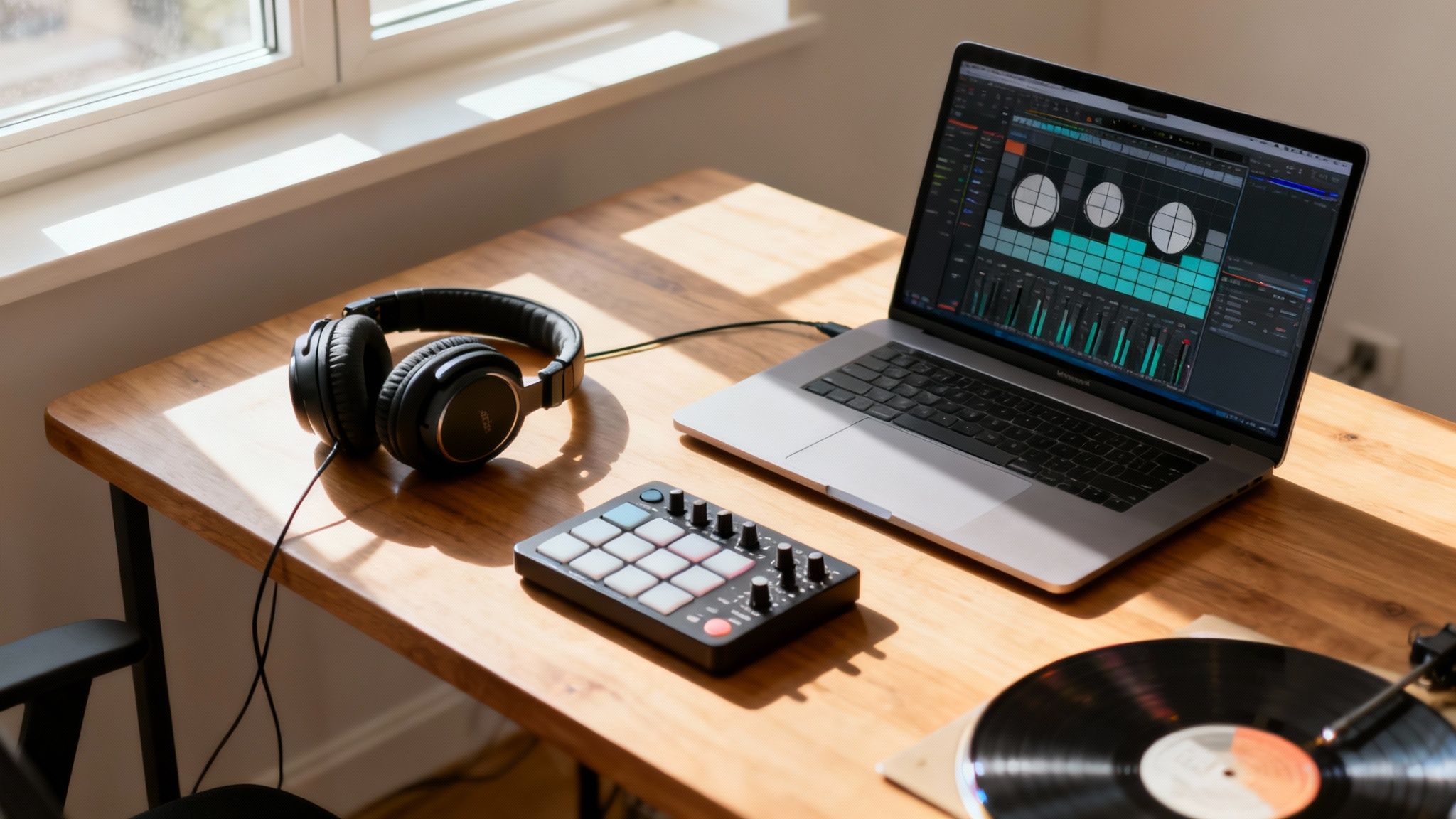
Making a rap beat is all about combining technical skill with creative vision. You're essentially taking simple loops, drum patterns, and melodic ideas and weaving them together to build the entire foundation for an artist to shine on.
Choosing Your Beat Making Tools
Before you can cook up a banger, you need the right tools in your kitchen. The great thing is, you don’t need a million-dollar studio anymore. A solid laptop, a Digital Audio Workstation (DAW), and a good pair of headphones are really all you need to get started. Think of your DAW as your digital command center—it's the software where all the magic happens.
Music production has completely changed over the years. We've seen the global music production and distribution market explode, on track to hit $41.46 billion in 2024 and projected to soar to $96.02 billion by 2034. For producers like us, this just means more powerful and accessible tools are hitting the market all the time.
Your Essential Starter Kit
So, where do you start? Let’s talk about the software. When it comes to rap, two DAWs tend to dominate the conversation: FL Studio and Ableton Live. FL Studio is legendary for its super-fast, pattern-based workflow, which is why so many producers love it for banging out drum patterns and loops. On the other hand, Ableton Live is a beast when it comes to flexibility, especially if you're into creative sampling or thinking about performing live.
Honestly, the best one is the one that clicks with you. Most companies offer free demos, so I always tell people to download both and just play around. See which one feels more natural.
Next up, a MIDI controller. Is it absolutely essential? No, you can definitely click in all your notes with a mouse. But having a small keyboard or some drum pads makes the whole process feel less like data entry and more like actually playing music. It just makes tapping out drum patterns and finding melodies way more hands-on and fun.
Key Takeaway: If you're going to spend money on one thing, make it a good pair of studio headphones. They are your window into your mix. Without an accurate sound reference, you're flying blind, and you won't know if your 808 is muddy or your hi-hats are too sharp.
This whole setup process is pretty straightforward.
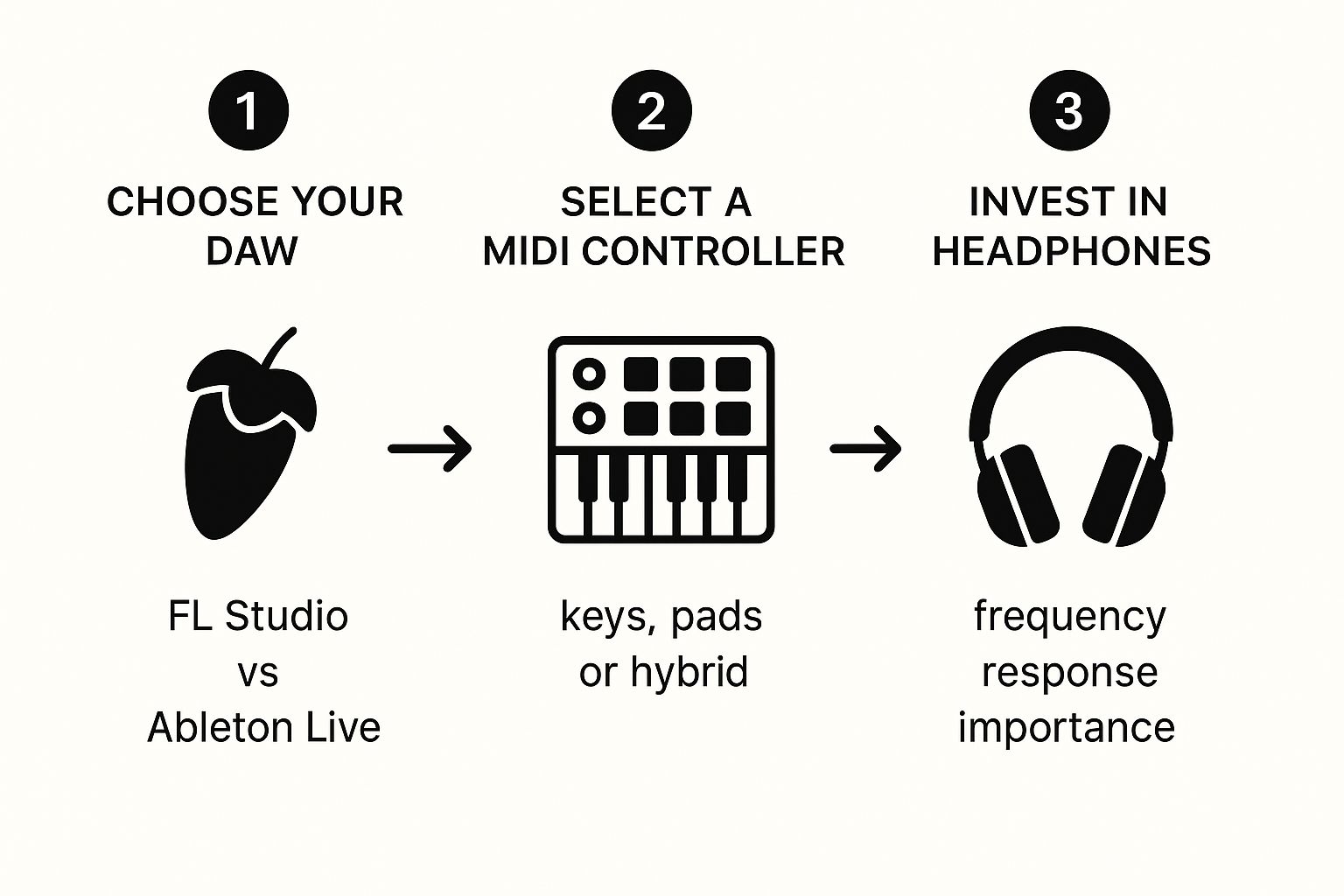
As you can see, it all flows from picking your software to getting your hardware in order, with listening being the final, critical piece. And don't forget, once you get comfortable, you can expand your sound. Thinking about getting some of the top microphones for recording can open up a new world of creating your own unique samples.
Choosing Your Digital Audio Workstation (DAW)
Picking the right DAW can feel overwhelming at first, but it really comes down to workflow and budget. Here’s a quick breakdown of some popular options to help you decide which lane you want to get in.
DAW | Best For | Key Features for Rap | Price Point |
|---|---|---|---|
FL Studio | Beginners and trap/hip-hop producers | Legendary step sequencer, fast pattern-based workflow, excellent piano roll, lifetime free updates. | Starts at $99 (Fruity Edition) |
Ableton Live | Sampling, live performance, and creative workflow | Session View for looping ideas, powerful warping/sampling tools (Simpler/Sampler), clean interface. | Starts at $99 (Intro) |
Logic Pro | Mac users looking for an all-in-one solution | Huge library of stock sounds/plugins, intuitive interface, great value for the price. | $199.99 (Mac only) |
BandLab | Producers on a tight budget or just starting | Free, browser-based, and collaborative. A great way to learn the basics without any investment. | Free |
Ultimately, any of these can make incredible rap beats. It's less about the tool and more about the person using it. Don't get stuck on this decision for too long—just pick one and start creating.
Once your beat is fire and ready for vocals, the next challenge is writing lyrics that hit just as hard. To get a creative assist, Download Lyric Studio free on iOS. It gives you AI-driven, context-aware lyric suggestions that adapt to your theme and emotion. (Note: In-app purchases may apply.)
Programming Drums That Slap
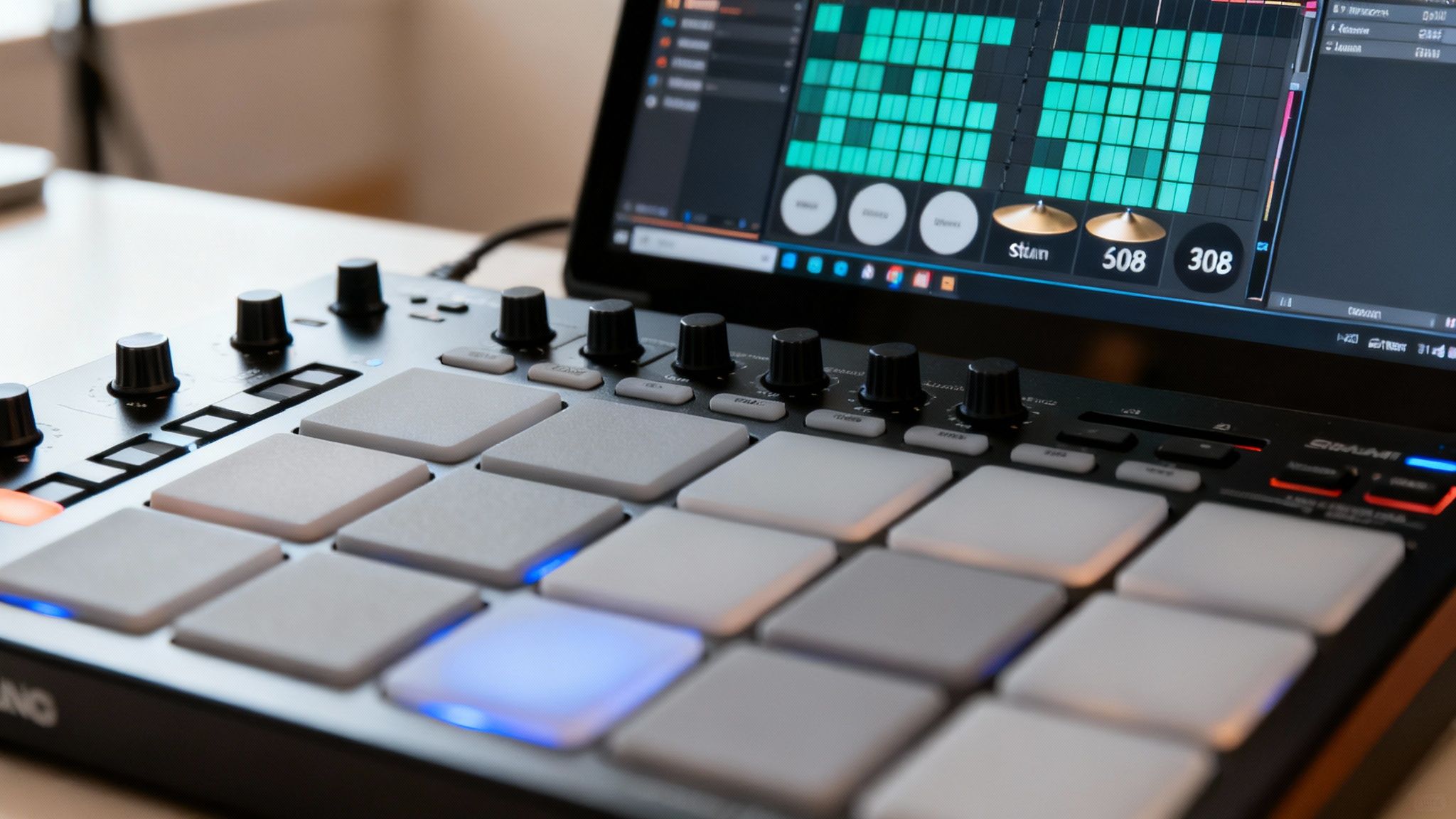
Let's be real: the drums are everything in a rap beat. They're the foundation. They set the energy, create the pocket, and give an MC the rhythm to lock into. Simply dropping notes onto a grid won't cut it. You're trying to build a groove that has genuine bounce and hits hard.
Your typical hip-hop drum pattern boils down to four key players: the kick, the snare, the hi-hats, and the 808. Each one has a specific job to do, and knowing how they work together is the first real step to making your drums sound legit.
The Core Rhythmic Elements
The kick drum is your low-end thump, almost always landing on the first beat of the bar to establish the downbeat. The snare is the crack, the backbeat that anchors the groove, traditionally hitting on beats 2 and 4. This simple kick-snare combo is the heart of that classic "boom-bap" feel that gets heads nodding.
Kick Drum: The pulse of your track. You want it to be punchy without turning the low-end into mud.
Snare/Clap: This is the snap that gives the beat its character. A great trick is to layer a clap on top of your snare for extra texture and impact.
Hi-Hats: These are the timekeepers. They bring that high-frequency sizzle and can totally define the vibe, whether you're using straight 8th notes or intricate trap rolls.
808: It's more than just bass; it's a melodic instrument in its own right. It often shadows the kick pattern but can also carve out its own rhythm to add movement and depth.
Once you’ve got a basic pattern down, it's time to make it feel human. That’s where quantization and swing come in. Quantizing snaps everything perfectly to the grid, which gives you that tight, precise feel you hear in a lot of modern rap.
But if you want more of a human groove, you need swing. Sometimes called "shuffle," this feature in your DAW slightly delays every other note, creating a looser, more natural rhythm. Play around with the swing percentage until you find a pocket that feels just right.
Pro Tip: Don't hesitate to layer your drum sounds. If your snare feels weak, stack a sharp clap or a finger snap on top. If your kick isn't cutting through, try layering a punchier, shorter kick sample underneath to give it more attack.
Adding Bounce and Dynamics
Modern rap beats live and die by their dynamics, and this is most obvious in the hi-hats. A straight line of 16th notes is boring. You want to program in some faster rolls—think 32nd or 64th notes—usually at the end of a phrase to build up and release tension.
Another key is to mess with the velocity (how hard each note hits). Varying the velocity of your hi-hats will instantly make them sound less like a machine and more like a real drummer.
Getting these fundamentals down is non-negotiable. A fire drum loop is often the single spark that an entire song is built around. Once you have a beat that you can’t help but nod along to, the next step is finding lyrics that match that energy. If you need a creative assist to find the perfect rhymes, Download Lyric Studio free on iOS and check out how its integrated rhyme and thesaurus tools can level up your writing game. (Note: In-app purchases may apply.)
Making a Melody That Hooks You In
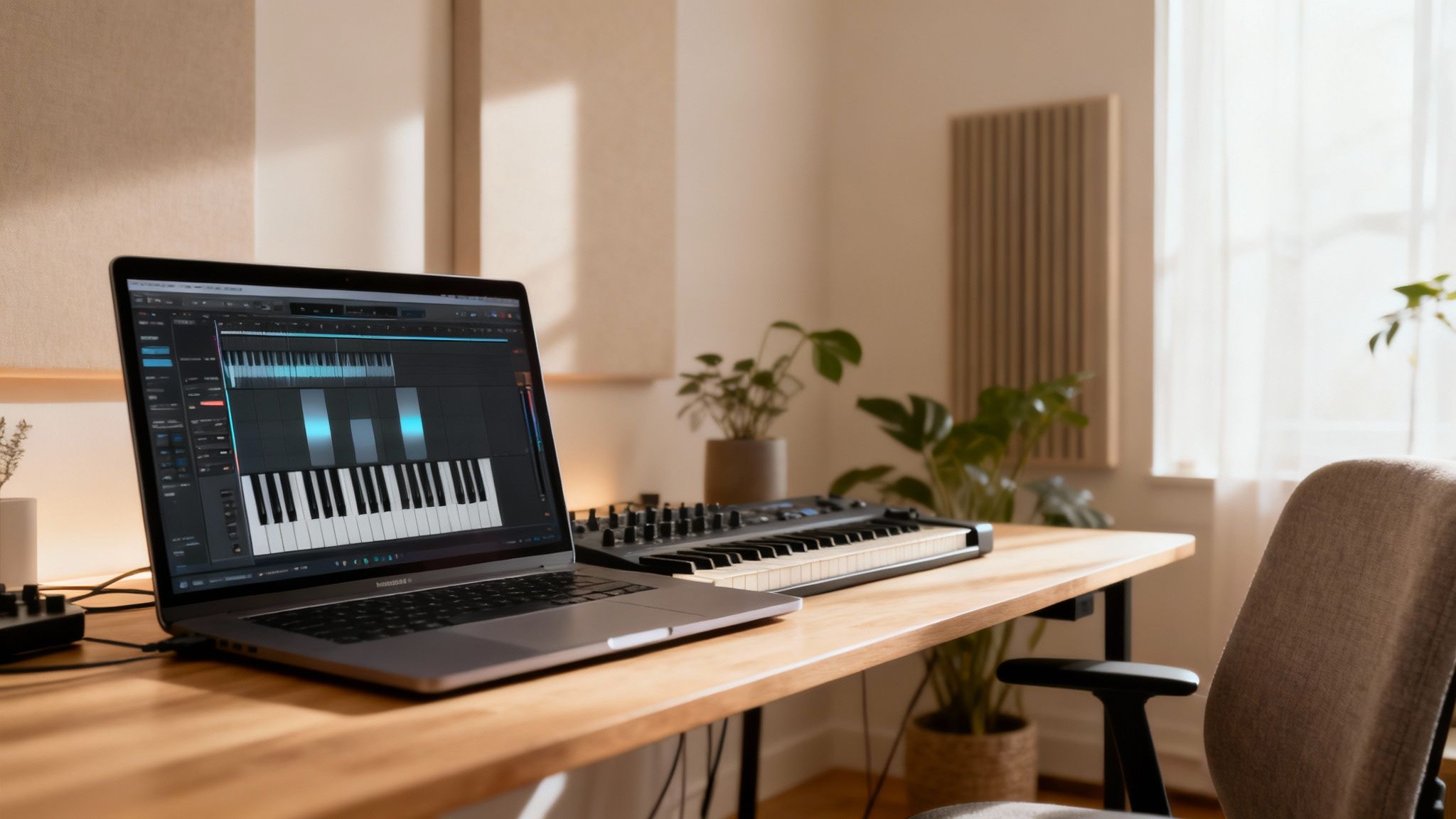
If your drum pattern is the heartbeat of the track, the melody is its soul. It's the part that sets the mood, evokes emotion, and gets stuck in someone's head for days. The best news? You don't need a music degree to write a great melody. It really comes down to choosing the right sounds and, most importantly, trusting your gut.
Your sound selection is everything. A somber piano can immediately give you a reflective, moody vibe, while a sharp, plucky synth might scream high-energy. Before you even touch the keyboard, think about the feeling you're trying to capture with the beat.
Picking Your Sounds
The instruments you pick will define your track's entire personality. Don't just stick with the first sound you find; play around, layer different textures, and build something that feels uniquely yours.
Pianos & Keys: These are a go-to for a reason. A simple, dark piano loop can be the perfect foundation for an artist to get personal on the mic.
Synth Pads: Think of these as the atmosphere. A warm, swelling pad can fill up the empty space in your mix, making everything sound bigger and more professional.
Leads & Plucks: This is where you write the hook. A catchy synth lead or a sharp, rhythmic pluck is often the star of the show—the part everyone remembers.
Once you’ve got your sounds, it's time to think about chords. Most rap beats are built on simple, powerful chord progressions. You don't need to get lost in complex theory; often, just two or three minor chords looping over and over is all you need to create a vibe. If you're just starting out, check out this guide on chord progressions for beginners to nail the basics.
Pro Tip: Many of the biggest rap songs use simple progressions that just repeat every two or four bars. The idea is to create something hypnotic that a rapper can flow on top of, not something so busy it gets in their way.
The Art of the Sample
Another classic way to create a melody is by sampling. This is the art of taking a small section of audio from another song—a cool piano part, a funky guitar riff, a soulful vocal—and building your entire beat around it. Sampling is the bedrock of hip-hop culture.
The real magic happens when you "flip" the sample. You can chop it up, pitch it way up or down, reverse it, and rearrange the pieces to make something totally new and unrecognizable. This process is one of the most creative and fun parts of making beats. It’s this kind of raw creativity that helped build a global hip-hop industry that generated over $25 billion in 2020 alone.
Whether you're writing melodies from scratch or flipping old records, the goal is always the same: create an instrumental that inspires an artist to write. When the beat is right, the lyrics just flow.
Arranging Your Beat Into A Full Song
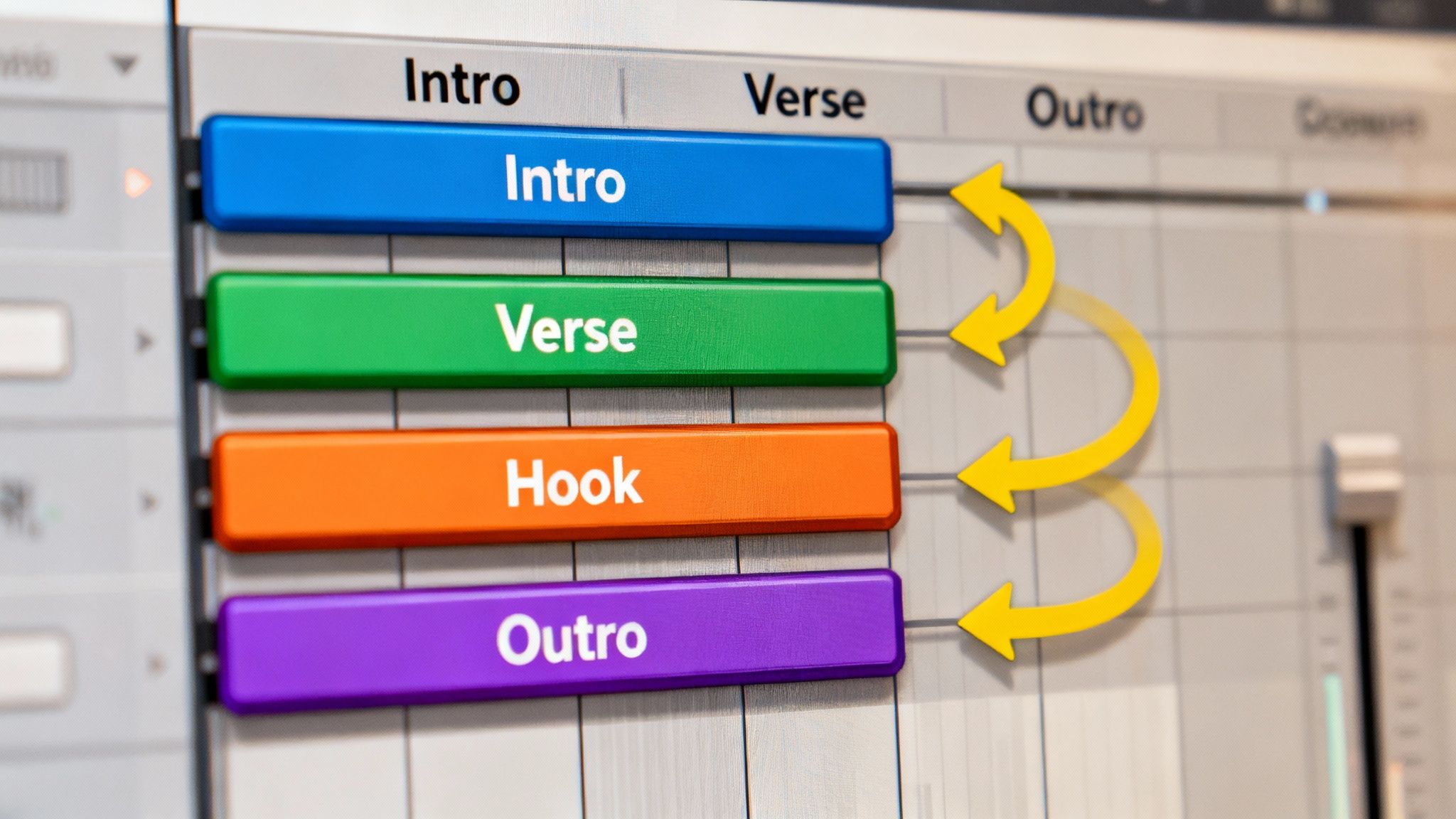
Alright, so you’ve got a fire 8-bar loop. The drums are knocking, the melody is addictive, and the 808 is rattling the windows. That’s a great start, but it's not a song yet. The real magic happens when you turn that loop into a full, dynamic track that an artist can actually rap on.
This whole process is called arrangement, and it’s all about creating a journey for the listener. It’s how you build tension, create release, and, most importantly, leave space for a vocalist to do their thing. Without a solid arrangement, even the hottest beat gets stale after a minute. You’ve got to make it breathe.
The Blueprint of a Rap Song
Most rap songs follow a structure that just works. Sure, you can break the rules, but knowing the standard blueprint is your best bet for getting started. It’s the framework that artists and listeners just get.
Here’s what a typical arrangement looks like:
Intro (4-8 bars): This is your first impression. You can ease the listener in with a filtered-down version of your main melody, a cool sound effect, or maybe just the chords without any drums.
Verse (16 bars): This is the storyteller's section. The energy here is usually dialed back to give the rapper’s vocals plenty of room. A classic move is to pull the kick and 808 out for the first few bars or simplify the hi-hats.
Chorus/Hook (8 bars): This is the payoff—the part everyone will remember. You want to bring all your best elements back in full force. The energy should be at its peak here to make the hook slam.
Outro (4-8 bars): Time to wrap it up. You can fade the beat out, strip elements away one by one, or just cut it short for a more dramatic ending.
Key Insight: Arrangement is about subtraction just as much as addition. The easiest way to create dynamics is to take things out. Try dropping the drums for the first four bars of a verse. It’s a simple trick, but it makes them hit so much harder when they come back in.
Creating Energy and Flow
Once you’ve got your main sections mapped out, it’s time to add the small details that make the beat feel alive. These are the little transitions that glue everything together, guiding the listener from one part to the next.
Think about adding little touches like:
Risers and Sweeps: These sounds build in pitch or intensity and are perfect for signaling that something big—like the chorus—is about to drop.
Drum Fills: A quick snare roll or a few tom hits right at the end of a 16-bar verse can be the perfect launchpad into the hook.
Impacts and Crashes: Placing a single cymbal crash or a deep "boom" right on the first beat of the chorus gives it that instant, undeniable punch.
Arranging is really just storytelling with sound. You're building an instrumental that doesn't just bang on its own but also inspires an artist to start writing. When you nail the structure and flow, the lyrics practically write themselves.
And for those moments when you hit a wall, tools like Lyric Studio can keep the ideas coming. Its “Magic Draft” feature instantly generates a first verse-and-chorus to jump-start your songwriting. Download Lyric Studio free on iOS and see how its AI-driven suggestions can help you finish your next track.
Mixing Your Beat for a Professional Sound
This is where the magic happens. The final polish is what makes a beat sound like it came from a real studio instead of just a laptop. Mixing is all about making every element—the kick, the 808, the melody, the snares—sit perfectly together. Forget complicated rules for a second; this is about training your ears to create balance, clarity, and punch.
We're not just cranking up the volume. We're aiming for clean. The goal is to give every sound its own space to breathe, so nothing gets buried or turns into a muddy mess. With a few key techniques, you can get your tracks hitting hard on everything from cheap earbuds to a car stereo.
The Three Pillars of a Good Mix
Honestly, mixing really just comes down to managing three things: volume, frequency, and where the sound sits between your speakers.
Leveling: This is priority number one, and it's as simple as moving the volume faders. Start by getting a rough balance. You want the drums to hit hard, the 808 to be felt without overpowering everything, and the melodies to be clear.
Panning: This is just placing sounds in the stereo field—left, right, or center. I almost always keep my kick, 808, and main snare dead center. That creates a solid foundation. Then, I’ll pan things like hi-hats, percussion, and background melodies a little to the left or right to create a wider, more immersive feel.
EQ (Equalization): Think of an EQ as a sonic chisel. It lets you boost or cut specific frequencies to carve out space for each instrument. This is your secret weapon for preventing sounds from clashing with each other.
Pro Tip: The most common mixing mistake is having too many sounds fighting for the same low-end frequency. Your kick and 808 are the usual suspects. Use an EQ to gently cut some bass from your 808 right where your kick hits hardest. This gives the kick its own little pocket to punch through cleanly.
Bringing Your Mix to Life
Once you have that basic balance, you can add that final layer of pro polish. One of the most important tools for this is compression.
Simply put, a compressor evens out the volume of a sound, making it feel more consistent and punchy. It’s perfect for making a snare really snap or for taming a melody that has some notes that are way louder than others.
In today's streaming-first world, a good mix is non-negotiable. In 2023, global music revenue hit a massive $28.6 billion, and streaming accounted for a whopping 67.3% of that. That means your beats have to sound crystal clear on platforms where every detail matters. If you want to discover more insights about music production trends, you'll see just how critical a clean digital sound has become.
A clean mix also gives a vocalist the perfect canvas to work on. When an artist can hear every element and feel the pocket you've created, they're going to deliver a better performance. And once your beat is ready for lyrics, you can Download Lyric Studio free on iOS to find the perfect words to match your professional-sounding track. (Note: In-app purchases may apply.)
If you're still figuring out the software side of things, our guide on the best music production software for beginners can point you toward the tools that make all this possible.
Got Questions? I've Got Answers
Every producer starting out has a million questions. It's totally normal. Let's tackle some of the most common ones I hear from aspiring beatmakers so you can spend less time guessing and more time creating.
What's the Easiest Software to Start With?
If you're just diving in, FL Studio is a fantastic starting point. Its pattern-based workflow feels natural for hip-hop, and the amount of tutorials on YouTube is endless. You'll never be stuck for long.
That said, Ableton Live is another beast entirely and a favorite among producers who love to experiment and perform live. My best advice? Download the free trials for both. See which one feels right to you. That's the one you'll stick with.
Do I Really Need to Learn Music Theory?
Honestly? No. You absolutely do not need a degree in music theory to make a hit record. Some of the greatest producers of all time work completely by ear.
Your ears are your best tool. Start by messing around with basic scales—the minor scale is a great place to start since it's all over rap music. Focus on creating a vibe and a feeling. If it sounds good, it is good.
Key Takeaway: The only thing that matters is how the beat feels. Does it make you nod your head? If the answer is yes, you're doing it right. Theory can come later, if at all.
How Can I Make My 808s and Kicks Punch Through the Mix?
Ah, the classic low-end battle. Getting your kick and 808 to hit hard without turning into a muddy mess is one of the biggest mixing hurdles.
The secret is giving each element its own space. Don't let them fight for the same frequencies. Use an EQ to carve out a little room in the 808 for the kick to pop through.
A game-changing technique is sidechain compression. This automatically ducks the 808's volume for a split second right when the kick hits. The result? A clean, powerful punch that feels massive. Also, make sure your 808 is tuned to the key of your track—it makes a huge difference.
Where Do I Find Quality Drum Kits and Samples?
You've got a ton of options, which can be overwhelming. A service like Splice is a great investment. It's a massive subscription library with pro-level, royalty-free sounds for pretty much any genre you can think of.
For free gems, check out communities like Reddit's /r/Drumkits. You can find some incredible kits there. A word of advice: don't become a sound hoarder. It's better to find one or two really solid, versatile kits and learn them inside and out. For a broader look at common questions about creative tools, you can explore additional frequently asked questions.
Lyric Studio can help turn that killer beat into a finished song. Get AI-driven, context-aware lyric suggestions that adapt to theme, emotion, and genre, plus an integrated rhyme and thesaurus tool to nail every line.
Download Lyric Studio free on iOS. (Note: In-app purchases may apply.)

SCAN TO GET